
The CSPC Dispatch - Sept 18, 2026
After an August recess, the CSPC Dispatch is back! This last month we were pleased to welcome two distinguished leaders to CSPC's Board of Counselors. Sir Tim Woods, who recently retired as a Rear Admiral in the Royal Navy after serving as the United Kingdom's Defence Attaché to the United States, brings decades of naval leadership and transatlantic defense experience to our network. Joining him is Ambassador Mikko Hautala, who served as Finland's Ambassador to the United States and now serves as Chief Geopolitical & Government Relations Officer at Nokia, bringing deep expertise in European security and Nordic-U.S. relations. We are grateful for their willingness to support CSPC's mission and look forward to their contributions in the years ahead.
In this issue of the Dispatch, James Kitfield reflects on the 25th anniversary of 9/11, tracing how the attacks reshaped homeland security while also fueling military interventions and civil liberties trade-offs the nation is still reckoning with. Victoria Flick examines the strategic risk posed by the USS George Washington's deployment to the Middle East, and what the resulting carrier gap in the Pacific means for America's regional allies. Finally, Sarena Sohan looks at efforts to roll back national monument protections, and what they mean for Theodore Roosevelt's conservation legacy.
Also recently at CSPC, our President & CEO, Glenn Nye, joined the House Problem Solvers Caucus to unveil a package of bipartisan legislation combating partisan gerrymandering. Our Senior Fellow Robert Gerber also joined Nye last month on a trip to Ukraine where they both came back with reports on on the lessons of Ukraine's war economy and how closer U.S.-Ukraine alignment bolsters America's own interests. Read more below!
The Day America Stood Still
by James Kitfield

9/11 Anniversary Remembrance Ceremony at Ground Zero in New York City on September 11, 2023. Photo courtesy of the Department of Homeland Security.
Back in the summer of 2001, the warning lights on America’s threat matrix were blinking bright red. Just a few years earlier terrorists had launched a highly coordinated truck bomb attack targeting U.S. embassies in Tanzania and Kenya, killing more than 220 people and wounding hundreds of others. In 2000, two suicide bombers in Yemen steered a small boat laden with C4 explosives into the USS Cole, killing 17 U.S. sailors and maiming many others, and very nearly sinking a U.S. warship. In July 2001, the FBI received a warning from its field office in Phoenix that suspected terrorists tied to the shadowy Al Qaeda network were training at U.S. flight schools. The next month, CIA intelligence appeared in President George W. Bush’s Daily Brief warning that Al Qaeda was actively developing plans for a major attack on the homeland. The brief was titled “Bin Laden Determined to Strike U.S.”
As the nation held solemn remembrances last week noting the 25th anniversary of the worst attack on the U.S. homeland since Pearl Harbor, difficult questions were once again raised as Americans recalled those events: How was the nation taken by surprise when there was so much warning of a likely attack? How did our reaction to the attack morph into a boundless “Global War on Terror” that included regime change in Afghanistan and Iraq and the two longest wars in U.S. history? How did nation that was unified in supporting the initial response to 9/11, and expressed majority trust in the federal government according to polls at the time, devolve into today’s polarized country that seems to have lost faith in virtually all institutions? Most importantly, what have we learned from the experience?
At least the facts are not in dispute. Twenty-five years ago, 19 hijackers flew airliners into the twin towers of the World Trade Center in New York, and into the Pentagon in Washington, D.C. Another hijacked airliner thought to be targeting the White House or Congress was downed in a Pennsylvania field by the heroic actions of its passengers. Nearly 3,000 people were killed in the initial attack, making it the greatest one-day loss of life in the United Staes since the Battle of Antietam during the Civil War. Thousands of more first responders died later from illnesses attributed to exposure to smoldering pollutants at ground zero in New York.
Hardening the Homeland
Today’s more than 100 million U.S. residents born after September 11, 2001, have no memory of driving up to an airport terminal and running unimpeded to their gate, or visiting a federal building without having to pass through a metal detector. They have grown up in an era when the balance between civil liberties and security tilted heavily towards the latter, whether out of necessity or expediency. Many recall heated debates over “warrantless searches,” “enhanced interrogation techniques” considered torture, or the still operational Guantanamo military detention center for suspected terrorists.
The federal government also looks different today. As a result of 9/11, the United States established the new Department of Homeland Security (DHS) to coordinate an all-of-government response to the threat of catastrophic terrorism. The Director of National Intelligence (DNI) organization was created to coordinate intelligence collection and fill dangerous gaps that 9/11 exposed between domestic intelligence agencies such as the Federal Bureau of Investigation (FBI), and gatherers of international intelligence at agencies such as the Central Intelligence Agency (CIA) and the eavesdroppers of the National Security Agency (NSA). Under the auspices of the DNI a new National Counterterrorism Center was created as a global counterterrorism operations hub.
Philip Gordon has served in numerous national security positions, most recently as the assistant to the president and national security adviser to the vice president in the Biden White House. “For Americans under-thirty it’s difficult to appreciate that after 9/11 it felt like these major mass casualty terrorist attacks would likely be our future, with buildings routinely coming down and metro stations blowing up,” Gordon said last week, speaking on a panel organized by the Carnegie Endowment for International Peace.
Despite all the costs and missteps of the “Global War on Terror,” the primary goal of U.S. policy after 9/11 was to prevent another massive casualty terrorist attack on the homeland, and that was achieved.
“A lot of us doubted at the time that we would be successful in avoiding [another 9/11-like attack] for 25 years. By reorganizing the government to share intelligence better, hardening the transport system against attack, and destroying Al Qaeda leadership structures, I think we were successful in that important but narrow goal,” said Gordon, now a foreign policy and national security scholar at the Brookings Institution. “At the same time, we probably overreached in terms of increasing presidential power and pushing the limits of civil liberties. That was understandable in the period just after 9/11, but what worries me is that 25-years later we haven’t managed to reverse the erosion in civil liberties and pull those norms back.”
War Without Bounds
In the immediate aftermath of 9/11, the George W. Bush administration announced a “Global War Against Terror” that would hunt Al Qaeda operatives wherever they gathered in the dark corners of the globe. While the framing was successful in rallying an injured nation bent on retribution, it also raised the question of where the boundaries lay in such a conflict. After all, “terror” is a tactic not an enemy, and pledging to stamp it out struck a number of observers as potentially dangerous overreach.
“The American way is to declare war on everything – we’ve had the ‘war on drugs,’ the ‘war on poverty,’ ‘the war on cancer,’ and ‘the war on racial injustice,” noted Aaron David Miller, Senior Fellow at the Carnegie Endowment, and a long-time foreign policy expert and author. “All of those ‘wars’ remain unresolved, and declaring a ‘Global War on Terror’ that suggested a remedy to end all terror was a very expansive objective.”
Nicholas Rasmussen is a Senior Advisor for National Security at the McCain Institute, and formerly the Director of the National Counterterrorism Center.
“To be fair to President [George W.] Bush, right after 9/11 he was using pretty dramatic language to rally the country and mobilize society to adopt a wartime footing, and you can’t do that by simply saying we’re going to do our best to prevent an attack like this from happening again,” he said during the Carnegie panel. Looking back over the last 25 years at the evolution of terrorism, he noted, it was a stretch to continue framing the objective as an all-out “Global War on Terror.”
“Because that is unachievable,” said Rasmussen. “I see terrorism as a threat and an enduring national security challenge that has to be managed and dealt with. The goal should be to apply the appropriate levels of resources while acting in ways that are consistent with American values and traditions.”
The Hammer & the Nail
If there was a fateful turning point in America’s post-9/11 war on terror, it was the Bush administration’s decision to invade Iraq in 2003 based on faulty intelligence about non-existent stockpiles of doomsday weapons. That single decision for a second regime change operation in as many years opened another front in the global war on terror, ensnaring an overstretched U.S. military in both the remote mountains of Afghanistan and deserts of Iraq. It ensured that neither operational front would prove decisive for years to come. It also laid the foundation for the American public to become disillusioned with seemingly endless “forever wars” whose ties to the original 9/11 attacks became less clear over many years.
Along with many others, I have written books about the wars in Afghanistan and Iraq, and I believe they point to an even greater danger inherent in the post-Cold War era. Victory in that decades-long showdown left the United States with the most powerful, globe-spanning military in the world, without the constraint of another superpower such as the Soviet Union to give pause. Every U.S. president since has been tempted into military adventures because, as the saying goes, if you have the world’s biggest hammer, every geostrategic challenge looks like a nail.
Bill Clinton thus used the U.S. military successfully to defuse the Balkan wars in the 1990s but overreached in trying to solve a famine in Somalia, leading to the Black Hawk Down debacle that killed 18 U.S. soldiers and led to an ignoble retreat. George W. Bush initially used the military to topple the Taliban in Afghanistan using only a light footprint of special forces and airpower yet ended up conducting troop-intensive nation-building and counterinsurgency operations in both that country and Iraq. Barack Obama leaned into targeted killings of terrorist leaders, but after prematurely withdrawing U.S. military forces from Iraq in 2011 he was forced to send them back to fight a resurgent Islamic State of Iraq and Syria (ISIS).
The nearly irresistible lure of using the U.S. military for a president unencumbered by Congress and dismissive of the War Powers Act has been made manifest in President Donald Trump’s second term. After frequently criticizing the “forever wars” on the campaign trail in 2024, Trump as commander-in-chief has ordered the U.S. military to conduct lethal operations against low-level drug runners in the Caribbean that have killed hundreds; launched a regime decapitation operation in Venezuela that captured President Nicolas Maduro and killed many of his security guards; conducted an embargo of Cuba considered an act of war under international law; and bombed nuclear facilities in Iran in the summer of 2025. All of that was before Trump joined Israel in attacking Iran earlier this year in an operation that decapitated Iranian leadership. Despite assurances that the operation would last only a few weeks, the Iran war continues to roil oil and energy markets months later and shows signs of escalating into another Mideast quagmire.
“I think most Americans agreed after Afghanistan and Iraq that the country finally needed to end these ‘forever wars,’ and I assumed that the military overreach and hubris of the past 25 years had taught us a lesson,” said Gordon. “But the current Iran war certainly suggests that we still have not learned the lesson that military force cannot achieve expansive geopolitical aims. It remains a dangerous world and there is a risk in not doing enough to head off threats, but my hope is we find the wisdom to recognize the space between doing too little, and the hubris of believing we can use military force to transform the world to one more to our liking.”
James Kitfield is a Senior Fellow at the Center for the Study of the Presidency & Congress, and author of “War & Destiny: How the Bush Revolution in Foreign and Military Affairs Redefined American Power (Potomac Books). He is a three-time recipient of the Gerald R. Ford Award for Distinguished Reporting on National Defense.
The Carrier Gap the United States Cannot Afford
by Victoria Flick

Friends and family members gather to say goodbye to Sailors embarked aboard the aircraft carrier USS George Washington in January 2004. Photo courtesy of the United States Navy
In mid-August, the USS George Washington Carrier Strike Group turned west through the Singapore and Malacca Straits, the gateway between the Western Pacific and the Indian Ocean and set a course towards the Arabian Sea. While U.S. carrier rotations are typically routine, this westward journey presented an extraordinary picture to international observers, signaling a conspicuous shift in American naval power away from the South China Sea. While for any other carrier this deployment would not have raised eyebrows, to allies in Asia the USS George Washington (CVN-73) is more than simply a hull that is usually stationed nearby.
CVN-73 is one of the Navy’s forward-deployed naval forces and the only carrier permanently based outside of the continental United States. Its homeport has been at Fleet Activities Yokosuka, Japan since it took over this location from the USS Ronald Reagan in mid-2025. Thus, CVN-73’s journey westbound into the Andaman Sea, leaving Yokosuka's home billet effectively unoccupied marks a drastic change in U.S. forward deployment strategy in the Pacific. The carrier whose entire mission is to serve as the U.S. Navy’s principal and permanent presence in the Pacific was pulled towards the Middle East, as the short-term necessities of the Iran conflict seemed to trump long-standing U.S. priorities in the South China Sea. This has implications for allies in the region, who view CVN-73 as a signpost of U.S. commitment to the region. Six months into the Iran conflict, CENTCOM is still absorbing enough naval power that transitioning CVN-73 to the Middle East now renders it an ordinary rotational asset as opposed to the pledge it was supposed to be.
Moreover, the impact of the George Washington’s deployment to the Middle East will likely outlast its time spent in the region. A carrier run of such length and hardship is unlikely to allow CVN-73 to immediately return back into the Yokosuka rotation immediately as reconstitution has its own timeline. And the implications extend beyond the Pacific. The strain imposed by sustained carrier deployments could also have longer-term consequences for the readiness of the U.S. naval fleet more broadly. As laid out in a recent article, efficient maintenance of the current fleet is adversely impacted by extended deployments. This coupled with delays in carrier production could severely affect the future readiness of the force. It is not just the crews and ships themselves who are squeezed by prolonged deployments at sea. Maintenance facilities that have anticipated repairs and the workers lined up to make them are also impacted by changes to existing schedules. The more and more extended deployments we are going to see caused by wars and other security concerns worldwide, the larger the availability crisis in the future will be.
While every Indo-Pacific strategy since 2017 has asserted that Asia is the priority theater, developments in the Middle East have shown that grand strategy and reality oftentimes clash. One regional conflict, against an adversary with no navy to speak of, consumed America's Pacific carrier presence entirely. Moreover, if a single regional conflict was sufficient to draw away the entire U.S. carrier presence in the Pacific, what does that reveal about the United States’ ability to sustain a two-theater strategy? As the United States seeks to refocus its grand strategy, it cannot afford to lose sight of these broader strategic questions or allow itself to become consumed by an unpopular war whose prospects for success remain uncertain.
The USS Abraham Lincoln (CVN-72) has been filling the headlines of major news outlets over the past months due to its extraordinarily long deployment with 266-272 days at sea without port access. Currently it is operating in the South China Sea, taking the place of CVN-73, where it arrived after its first full port call in Thailand on September 2. However, the Lincoln is not expected to stay in this theater for long. The location of CVN-72 highlights an interesting point: the only U.S. carrier currently in the South China Sea is there by coincidence of geography on its way home, while the George Washington, the carrier whose primary mission is to be there, is otherwise occupied.
Moreover, the question that needs to be addressed is “Is the bill the United States is paying by allocating its most important naval assets to the Iran war proportionate to what it is getting out of it?”. The Department of War/Defense is trading crew endurance and deferred fleet maintenance for an indefinite Hormuz escort mission against Iran, a predominantly asymmetric maritime threat, even as the U.S. Navy faces a far more capable competitor in China, one whose more regionally concentrated fleet does not confront the same demands of maintaining a global naval presence. Nor are the costs confined to fleet readiness. The repositioning of CVN-73 also risks creating uncertainty among U.S. allies in the Pacific, particularly Japan and the Philippines. In a region where China’s military power is increasingly central to allied security calculations, the visible presence of U.S. naval power serves as an important component of Washington’s security assurances. Diverting that presence to a regional conflict thousands of miles away therefore carries consequences not only for American capabilities, but also for the credibility of its long-term commitments in the Indo-Pacific.
Readiness debt does not show up in the next news cycle, it shows up in the next crisis. Therefore, the only real indicator of what the current naval fleet situation will mean for the future will be whether the next unplanned contingency in the Pacific finds the fleet able to respond quickly or finds ships still recovering.
Victoria Flick is a Non-Resident Research Fellow at the Center for the Study of the Presidency & Congress.
Honoring Theodore Roosevelt's Conservation Legacy
By Sarena Sohan
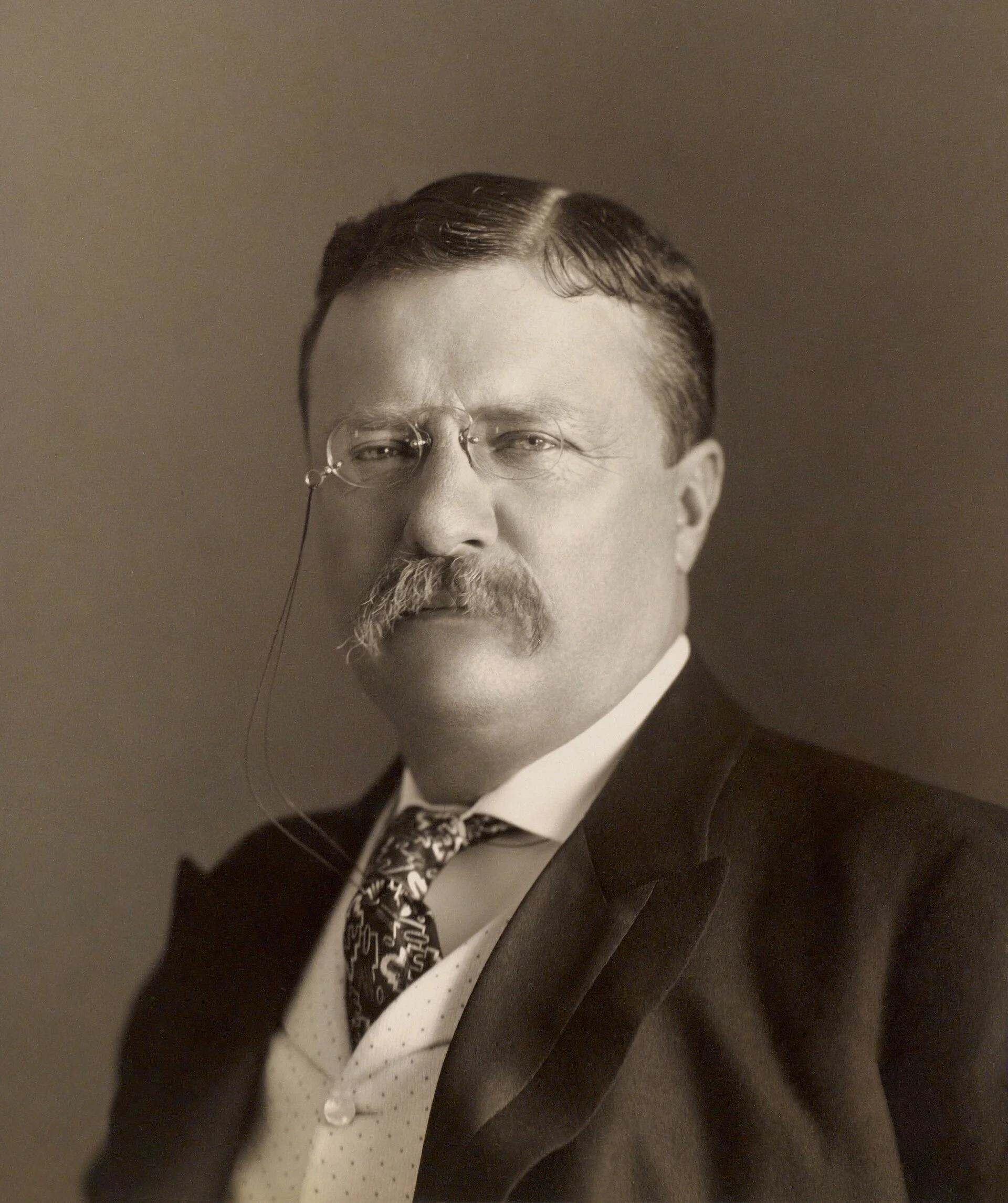
Theodore Roosevelt in 1904. Photo courtesy of the Library of Congress.
Earlier this year, President Theodore Roosevelt's direct descendants wrote an open letter to United States Senators urging them to vote “no” on a proposed law to allow development of one of the nation’s most pristine wilderness areas. The Boundary Waters Canoe Area Wilderness stretches 150 miles along the United States-Canada border and is made up of remote forests, lakes, and mountains. The Boundary Waters was also one of the very first designated wilderness areas in the United States.
The joint resolution introduced by Minnesota Republican Congressman Pete Stauber would allow the land “to be leased for the exploration and development of minerals and geothermal energy.” Despite the open letter from the Roosevelts, the Senate narrowly passed H.J. Resolution 140 on a vote of 50-49, and it was signed into law on April 27, 2026. The most visited wilderness area in the nation is now open for business, specifically the mining business.
Passing a law allowing mining in the Boundary Waters wilderness area, of course, is not an anomaly. Since the start of President Donald Trump’s second term, his administration and many Republican lawmakers have pushed for legislation reducing protections for America’s public lands. In some cases, the administration has even avoided the need for Congressional approval altogether.
Consider the example of the Grand Staircase-Escalante National Monument and Bears Ears National Monument in Utah. The Property Clause in the Constitution states that Congress has authority over federal lands. However, the Antiquities Act of 1906 gives the President authority to establish national monuments from existing federally owned lands. Wielding the Antiquities Act, Trump issued proclamations in July that reduced the size of both Grand Staircase-Escalante National Monument and Bears Ears National Monument by roughly 90 percent.
The Southern Utah Wilderness Alliance (SUWA) conservation group called the reductions “unlawful” in a public statement prior to the signing of the proclamations. In the statement SUWA Executive Director Scott Braden argued that the President’s action “will only bring uncertainty and chaos to places that should instead be protected for their rich biodiversity, unique geology, and remarkable cultural values.”
The Antiquities Act was intended to be broad, yet it does not explicitly state that Presidents have the authority to reduce or undo national monuments. Lawyers for the Trump administration argued that the administration has the authority to reduce or abolish national monuments if the space is deemed no longer in need of protection. Utah Republican Governor Spencer Cox supported the massive reduction in size of the two monuments. While standing next to President Trump during the signing of the proclamation he remarked, “This is a big day for Utah.”
Governor Cox and Congressman Stauber are hardly the only Republicans that have strayed from the conservation legacy of Theodore Roosevelt. The Center of American Progress (CAP) has even coined the term “antipark caucus" for members of Congress who have introduced or co-sponsored six or more bills shrinking or developing previously protected national parks and wilderness areas. CAP highlighted a total of 25 members in the antipark caucus, all of whom are Republican legislators.
Utah Republican Senator Mike Lee, for instance, proposed an amendment to the Trump administration’s “Big Beautiful Bill” last year that would have put 250 million acres of public lands up for sale. Ultimately, bipartisan backlash against the provision killed it.
According to bipartisan polling published this year, a sizeable majority of Western voters support the conservation of public lands in their region. In other words, many Americans in the West agree with President Theodore Rooselvelt’s dictate to “leave it as it is.”
Recently, Yosemite National Park and Big Bend National Park have also been in the headlines. The Trump administration is considering a land exchange between Yosemite National Park and a private developer, for instance, to build another access road into the park. Additionally, the construction of a border wall that was set to begin in Big Bend National Park [BBNP] has been paused. In a public statement, Customs and Border Protection Commissioner Rodney Scott shared that he would travel to the area to listen to the concerns of the local community, emphasizing that he wanted to “ensure that we secure our borders while simultaneously protecting BBNP for generations to come.”
President Theodore Rooselvelt showed great foresight when he began laying the groundwork for protecting some of the most beautiful, historic and pristine lands in the nation. At a time when our country is more divided than ever, the question today is whether lawmakers can still find common cause in honoring the conservation president’s legacy and preserving America’s national parks and wilderness areas for future generations.
Sarena Sohan is an intern at CSPC and a student at George Mason University majoring in Communication with a concentration in Journalism.
CSPC in the News
Ukraine Exposed Weakness In Russia's War Machine. Can Moscow Still Claim Military Superpower Status?
Published by Radio Free Europe
Our Senior Vice President of National Security & Intelligence Programs, Joshua Huminski, joined Radio Free Europe/Radio Liberty to weigh in on why accurately gauging Russia's current and future capabilities, not overstating or dismissing them, is essential to getting NATO strategy right.
Read the full piece here.
Problem Solvers Caucus Announces Bipartisan Gerrymandering Reforms
Broadcasted by C-SPAN on September 16th.
CSPC President & CEO, Glenn Nye, joined the Problem Solvers Caucus, including Co-Chairs Reps. Brian Fitzpatrick and Tom Suozzi, to unveil multiple pieces of bipartisan legislation aimed at combating partisan gerrymandering and establishing fair, transparent, and consistent standards for congressional redistricting. Nye emphasized that meaningful reform doesn't have to be out of reach, pointing to the bipartisan effort as proof of the practical progress that can be made to strengthen our democracy: "This is a difficult problem and it's pulling Americans apart, but there are practical answers that are available."
Watch the full news conference here.
NEw CSPC Reports
Lessons from Ukraine's War Economy
Published by CSPC on September 14.
Our Senior Fellow, Robert Gerber, authored a new report examining how Ukraine has transformed into a wartime economy since Russia's 2022 invasion, driving economic resilience through defense-sector innovation — particularly drone manufacturing — even as human capital shortages, supply chain disruptions, and insufficient foreign aid pose ongoing risks. The report offers recommendations for strengthening Ukraine's economy while accelerating the decline of Russia's own.
Read the full report here.
How Closer Alignment with Ukraine Bolsters America's Interests
Published by CSPC on September 1.
Our President & CEO, Glenn Nye, makes the case that deeper U.S.-Ukraine alignment serves American strategic interests well beyond moral considerations. He points to Ukraine's unmatched expertise in drone warfare, decentralized defense innovation, and veteran rehabilitation as knowledge Washington should be drawing on, and lays out a two-part strategy — closing Ukraine's air-defense gap and tightening economic pressure on Russia — that protects civilians while blocking Chinese inroads into a weakened Ukraine.
Read the full piece here.