
Lessons from Ukraine’s War Economy
by: Robert w. Gerber
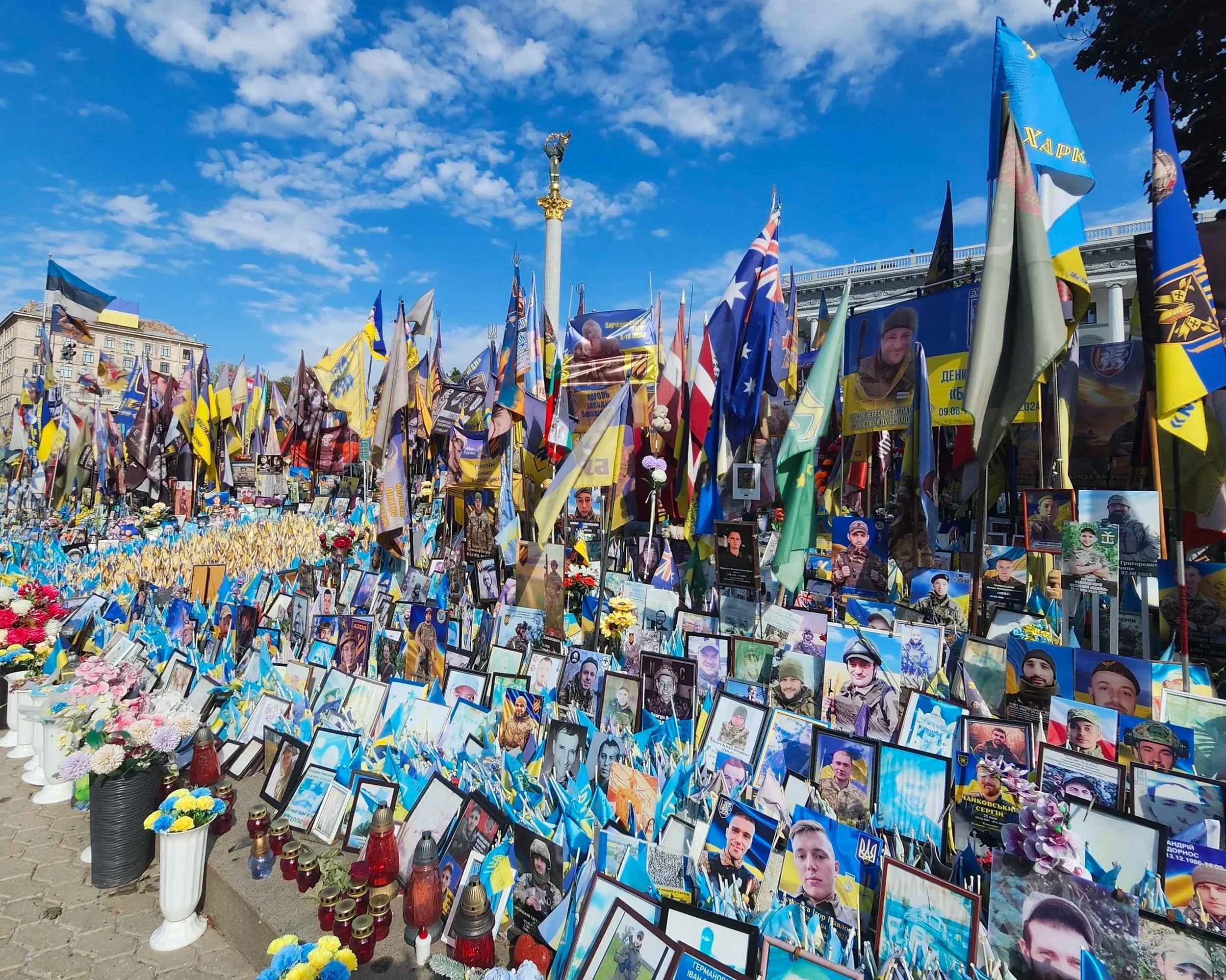
Memorials at Independence Square, Kyiv. Photo courtesy of Robert Gerber.
Introduction
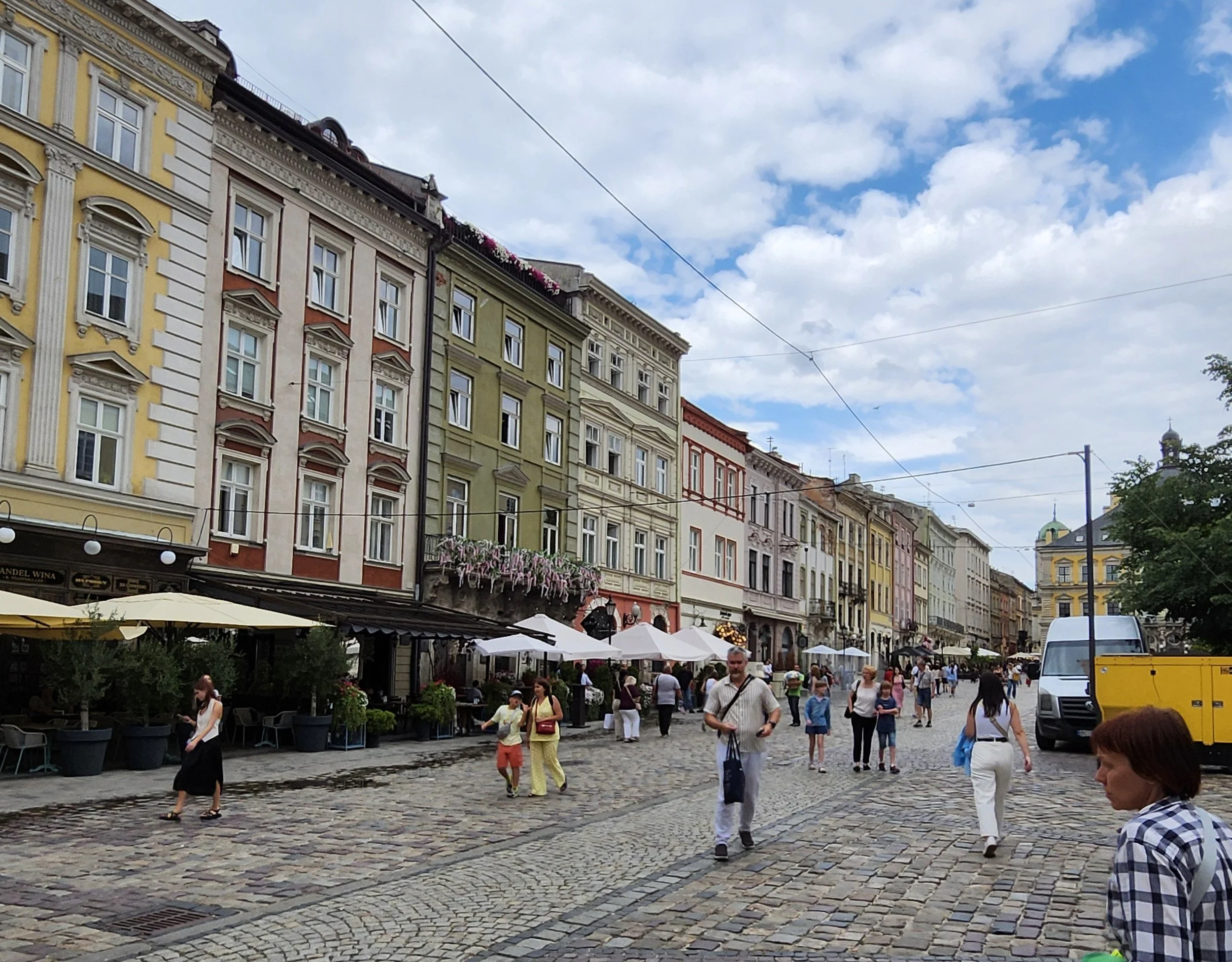
Lviv in August 2026. Photo courtesy of Robert Gerber.
When Russia launched its full-scale military assault against Ukraine in 2022, Ukraine’s economy plummeted by 19%. Since that time, Ukraine has managed to achieve relative economic stability with moderate economic growth by transforming into a "war economy." During a recent visit to Ukraine with CSPC President and CEO Glenn Nye, I saw some of the unique features of Ukraine’s wartime economy that have enabled the nation to mount an effective national defense against Russian military aggression. However, Ukraine’s economic resilience is now being severely tested because Russia has expanded its military air strikes against Ukrainian civilians and civil infrastructure.
As we drove to Kyiv, stopping in towns along the way, we were struck that life appeared remarkably normal with people going about their business or taking kids to school. Live music filled the public square in Lviv. Traffic was congested in Kyiv. But normalcy (which Ukrainians told us is a form of resistance) does not mean that people are detached from the conflict. Everyone we met on our trip had a person in their close circle who had been killed, injured, or is currently deployed to the conflict zone. Thousands of flags and photographs in Independence Square tell a piece of the story. In Kyiv, air alerts in the middle of the night sent us into the shelter in our hotel. On our second night in Kyiv, and we heard loud explosions as Russian ballistic missiles struck our neighborhood. For the past few weeks, Russia has launched missiles and jet-powered drones day and night against Ukrainian civilians and civil infrastructure.
This paper explores the current state of Ukraine’s wartime economy and offers solutions to preemptively address a set of vulnerabilities. This report also offers lessons for the free nations of the world as we confront new global security threats.
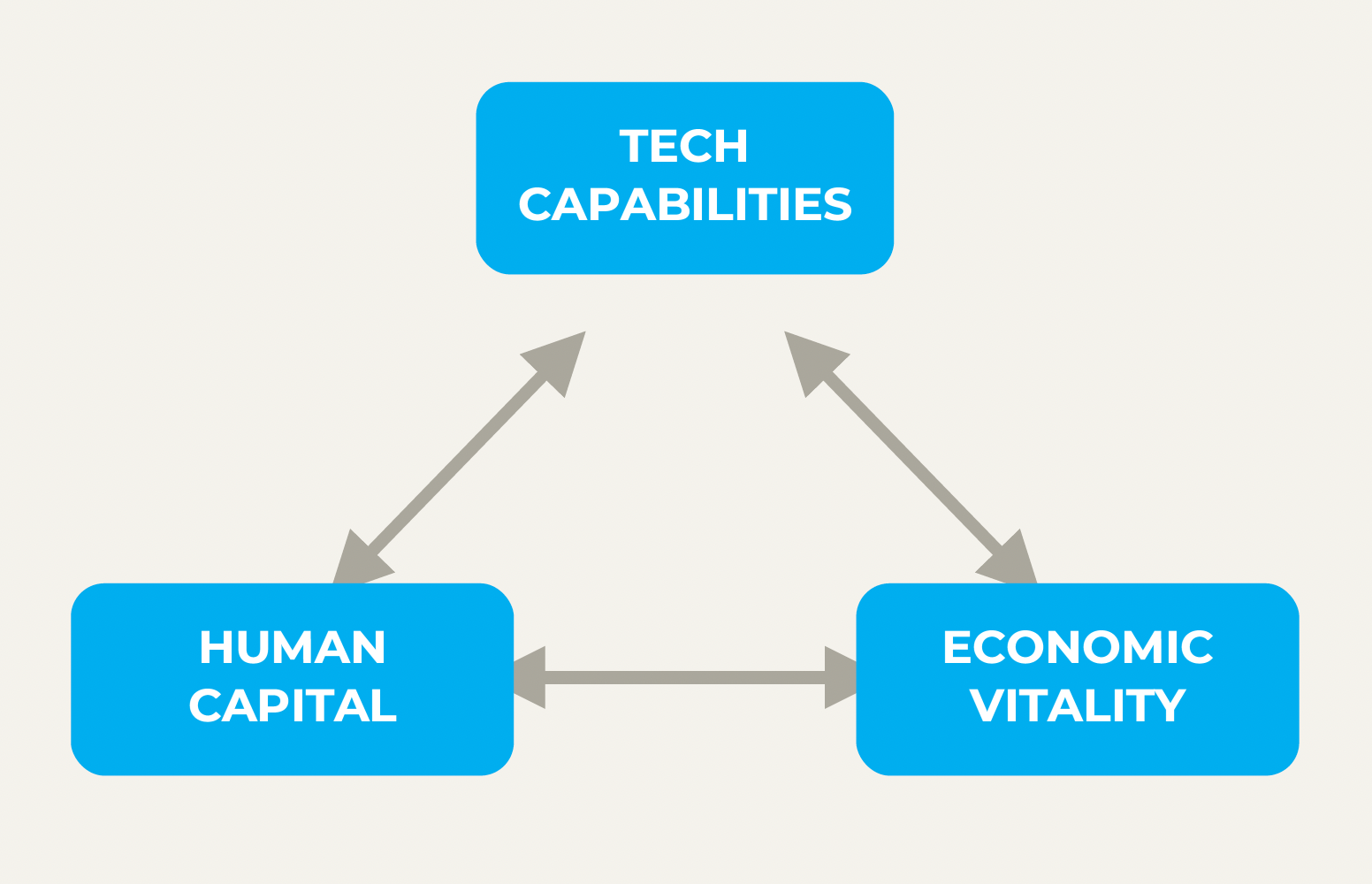
Putin’s military assault on Ukraine intended to erase Ukraine from the map. That has not happened largely because of the courage and determination of the Ukrainian people, foreign assistance, and Ukraine's success in unleashing extraordinary domestic innovation, particularly in low-cost drone warfare. Technological innovation, bolstered by human capital, has kept Ukraine’s economy afloat. All three are mutually enforcing elements that sustain the war effort. A vibrant economy depends on workers. Innovation depends on human capital. A sagging economy can accelerate migration and make funding for innovation less available. Effective civilian defense depends on both people and technology in the form of electronic warfare and drone-based defense.
A War Economy
Innovations in drone warfare and domestic munitions production have transformed Ukraine from an agricultural and services-based economy – with some heavy manufacturing in the east - into a defense production juggernaut. Ukraine now produces over 50% of its weapons systems, with a $55 billion defense production capacity. Ukraine's vast drone production ecosystem started as a government grant program designed to unleash private market competition. Today the sector employs hundreds of thousands of Ukrainians. Ukraine has leveraged its innovative Brave One market platform to help defense solution builders transition to large scale manufacturing. (Ukraine is collaborating with the EU on this front.) Nataliia Shapoval of the Kyiv School of Economics explained the defense tech sector's dual benefit: it is a significant economic driver that attracts investment, and it enables the military to carry out deep strikes against Russian logistics infrastructure, which hurts the enemy's economy. The government is seeking more joint production opportunities with friendly countries. It is also exploring ways to export surplus defense and to meet surging foreign demand for Ukrainian air defense expertise.
More Aid Needed
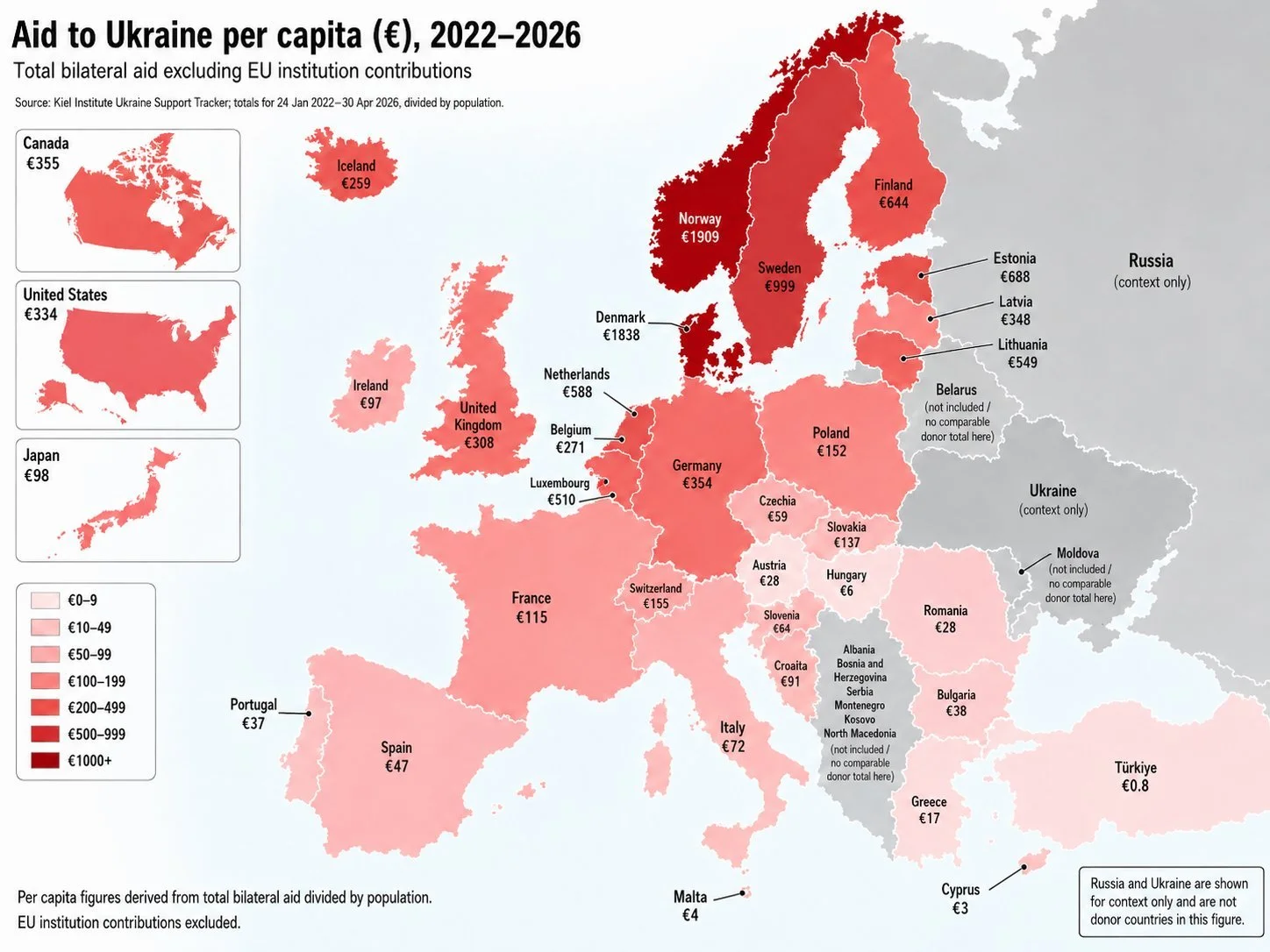
Loans and grants from foreign partners cover over 50% of Ukraine’s military operations and its general government budget. Since 2022, the United States has disbursed $127 billion to Ukraine’s government out of $195 billion appropriated by Congress. This includes money for purchases of U.S.-made military equipment. On May 23, Senators Grassley (R-IA) and Durbin (D-IL) urged Secretary Hegseth to disburse $400 million that Congress had appropriated for Ukraine for FY2026. Canada, the United Kingdom, Japan, and South Korea are also major bilateral donors. EU member states have collectively given $226 billion over the same period. The EU-funded Ukraine Support Loan is currently the single largest source of external funding. It is a €90 billion interest-free loan package disbursed in tranches to be repaid by Russian post-war reparations or by the $300 billion in confiscated Russian assets. (Ukraine’s government recently asked the EU to release and transfer some of the funds directly to Ukraine.) The G7’s $50 billion Extraordinary Revenue Acceleration loan program - also tied to confiscated Russian assets – is also ongoing, as are medium term World Bank and IMF programs.
Financial and humanitarian aid for 2026 fell below the 2025 totals, according to the Kiel Institute. Meanwhile, Ukraine is experiencing 7.7% inflation due to higher global fuel prices. The Kyiv School of Economics Institute calculated that, “the combined financing envelope…is sufficient to cover Ukraine's budgetary needs if the war ends in late-2026.” There is a high risk, of course, that Russia will escalate and prolong the war. Sporadic disbursements and a transition from grants to loans are increasing burdens on Ukraine's budget. Ukraine may also face donor fatigue, which is a natural phenomenon that occurs when a conflict reaches its five-year mark. Russia’s hybrid warfare against European capitals should be recognized as an effort to dissuade key donors from supporting Ukraine. These factors make President Zelenskyy’s diplomatic fundraising efforts even more important.
Recommendations:
Longer-term loan and grant disbursements would allow better Government of Ukraine resource planning and send a useful deterrence signal to Moscow.
Washington and Brussels should agree to transfer confiscated Russian foreign assets to Ukraine to help it rebuild. This action has bipartisan support in the U.S. Congress as well as the support of many EU member states.
Human Capital Shortage
According to UNHCR, about five million Ukrainians (representing 12% of the pre-2002 population) have left the country to find a safer place to raise their children. (Men of military service age require special permission to travel abroad. Putin's escalation of strikes against Ukrainian civilians aims in part to cause a new migration wave. Around 3.7 million Ukrainians are already internally displaced - many have moved to Kyiv and Lviv. The disruption has created an odd phenomenon where 75% of enterprises report they have trouble finding workers, but the unemployment rate is 11%, which is twice the EU average. Vox Ukraine stated that “mobilization has drawn a significant share of men out of the labor market, and the professional skills of those willing to work often do not match employers’ needs.” There is a particular shortage in blue collar technical jobs, engineers, and physicians. However, many Ukrainians are volunteering for the war effort: tracking overhead drones, working at veterans’ clinics, or assembling supplies for soldiers in their apartments. This work does not register in official employment statistics, but it contributes significantly to national resilience.
Recommendation:
To help address Ukraine’s skills gap, European and North American companies and governments should support upskilling programs within and outside of Ukraine. This would also benefit companies who provide the training as it would create lasting business partnerships.
Need for Supplies and Investment
Alongside a shortage of skilled workers, Ukraine faces gaps in both supplies and investment. There is a well-reported need for high-end military technology that Ukraine cannot produce locally, like certain air defense missile systems. There is also an urgent demand for medical/pharmaceutical supplies. The energy sector, which has been heavily damaged by Russian air strikes, requires capital and equipment to restore and maintain operations. Energy shortages could return this winter, which would cause additional hardships and sap economic output. The European Bank for Reconstruction and Development has helped fill gaps with $1.5 billion in loans to private power generation companies in 2025.
A business transactions lawyer we met in Lviv explained that small manufacturers need capital investment to modernize facilities and processes. This would help companies reduce production costs, scale output, and hedge against labor shortages.
Recommendations:
Further mobilize government and private sector resources to spur investment in industry and infrastructure
Support overseas trade missions for Ukrainian companies
Trade Facilitation
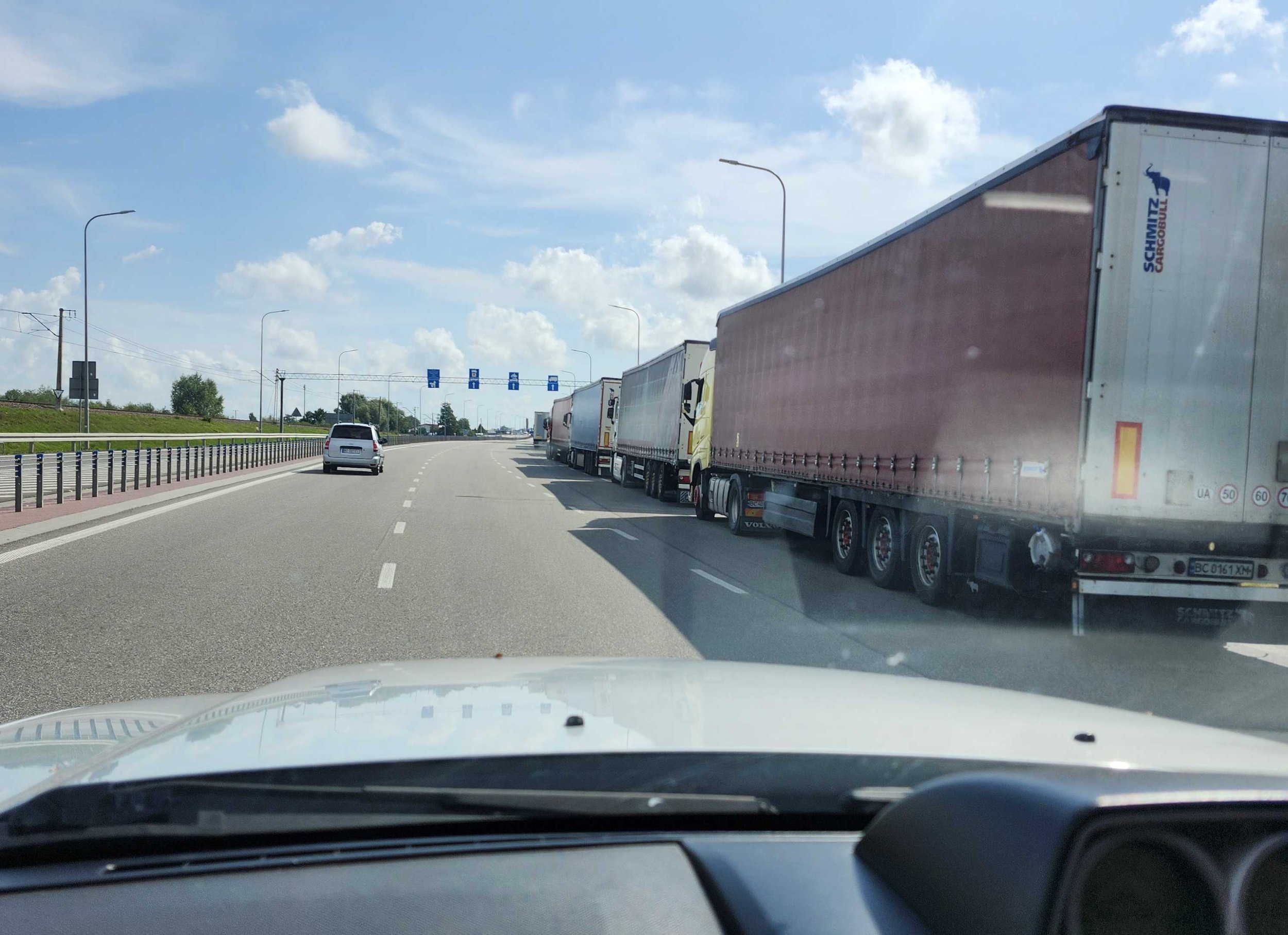
Trucks wait to enter Ukraine from Poland. Photo courtesy of Robert Gerber.
Trucks and trains experience significant delays entering Ukraine from Poland. Exports face the same difficulties – it can take a full day to clear a truck/lorry through customs, which reduces profit margins. A drone manufacturer told us it is hard to source key components like electric drone motors - which come from China – because the supply chain is vulnerable to disruption. There is an opportunity for mass production of interchangeable components in Western countries. This would alleviate import dependence on China, whose government is helping Russia’s war against Ukraine. The EU opened accession negotiations with Ukraine on June 15, declaring it would continue to support Ukraine “every step of the way” on its path to EU membership. It is too early to gauge the economic implications for Ukraine of EU membership, but the accession process provides incentive for Ukraine to align its regulatory framework with the EU, which would benefit Ukrainian exporters.
Recommendations:
Friends of Ukraine should broker dialogue between Poland and Ukraine to resolve differences and eliminate delays at Ukraine border crossings.
Build supply networks in friendly countries to reduce over-dependence on strategic competitors for sources of essential commodities2, particularly for drone manufacturing.
The World Bank and/or United Nations should double down on trade facilitation technical assistance to Ukraine to facilitate smoother customs clearance.
Russian aerial attacks have forced a near closure of Ukraine's Black Sea ports. This alongside surging insurance costs has impeded agricultural exports, which made up 45% of exports prior to 2022. A recent Ukraine-Moldova agreement to transport agricultural commodities by train will provide some relief. Ukraine closed its commercial airports in February 2022, which has had an incalculable impact on the economy.
Recommendations:
The United States and NATO allies should make international Black Sea maritime passage an equal priority to passage through the Straits of Hormuz.
G7 countries and the OECD should develop a re-insurance or risk-mitigation program to lower the cost of cargo insurance for goods transport into and within Ukraine.
Key Challenge: Outlasting Russia’s Economy
Russia’s economy is faltering but probably has enough “gas in the tank” to maintain its war footing against Ukraine for two more years, according to Ukrainian military intelligence. Ukrainian long-range strikes on Russian infrastructure and logistics sites demonstrate that Ukraine knows it must try to accelerate the decline of the Russian economy (and popular support for Putin's war) before Ukraine's economy runs into serious trouble. Russian crude oil refining, which is important for gasoline, is down 40% since January, as are Russia’s grain exports, according to the Wall Street Journal. The drop in exports makes it more difficult for Russia to finance its growing debt, which is becoming a major issue for Moscow. Ukrainian air strikes are also causing disruptions in the banking sector, civil aviation, and consumer goods. Internet outages have frustrated Russians.
Recommendation:
Continue diplomatic pressure on countries supplying Russia’s war economy; strengthen international sanctions regime against Russia, support debt financing for Ukraine.
Conclusions
We need to start talking about Ukraine’s economic resilience as it is critical to the nation’s ability to counter Russian aggression. Ukraine deserves support from the West to help meet the immediate and longer-term needs that Ukrainians cannot cover on their own. This entails both government assistance and private capital. There is no point in waiting for a future armistice - now is the time for reconstruction.
Saving Ukrainian lives is an urgent responsibility. But this is not just a charity case; in fact, there are many ways that partnership with Ukraine benefits the West. Ukraine’s cutting-edge diversified defense sector and high demand for consumer products makes it an attractive investment and market opportunity for Western companies. Our defense sectors can benefit greatly from Ukrainian technology and knowledge. We also can learn from their innovative method of decentralized procurement, which enables rapid iteration, product-market fit, and just-in-time delivery with efficiencies and speed that we can’t imagine in the West. We should not bypass these opportunities.
Robert W. Gerber is a former U.S. diplomat and a Senior fellow at CSPC.