
The CSPC Dispatch - Aug 7, 2026
This week's CSPC Dispatch is a World Cup special edition that examines what last month’s tournament revealed beyond the game itself. Robert W. Gerber unpacks the governance crisis now engulfing FIFA in the wake of the 2026 tournament, arguing the organization's dysfunction runs too deep for reform and should instead be rebuilt from scratch. Additionally, Isabelle Deng looks at why the World Cup failed to move the needle on global polling of the United States, even as a wave of positive, viral interactions between tourists and Americans built a real, if harder to measure, form of soft power.
This week CSPC also announced the launch of a new research project on U.S.-Russia strategic stability, led by Senior Vice President of National Security & Intelligence Programs, Joshua C. Huminski. The effort will convene private roundtables, expert consultations, and policy tabletop exercises to examine what it would take to resume strategic stability discussions with Russia and how the United States, NATO, and Congress should think about deterrence, reassurance, and arms control in a rapidly shifting European security environment.
The Dispatch will be taking a short hiatus for the rest of August and will return after Labor Day!
World Soccer Governance: Failures Create an Opportunity for Change
By Robert W. Gerber
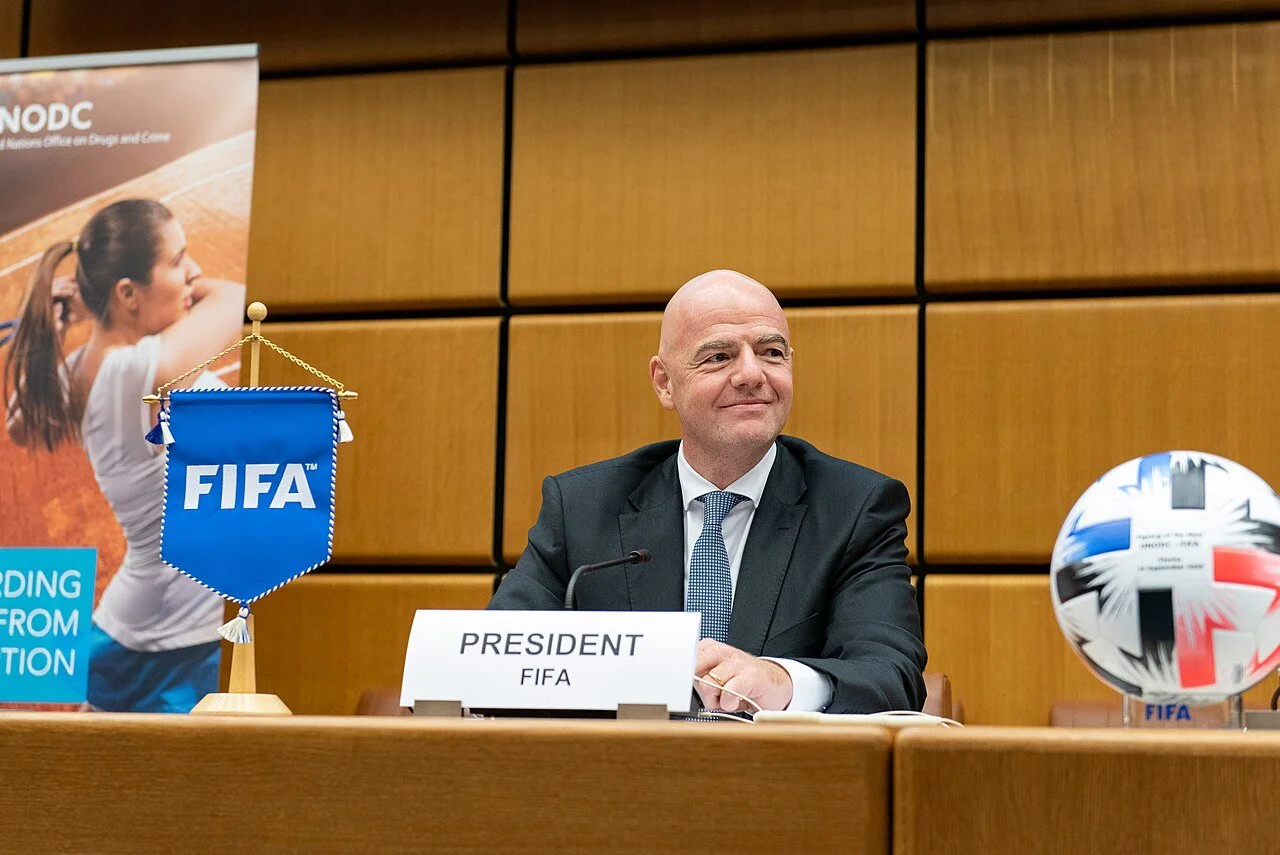
Gianni Infantino, President of the Federation Internationale de Football Association (FIFA), on 14 September 2020. (Photo Courtesy of UNIS Vienna/Nikoleta Haffar, CC BY 2.0)
The 2026 Men’s World Cup concluded with Spain winning the cup and Argentina receiving a red card – two outcomes that most fans felt were well-deserved. Also well-deserved: widespread press reporting on the extraordinary gemütlichkeit on display in American towns as they hosted visiting teams and legions of foreign fans.
By contrast, FIFA, the global governing body for football/fútbol/soccer, emerged from the World Cup embroiled in an existential crisis stemming from a controversial proposal to spin off some of FIFA’s lucrative media rights and advertising functions into a multi-billion-dollar commercial entity. The plan, which FIFA President Gianni Infantino concocted in secret, drew condemnations from football confederations in Asia, North America, and Europe. A senior FIFA official resigned in dissent. A growing number of nations are withdrawing their support for Infantino’s re-election, which could happen in 2027. FIFA has since shelved the proposal and admitted that errors were made. Nevertheless, FIFA faces a reckoning that may turn out to be as significant as the 2015 corruption and bribery scandal that resulted in the arrest of several FIFA executives in a Zurich hotel.
The event matters because it is an instructive example of a failure of institutional governance at an international organization with global reach and significant political and economic influence. Furthermore, there are ongoing international investigations into FIFA’s actions – with implications for the United States. The European soccer confederation, known as UEFA, appears to be preparing legal action against FIFA leadership for the privatization scheme, which would have involved an American venture capital firm tied to the Kushner family. Representative Jamie Raskin, ranking Democrat on the House Judiciary Committee, has called on Infantino to furnish information on any gifts, payments or benefits offered to President Trump and his associates before and during the 2026 World Cup. FIFA’s exorbitant ticket prices at the recent World Cup prompted several U.S. states to launch investigations into price-gouging and a number of U.S. localities claim that FIFA still owes them money, according to The Athletic.
How Did We Get Here?
Mr. Infantino was elected FIFA President in 2016 after the previous FIFA president resigned on bribery, racketeering, and money laundering allegations related to FIFA’s awarding of World Cup competitions to Russia and Qatar. A U.S. Department of Justice investigation resulted in criminal indictments against dozens of FIFA executives. (Earlier this year DOJ dropped charges against two of the FIFA executives, saying that anti-bribery no longer fit Trump Administration priorities.) Infantino was elected to usher in a reform agenda. Once in office, Infantino instead de-emphasized institutional reforms and prioritized expanding his own power and increasing FIFA’s revenue streams. As FIFA President, Infantino gained notoriety for his cozy relationship with Vladimir Putin, for dismissing human rights concerns surrounding the 2022 Qatar World Cup, and for awarding the 2034 hosting rights to Saudi Arabia after its sovereign wealth fund sponsored his new “FIFA Club World Cup.”
FIFA reportedly made a record $9 billion on the 2026 World Cup. FIFA claims this money benefits soccer development programs managed by individual national football associations, but accountability and transparency have long been lacking at the organization and there have been widespread complaints about the actual benefits for small and developing nations. While FIFA set record ticket prices at the 2026 World Cup, it also denied localities the right to collect concessions or parking revenue and forced stadiums to cover up their own advertising. In a move that outraged longtime soccer fans, FIFA instituted mandatory five-minute breaks during matches, which enabled FIFA to maximize TV advertising revenue. Infantino likely violated FIFA’s political neutrality rule when he gave President Trump a “FIFA Peace Award” at the White House, and FIFA broke its own “third party non-interference” rule when it overturned a referee’s red card decision against U.S. striker Folarin Balogun following President Trump’s phone call to Infantino.
After the final match of the 2026 World Cup, press reports revealed Infantino’s plan to sell off a portion of FIFA’s advertising and media rights to a private equity firm. Infantino threatened to punish football associations who opposed the plan. This was one sin too many for the European, Asian, and North American/Caribbean confederations, each of which is represented on the FIFA governing council. Their opposition to Infantino’s scheme appears to have killed the privatization plan, and Infantino has called for an emergency meeting of the FIFA Council to be held August 5. There is a growing chorus of calls for Infantino to resign. Infantino has claimed his mission is simply to “promote global happiness” blames his critics for “fostering hate.”
Systemic Problems
But Infantino’s departure will not solve the problem, because FIFA’s problems are systemic.
The 2026 World Cup’s excessive profiteering demonstrated how FIFA incentivizes profit over the good of the sport, its fans, and the players. Infantino -who earns a $3.3 million salary – won a $2.7 million “performance bonus” last year for expanding FIFA’s revenue base. Infantino attended over 40 matches courtesy of a Gulfstream jet furnished by “Official World Cup Sponsor” Qatar Airways. FIFA gave a 2026 sponsorship deal to predictive markets company ADF Predictstreet, which is banned in several European countries and under investigation by the German government, according to Deutsche Welle.
Fans, players, and teams are not stakeholders in its enterprise – it is only accountable to the 211 national football associations (FAs), each of which has one vote in the FIFA Congress. This means Brazil has the same vote weight as Andorra. FA support can be secured by an opaque system of FIFA payouts, purportedly for soccer development.
The FIFA presidency lacks checks and balances or meaningful oversight. In 2016, head of FIFA’s independent audit and compliance committee Domenico Scala resigned, arguing that committee members had been “factually deprived of their independence and are in danger of becoming auxiliary agents of those whom they should actually supervise.” Der Spiegel reported that Infantino unilaterally changed FIFA’s ethics rules. UEFA said that Infantino’s privatization plan evaded “outside established governance processes, with no transparency, consultation, or due process.” Finally, FIFA’s non-profit status under Swiss law helps it insulate itself from external judicial intervention, according to sports industry experts.
A Way Forward and An Opportunity to Lead
UEFA has called for institutional reform at FIFA in response to the privatization scandal. However, legal scholar and former chair of the FIFA Governance Committee’s adjudicatory chamber Joseph Weiler concluded that “fundamental reform of the entity is not possible under its current structure.” There are also growing calls for Infantino to resign. Certainly, Infantino deserves to go. But FIFA needs more than reform and restructuring. Instead, it should be disbanded and replaced by an entirely new organization. The new entity should be decentralized, grounded in transparency and integrity, and accountable to all genuine stakeholders – including fans, clubs, and players. It also demands reputable external audits and meaningful oversight. This effort would require intense diplomacy and will face significant resistance from small nations who have benefited from FIFA’s status quo. The movement could emerge from a coalition of committed leaders from the European, North American, and Asian football confederations, with a door open for other Confederations and FAs to join. The United States has an important role to play. It is hard to imagine President Trump staying on the sidelines on this matter. Will President Trump double down on his effusive support for Infantino? Or will the United States capitalize on its recent experience hosting the World Cup and its status as a rising soccer power to lead an effort to forge a better future for the world’s sport with President Trump’s help? This project would be a great use of the talented and under-utilized Career Foreign Service, in partnership with the U.S. Soccer Federation, and with bipartisan Congressional support.
Robert W. Gerber is a a former U.S. diplomat and a Senior fellow at CSPC.
The World Cup Didn’t Boost America’s Image. Why Does It Still Matter?
By Isabelle Deng

2026 FIFA World Cup opening ceremony in Mexico City on June 11, 2026. (Photo Courtesy of Omar David Sandoval Sida, CC BY-SA 4.0)
The 2026 FIFA World Cup had an overwhelmingly positive reception. While initial assessments painted the tournament as a logistical hurdle, complicated by the fact that a host country was actively at war with a participating nation, the tournament’s record-breaking attendance, memorable underdogs, and social media attention largely caused those criticisms to subside.
The social media frenzy is a particular point of interest. During the tournament, scenes of international unity and visitors bonding over U.S. culture took over social media. Visitors posted videos indulging in the wonders of American commercial institutions like Walmart and McDonald’s, demonstrating tourists’ unbridled wonder at the Americana they encountered. These posts, in turn, went viral among Americans because they offered an opportunity for Americans, a group increasingly characterized as hostile to foreigners, to be the subject of something positive.
That said, despite the positive reception of the U.S. online, the World Cup did not improve global perception of the country. According to a poll by Morning Consult, global net favorability towards the U.S. averaged -6.8 across the 42 markets Morning Consult tracks in the month before kickoff. By comparison, it was -5.2 over the entire tournament. Not only is this change in favorability minor, but it is essentially a continuation of a recovery that began in May, long before the World Cup kicked off.
However, while global perceptions of the U.S. didn’t change, the influx of positive interactions between tourists and Americans on social media that came about as a result of the World Cup suggests that perceptions of the U.S. did shift, even if it was in a way that wasn’t reflected in polling. Moreover, even though co-hosting the tournament — and consequently, allowing foreigners a peek into the U.S. — didn’t significantly alter global perceptions of the U.S., it doesn’t mean that the advances in soft power the U.S. gained as a result of the World Cup aren’t meaningful.
Soft power is developed through a variety of mechanisms, with cross-border tourism being particularly vital for building soft power. However, soft power is under threat in Trump’s second term. Since taking office for the second time in January 2025, the Trump administration has detained an increasing number of foreign tourists at the border. In response, an increasing number of nations have issued travel warnings to the U.S., and many potential visitors have refrained from traveling here, calling for a travel boycott instead. The U.S. remains the top travel and tourism market in the world, but it’s losing market share. In fact, in 2025, U.S. visitor numbers declined 5.5% against 2024 and international visitor spending fell 4.6% to $176 billion.
Additionally, the 2026 World Cup has come during a time in which the U.S. has seen a significant decrease in the share of countries that see the U.S. as a reliable country. Since 2022, countries with whom the U.S. has longstanding economic and security ties have adopted a more negative view of the U.S., such as the U.K., Japan, Australia, Canada, and South Korea.
Considering the image of the unforgiving, distant world power that the U.S. exudes, it is no surprise that posts celebrating quintessentially American institutions — Buc-ee’s, Texas Roadhouse, Waffle House, and Target — capture tourists’ genuine surprise at what they find once they visit. The 2026 World Cup, while certainly being another opportunity for people around the world to bond over a shared love for sport, has been a demonstration of the way that tourism functions as a form of soft power by dispelling preconceived notions about a country to the benefit of the host country. When hostile notions are dispelled, people can bond, instead of accepting the tendency towards isolation that often results from adhering to linguistic and cultural barriers.
Social media holds great power in bolstering a country’s image in the 21st century, even if the effects and longevity of its impact feel artificial. Interpersonal communication is powerful and meaningful, even when the government is actively pursuing foreign policy objectives that negatively affect its soft power, such as the detention of an increasing number of foreign tourists at the border.
Why do people who otherwise never watch football tune into the World Cup? Cynics may argue that it’s performative, but they forget that the people who watch the World Cup gain access to a sense of a broader global community when they tune into “the beautiful game” — something that is often difficult to do in our increasingly polarized world. In the World Cup, there is an opportunity to feel connected to something larger, and by investing in soft power, countries can communicate a sense of community to foreigners. Soft power is built through positive communication between people, which is why the soft power generated by this World Cup is nonetheless meaningful, even if global perceptions of the U.S. didn’t improve in polling. Ultimately, a sense of belonging and community is often all that people wish for.
Isabelle Deng is an intern at CSPC and a rising junior at the University of Michigan majoring in Political Science and English.