
How Closer Alignment with Ukraine Bolsters America's Interests
by: Glenn Nye
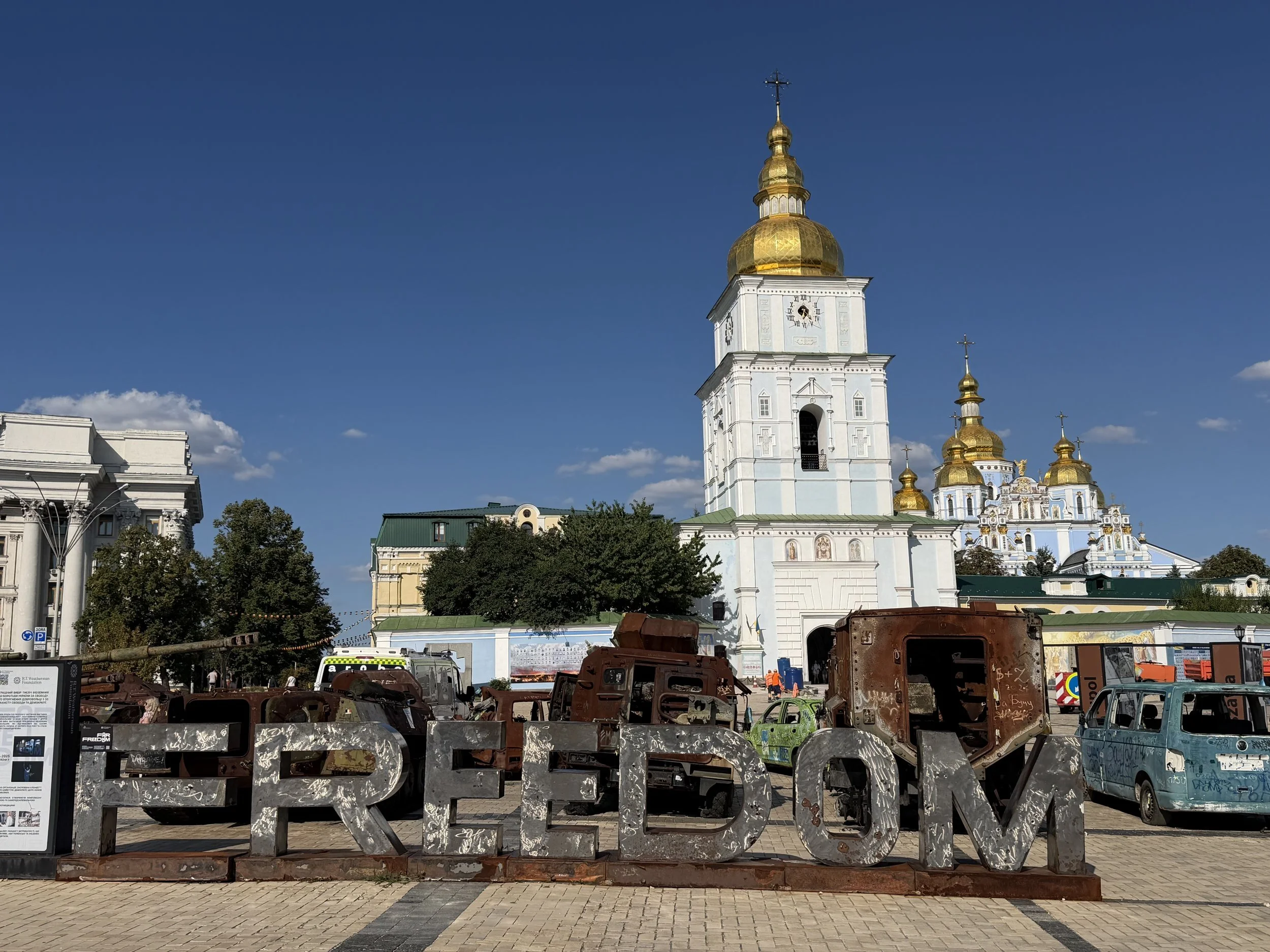
Monumental 'Freedom' sign with damaged Russian military vehicles at St. Michael's Monastery in Kyiv.
On a recent visit to Ukraine, the case for deeper connection between our countries became clearer. I built the trip around a charitable project organized with Mission Ukraine UK, with support from Dignitas Ukraine, involving privately raising funds to buy a used 4x4 vehicle which I drove into Ukraine, along with my colleague Robert Gerber, to donate to a Ukrainian military unit. Driving east from Lviv to Kyiv the road cut through fields of sunflowers, a vivid yellow canvas under a cloudless blue August sky, the Ukrainian flag embodied. It was a warm, beautiful welcome. It’s striking what is missing overhead: no aircraft, no contrails, nothing. Its absence here is disorienting, a small daily reminder that this is a nation whose airspace has been stolen from it.
The road was bustling with traffic in both directions, everything from high end Teslas to the occasional Lada and commercial trucks, dotted frequently with high end gas stations, shelves fully stocked with local and imported foods and excellent cafes. One could believe for a moment that you were in a country at peace, billboards advertising military recruitment the only obvious tells. That moment would come to a dramatic end once we reached Kyiv, where days begin with a national moment of silence to mark the fallen defenders of the nation, and sleepless nights are punctuated with air raid alarms and impact sounds.
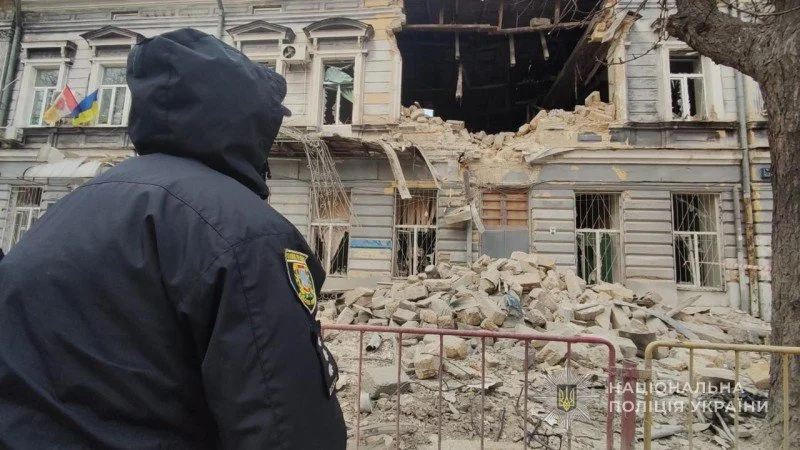
Building of Odesa Law Lyceum (architectural monument of 1892) after Russian drone strike in the night on February 21, 2026. Photo courtesy of the National Police of Ukraine, CC BY 4.0.
The War Is in the Cities
Life in Ukrainian cities is a juxtaposition of defiant normalcy and dread. We were able to conduct meetings in restaurants and offices with Ukrainians refusing to have their daily function robbed from them. In Kyiv, I slept in stretches of three hours at most before the air raid sirens sent me back to the hotel shelter. In Odesa, the alarms came roughly every two hours, day and night. I was exhausted after four days of this. Ukrainians live this every day. The second night I was in Kyiv, Russian missiles loudly struck a warehouse and a children's hospital in my neighborhood. Russian forces deliberately target civilian life support systems — power plants, water treatment facilities, hospitals, food storage warehouses, gas stations — as well as housing blocks, in a campaign of state terrorism designed to break Ukrainian will to resist. Ballistic missiles arrive with little warning. There is significant concern of a pending human crisis with winter approaching and heat and water increasingly at risk. Shahed drones are flown over cities triggering air raid alarms over population centers before they strike. In parts of the country Russian FPV (first person view) drone operators deliberately hunt individual civilians — cyclists, market vendors, people simply walking home, in "human safari" attacks. In eastern Ukraine gas stations are prime targets. While not new, the conditions are getting rapidly worse. This is a strategy of exhaustion and terror.
Through it, Ukrainians have found room for dark humor. The voice on the national air raid app is the actor Mark Hamill, aka Luke Skywalker, and when the imminent danger passes, he tells listeners: "may the Force be with you." That a nation under nightly bombardment can still smile, even quietly, says something about what it is trying to protect. I am told this humor is typical of Ukraine. This is not a people that is going to give up.
The War is Long Range Strike vs Interceptors: A Race That America Can Help Ukraine Win
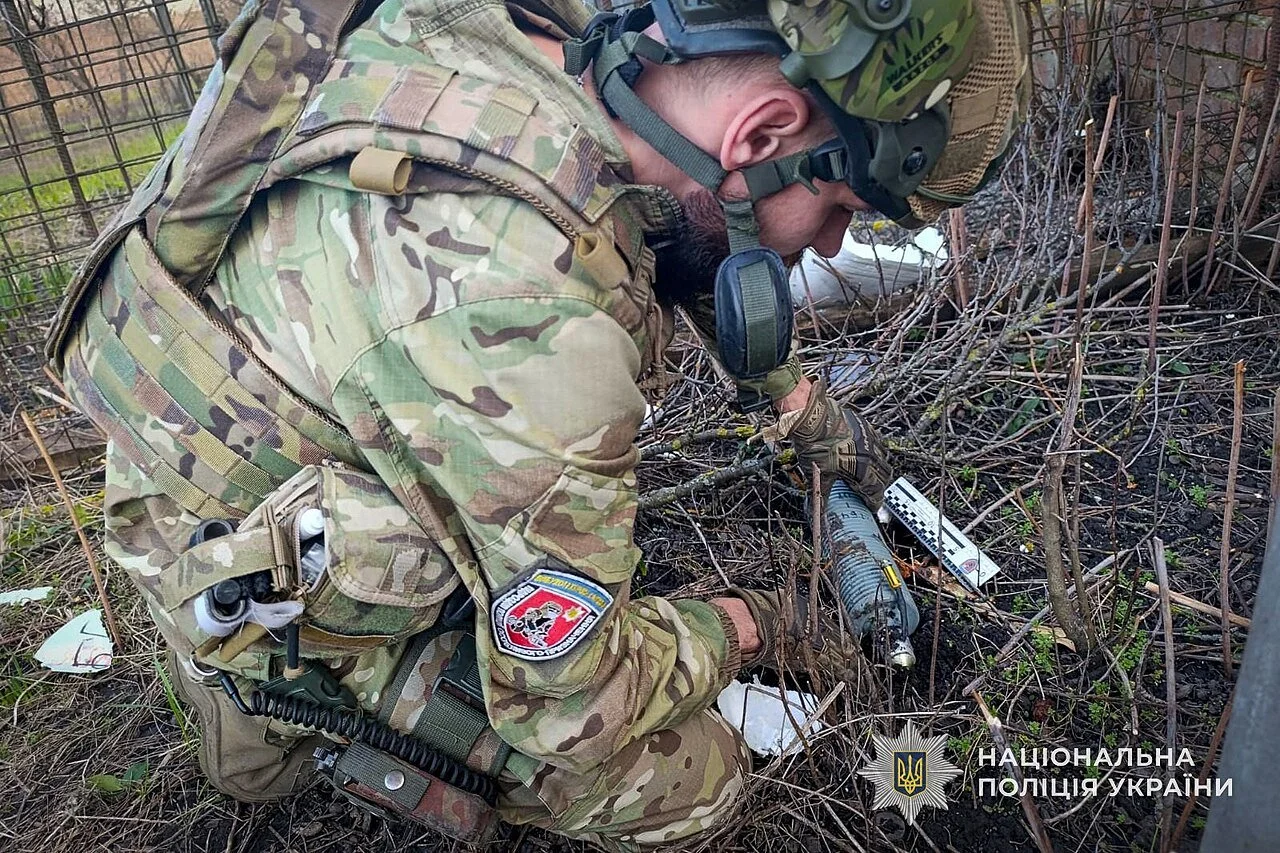
Police sapper with a 5-kg warhead of a downed Russian drone found on a field in Sumy region of Ukraine on April 7, 2026. Photo courtesy of the National Police of Ukraine, CC BY 4.0.
Militarily, this has become a race between missiles and the interceptors that stop them. Ukrainian forces have degraded Russian defenses and developed long range strike capabilities that now achieve dramatic successes striking strategic targets of military value deep inside Russia. Ukraine has gotten remarkably good at shooting down Shahed drones over its cities. But the enemy is innovating too — newer, jet-powered Shahed variants are harder to intercept — and Ukraine is running dangerously short on interceptors for ballistic missiles, the faster, more destructive threat. Russian forces are increasingly able to successfully strike Ukrainian cities and infrastructure. Patriot and similar interceptors are needed desperately, and winter cold will make Putin’s escalation more devastating. The vehicle donation we brought was given to a counter-drone training unit which will use the truck to train forces to shoot down Shahed drones en route to attack Ukrainian civilians, and to close a gap in the defensive line. It’s one cog in a constantly adapting machine, and the need is high: vehicle attrition especially near the front is astronomical, with small mobile vehicles outlasting their larger armored counterparts.
Russia is also waging an economic siege. Repeated strikes on the port of Odesa and approaching ships have created an Iran-style blockade: grain silos across the country sit full, unable to reach world markets, some produce wrapped in white preservation covering remains in the fields because it has nowhere to go. This is not just a Ukrainian problem — it is a global food security problem.
Taken together, these two campaigns — terror against civilians and strangulation of exports — suggest the Russian regime believes it can still win even where it cannot win on the front line. Helping Ukraine close its interceptor gap and break the blockade would deny Russia that theory of victory, and it would save a great many lives. The moral case for assisting Ukraine to defend itself is clear. But the advantages don’t stop there. Matching interceptors efficiently with inbound drones and missiles is a strategic necessity, a lesson the U.S. learned the hard way defending against Iranian drones in the Persian Gulf. Ukraine is in a persistent adaptive learning loop, making them a valuable knowledge partner.
The War is a Frontline Driven by Drone Innovation: A Case Study in National Resilience and Industrial Adaptability
Civil society has organized itself for endurance. Civilians and military sources collect and share real-time information on incoming drones and missiles through phone app chat groups, warning specific communities when they are under imminent threat. Volunteers 3D-print components requested by military units online and mail finished parts to units using public and private postal services. Local and international NGOs form a robust support network providing logistics, small scale production, and distribution of donated items. This supports a broad decentralized professional network of distributed military systems producers, including ground and aerial drones and components, serving twins goals of automation of the force and rapid innovation of product to match demands from the tactical environment. Decentralization is necessary to avoid concentration of production in fewer vulnerable points.
The urgency for automation is arithmetic. Ukraine cannot match Russia soldier for soldier — Russia's population advantage is compounded by reinforcements from abroad, including North Korean troops. Unmanned and remote-controlled systems increasingly substitute for manpower, helping Ukraine preserve precious human resources.
Decentralized production, combined with brigade level budget autonomy, creates an adaptability advantage. A large array of small producers competing to adapt products to match unit needs at competitive cost has resulted in a production loop that takes field tested results into product in a matter of weeks rather than months or years. Brave1, a government-run defense technology cluster, connects thousands of manufacturers directly with military units through an online marketplace where brigades can select and purchase drones and equipment themselves, testing new designs in real combat and feeding tactical lessons back into the next round of production. They are able to adopt new methods of tactical drone coordination, guidance systems, sensor design, modularity of components, in real time, The result is that Ukraine has become, out of necessity, the world's most experienced laboratory for drone warfare and rapid wartime production.
Ukraine undoubtedly benefits from American technology it would struggle to replicate. Starlink, for example, underpins some Ukrainian communications and drone guidance. But local lessons building a highly distributed and adaptable innovation/production loop are highly valuable to American thinking about accelerating parts of our own industrial production.
The War is The Human Factor: What We Can Learn from Ukrainian Veterans

Last December on the Day of the Armed Forces of Ukraine, President Volodymyr Zelenskyy visited service members undergoing treatment at a medical facility in Kyiv. Photo courtesy of the Office of the President of Ukraine.
At a veterans' rehabilitation clinic in Odesa, I observed practitioners use modern techniques to treat burns and restore the use of injured limbs. The physical wounds, difficult as they are, may prove the easier problem. I sat in on a group therapy session with a dozen active-duty soldiers on leave. This group’s unit had recently informed them their leave was cancelled and they were being recalled to the front. Service in Ukraine is compulsory, though not universal (there are deferrals for younger Ukrainians and some autonomy for volunteers), and stop-loss orders keep many soldiers in continuous combat with no defined end date. The front is a brutal environment. Drone kill zones extend 20 km in both directions from the front, making use of heavy vehicles nearly impossible. Supplies are brought by aerial or ground drones, or carried in on foot, while critically wounded soldiers must risk evacuation in ground vehicles: metal containers guided remotely through a gauntlet of drones and mines. Some soldiers remain in trenches for over 100 days at a time. Many soldiers are dealing with traumatic brain injuries that must be treated physically before psychological therapy can help, a pattern painfully familiar from America's own veterans returning from Iraq and Afghanistan.
Ukraine is being asked to sustain its fighting force and build a veterans' reintegration system at the same time, with no relief in between. Having spent time on the House Veterans Affairs Committee and visited VA facilities in my own district, I recognize both the scale of this challenge and the value of what America has learned the hard way in terms of veterans’ care. We should be sharing those lessons with Ukraine. Despite the similarities, each new war provides unique lessons in military casualty care and rehabilitation. This exchange should run in both directions: Ukrainian medics and caregivers have accumulated the world's most current expertise in treating casualties under drone-saturated, high-intensity conditions — knowledge the American military would be wise to learn as well.
The Great Power(s) Play
There is a further reason this war matters beyond Ukraine's borders. If Russia subjugates Ukraine, Chinese influence will not be far behind, arriving as the senior partner in Beijing's relationship with a weakened Moscow — a troubling foothold in Europe. But the danger does not depend on a Russian victory. An exhausted Ukraine, even one that avoids subjugation, could welcome direct Chinese investment in the absence of definitive American and western European bonds. Investment in Ukrainian victory would add an important and valuable ally to the western roster in a way that incremental or tentative support may not.
Russia, for its part, is already ideologically aligned with China and adversarial toward American leadership regardless of what happens in Ukraine. The strategic error would be to imagine that restraint toward Russia might somehow pry it away from Beijing. It will not. The winning move is not appeasement in pursuit of a divorce that isn't coming — it is standing more firmly with Ukraine. A more unified western alliance, with Ukraine closely aligned, would be in a stronger position to deal with a Russo-Chinese alignment as long as is necessary.
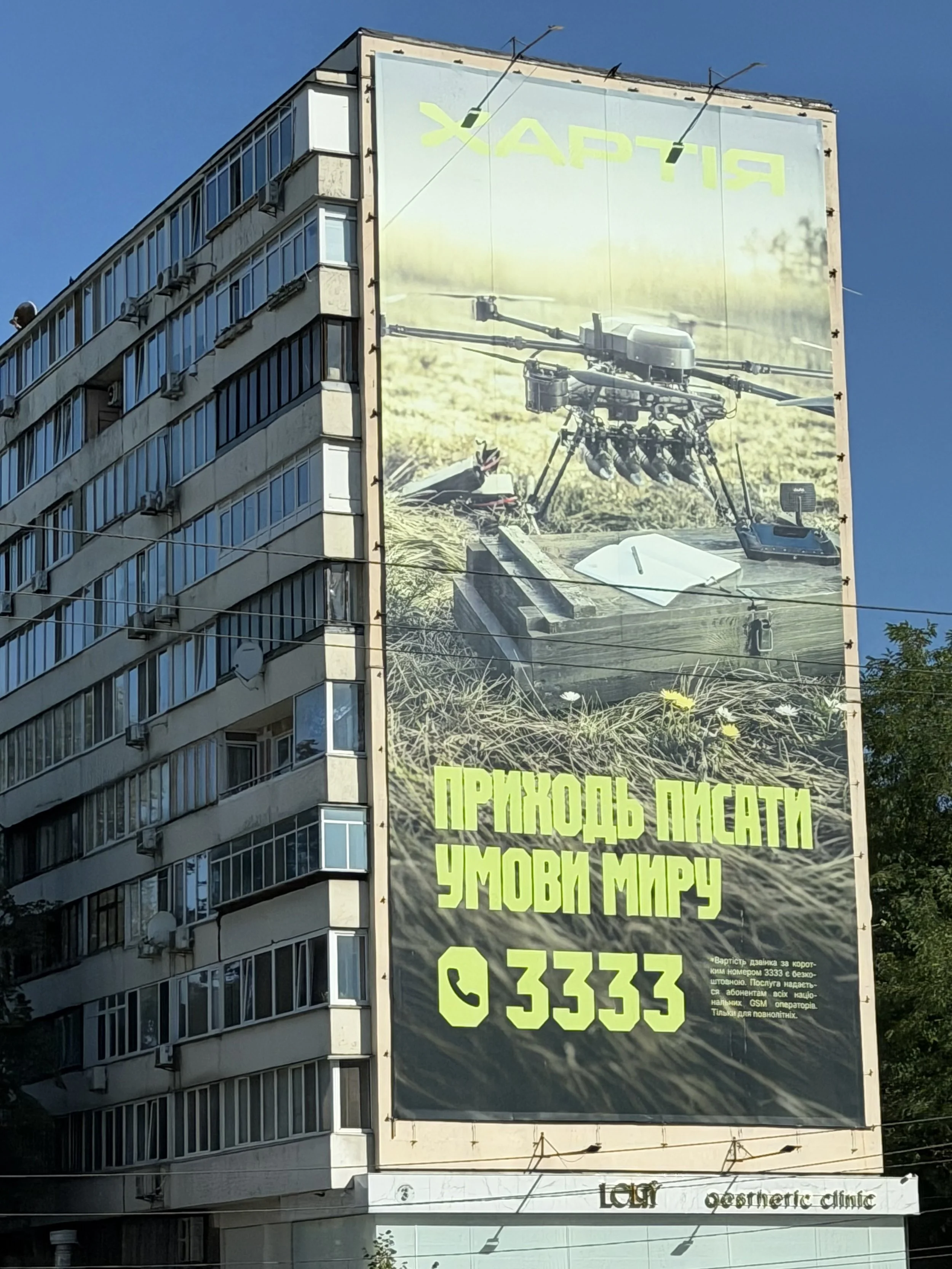
A billboard advertisement for Khartiya, a Ukrainian National Guard brigade, in Kyiv, Ukraine.
The Imperative of Closer Alignment
It is time for U.S. policy to fret less on the costs and risks of assisting Ukraine and focus more on the strategic value of the partnership to us. The advantages of aligning more closely with the world’s preeminent expert on drone warfare, forces that handily beat our own in drone-based exercises, are obvious. In the short term we could learn much from affiliating with organizations like the Ukrainian Federation of Military UAV Pilots. Ukrainian society is constantly increasing its drone skills as a matter of national resilience. Injured troops are receiving training as drone pilots so they can return to the fight, while Ukrainian youth are being trained in drone skills as preparation for future generations able to quickly heed to call to serve and rebuild.
Ukraine is showing the world what future wars will look like: a contest to close the innovation loop faster than the adversary, and a volume contest — enough long-range missiles, and enough interceptors to stop the adversary's own. It is a volume/cost game, layered with an adaptation challenge, serving the joint tasks of winning on the battlefront while protecting infrastructure, supply lines, life support and citizens. Ukrainian experience with this type of warfare is now unrivaled.
Alignment with Ukraine also brings ranges for real time testing of electromagnetic resistance for military hardware and post-war production of the latest drones and components with a war tested supply chain.[1] It offers valuable lessons in cognitive warfare that would serve our alliances well.
The Time to Act is Now
There are two concrete things America can do that would matter most: tighten the economic pressure to make this invasion unsustainable for Russia and help close the air-defense gap that is currently allowing Russian forces to terrorize and brutalize Ukrainian civilians. Despite recent depletion of American interceptor reserves in the Persian Gulf, both are within reach if there is sufficient will, and may involve some combination of selling high-end interceptors while helping Ukraine develop affordable, scalable interceptor solutions. We have only to join in building on momentum already established by our UK and European friends who are ramping up provision of long-range strike capabilities to Ukraine.
There is a reason I chose to take some personal risk to travel to Ukraine at this time. American policy has drifted into an ambiguous state, leaving many Ukrainians to worry that Americans are forgetting about them four years into the full-scale invasion. I wanted to show them we still care. I also wanted to ground-truth my assumptions about the value of the relationship to the United States, as I believe we can serve both the moral imperative and American interests with robust support to and alignment with Ukraine. I believe my theory is validated.
[1] For deeper analysis on these advantages please see the excellent essay by Daria Synelnykova in the 2025-6 CSPC Fellows Review, starting page 82.
Glenn Nye, a former Member of Congress from Virginia, is President and CEO of the Center for the Study of the Presidency and Congress.