In this issue, Amarah Din looks at the fight over student IDs at the polls. After the Supreme Court’s recent New Hampshire decision, she asks how voter ID restrictions affect young voters and proposes a middle ground ahead of the midterms. Sarena Sohan compares the current administration’s clashes with the press to the Nixon era and makes the case that an independent press is essential to democracy. Lara Bhakdi explains why neither the United States nor China can afford to lose Southeast Asia, as the region’s balancing act between the two powers comes under growing strain.
As always, we hope you find the Dispatch engaging and welcome your feedback on how we can continue to improve—and may your inbox be full of treats, not tricks, this Halloween!
Student Voting in America’s 250th Year
By Amarah Din
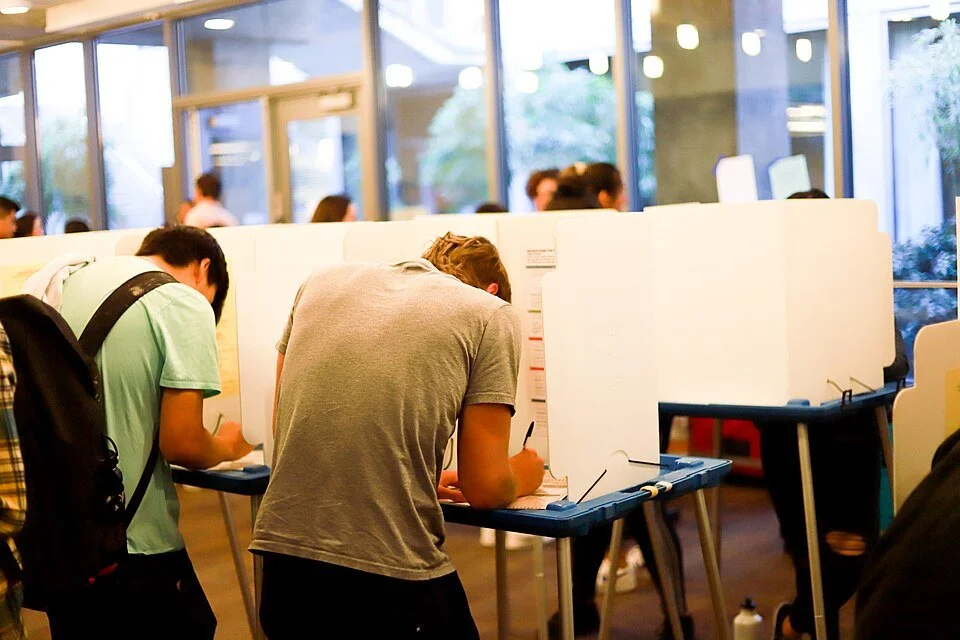
A college sophomore walks into her polling place carrying the card she uses every day: one that opens her dorm, pays for her lunch, and gets her into student events. It bears her name and photo. This year, in a growing number of states, that card will not get her a ballot.
On October 22, the U.S. Supreme Court allowed a New Hampshire law that bars student ID as a valid form of photo ID needed to get a ballot at the polls. The decision came a week after a federal appeals court upheld a lower court order that blocked the state from fully enforcing the restrictions. The Supreme Court’s ruling rests on the Purcell principle, under which, “lower federal courts should ordinarily not alter the election rules on the eve of an election.” Justice Ketanji Brown Jackson was the lone dissenter, arguing that the district court order was “reasonably designed to address alleged misinformation, not to change the law.” The Court did not decide whether the law is unconstitutional, but that question is still working its way through the lower courts.
New Hampshire is not alone in the debate over student IDs. Indiana’s 2025 law prohibiting student IDs at polling places was briefly blocked by a federal judge in April before an appeals court reinstated it on timing grounds, again without ruling on the merits. Florida’s ban will take effect in January. North Carolina requires colleges and universities to receive approval from the state board of elections for student IDs to be accepted as voter ID. Georgia accepts only student IDs from public institutions, excluding seven of its ten historically Black colleges and universities.
Supporters’ concerns are not without merit. Indiana lawyers argue that student IDs are issued without a statewide standard, raising concerns about voter fraud. They also argue that the new restrictions do not burden the right to vote, and very few voters who relied on student IDs would be impacted.
However, voter fraud remains extremely rare, with no evidence of student IDs causing widespread violations. The Indiana district court judge stated that the restriction on student IDs “looks more like a solution in search of a problem.” While proponents of such changes to voting ID may argue that few students will be impacted, an election supervisor in Indiana estimates that two-thirds of voters at Indiana University at Bloomington’s polling site used student ID in 2024. With these new restrictions, the practical burden falls on those with the least experience navigating the system. Young people today are less likely than earlier generations to hold a driver’s license, and replacing missing documents, like a birth certificate, can take time and money.
The issue of already-low student turnout must also be addressed. A survey by the Center for Information and Research on Civic Learning and Engagement (CIRCLE) at Tufts University found that two-thirds of college students say they’ll vote in the 2026 midterm elections. While college student voting turnout in the 2024 presidential election reached 53%, midterm election years see a different trend. The national college student voting turnout in the 2022 midterms reached only 31.3%–that’s over 8% less than the student turnout rate in 2018. These numbers show us just how hard it is to get young people, including students, out to the polls. Implementing restrictions on students’ access to elections, whether it be removing student IDs or college campus polling sites, only discourages them from engaging in their civic duties. For a first-time voter, being turned away is rarely a minor inconvenience. Voting is a habit formed early, and if the first experience at the polls is a rejection, the second attempt may never come.
Lawmakers should meet in the middle. States could accept any student ID that shows a photo, full name, and an expiration date, so long as it comes from an accredited institution. State-certified ID templates could be available to schools to guide their designs in order to be compliant, adequately addressing concerns about uniformity. States and schools could also work in tandem to provide services that make obtaining identification documents for students more streamlined and financially accessible.
As America celebrates 250 years of democracy, it is only appropriate to confront the barriers that prevent the future leaders of our great nation from building upon the foundations that are meant to be responsive to, by, and for the people. Commonsense, bipartisan political reform is possible and worthy of discussion, especially when it concerns the integrity of our elections. So, when a whole generation of Americans face hurdles when genuinely attempting to engage in civic life, it begs a greater question: what message are we sending young people when we make our democratic processes less accessible and more convoluted and burdensome? Instead, our message should read clearly: this nation’s future deserves access to democracy now and for the next 250 years and beyond.
Amarah Din is a returning contributor to the CSPC Dispatch and a former CSPC intern. She is a Legislative Intern at Issue One and is pursuing a master’s degree in International Peace and Conflict Resolution at American University. She graduated with honors from Appalachian State University, where she studied Political Science with a concentration in Pre-Professional Legal Studies and a minor in Criminal Justice.
The Press and The Presidency
By Sarena Sohan
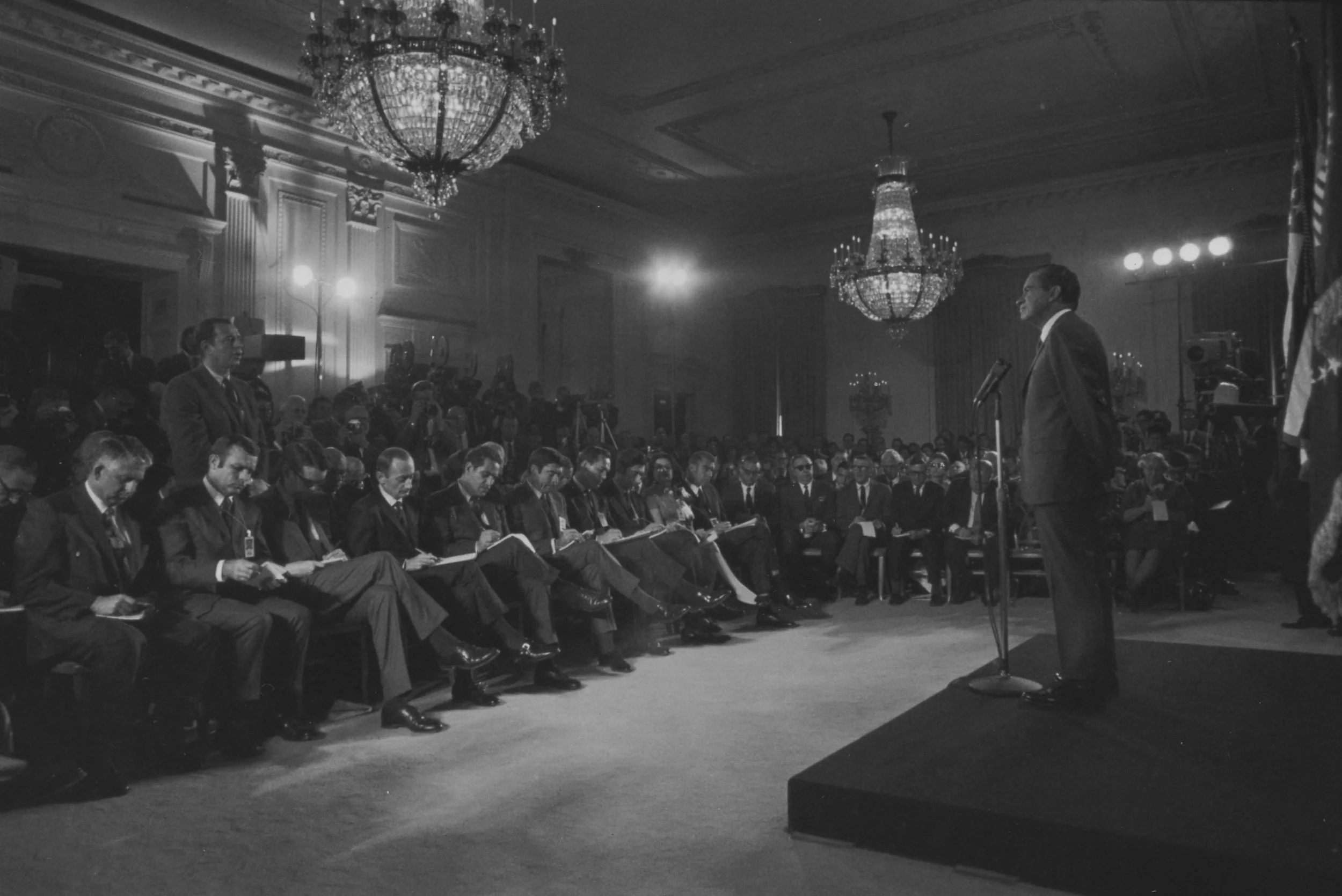
Richard Nixon during a White House press conference. Photo courtesy of the Nixon Library.
Last month, President Donald Trump announced on Truth Social that he was banning the media outlets CNN, Politico, and MS NOW from the White House. With a mid-term election looming and favorability ratings of the president dropping, it may have seemed like a curious choice for the administration to choose a renewed confrontation with the news media.
“I am proud to announce that, effective immediately, I am banning Fake News CNN, MSNOW and Politico …. from the White House as a result of their constant ‘reporting’ FAKE NEWS! Media Outlets shouldn’t be able to constantly write or report FICTION and LIES when they’re covering the President of the United States,” Trump wrote in the post. A federal judge promptly issued an order blocking the Trump administration from enforcing the ban. This week, multiple organizations followed up with a new lawsuit alleging that the ban deprives “American citizens of their constitutional rights to access information.”
Prior to the recent clash between the White House and news media, the Trump administration’s most notable restriction against a specific news outlet came in February 2025, when it barred Associated Press reporters from the Oval Office and presidential events due to the wire service’s refusal to change “Gulf of America,” to “Gulf of Mexico” in its reporting. That ban was also rejected by the courts, with U.S. District Judge Trevor N. McFadden ordering the White House to restore the AP’s access and noting “Under the First Amendment, if the Government opens its doors to some journalists—be it to the Oval Office, the East Room, or elsewhere—it cannot then shut those doors to other journalists because of their viewpoints” in April 2025. At the beginning of Trump’s second term, the White House also placed a “media offenders” list on its website naming several outlets that the White House deemed to be “misleading” or “biased.”
While some tensions are structurally built into the relationship between presidents and the media, and no president has escaped intense media scrutiny and criticism, in declaring the media “fake news” and calling it the “enemy of the people,” Trump harkens back in many ways to the Presidency of Richard Nixon. In one of the later released Nixon tapes dating back to 1972, Nixon can be heard saying, “The press is the enemy. The press is the enemy. The establishment is the enemy. The professors are the enemy. Professors are the enemy. Write that on the blackboard 100 times and never forget it.” Matching deed to word, Nixon’s team developed a secret “enemies list,” the goal of which was, according to White House counsel John Dean, to “use the available federal machinery to screw our political enemies.”
Although Nixon never fully banned specific news outlets from the White House complex, he arguably went further in other regards by illegally wiretapping the phones of journalists. Senior Nixon aides allegedly even plotted and then abandoned a plan to assassinate investigative journalist and longtime critic Jack Anderson.
Nixon frequently clashed with the news media of his day during his presidency, but a new type of media today has certainly been embracing him. Nixon is at the center of a social media trend called “Nixonmaxxing.” The trend consists of short form video edits that include pictures and videos of Nixon set to popular music. The content first began to appear on the Richard Nixon Foundation’s social media accounts this summer. The videos have been racking up millions of views since then. The Trump administration has also contributed to a renewed interest in the former president. According to reporting in the Wall Street Journal, a former Nixon aide recently gave a two hour presentation at the Justice Department laying out his theory about Nixon and the “deep state,” making the case that the former president had gotten a raw deal from prosecutors. A retired lawmaker who had taken part in Nixon’s initial impeachment proceedings called the Trump administration's renewed focus on Watergate “beyond stupid.”
Viewing presidencies through their relationship with the press is always variable, but an independent press is certainly crucial to a thriving democracy. This sort of Nixon renaissance more than 50 years after the end of his presidency introduces new questions about how generations new and old, remember a president long after they're gone, especially with advanced ways of sharing and interpreting history. Henry Kissinger, one of Nixon’s most trusted confidants, once said to Nixon that “history will treat you better than your contemporaries did” and in a strange way, perhaps this may now be the case for the disgraced Watergate president.
Sarena Sohan is an intern at CSPC and a student at George Mason University majoring in Communication with a concentration in Journalism.
Why Neither Superpower Can Afford to Lose Southeast Asia
By Lara Bhakdi


A U.S. Navy littoral combat ship and a Philippine Navy patrol ship in the South China Sea. Photo courtesy of the United States Navy.
A month ago, China's Ministry of National Defense announced the inauguration of a new airbase in Ban Keun, Laos. Situated close to the country’s capital, Vientiane, and to its border with Thailand, it is China’s first official military base in Southeast Asia.
The opening of the base itself has not been a cause for alarm in the U.S.: fitting only small aircraft and located in a landlocked country, it promises comparatively few strategic benefits. Still, it raises questions regarding the broader signal the development sends about Chinese efforts to strengthen the country’s influence and ultimate dominance in Southeast Asia, a region of considerable strategic importance for the United States.
Preventing Chinese hegemony over the region has long been a priority for the U.S., though questions about the country’s ability to maintain the required strategic focus amid other foreign policy challenges have increased in recent months. While the Trump administration has continued to pursue strategic competition with China in some areas – for example, through investments in critical minerals and the president’s adamant refusal to regulate generative AI, ostensibly out of fear of Chinese technological superiority – in other areas, the U.S. has sacrificed political standing abroad for policy goals at home. Southeast Asian countries, many of which run significant trade deficits with the U.S. and rely on fuel transported through the Strait of Hormuz, were among the hardest hit by the administration’s tariff regime and the war in Iran.
Southeast Asia has long balanced its political commitments between the U.S. and China. As an amalgam of small and middle powers, the eleven countries comprising the Association of Southeast Asian Nations (ASEAN) have generally attempted to sustain economic ties with both superpowers and to avoid becoming polarized in either direction. This ‘balancing act’, a decades-long foreign policy strategy, has found relative success despite the region's precarious geopolitical position – more specifically, its proximity to the embattled South China Sea.
For Southeast Asian nations, managing relationships with both superpowers while safeguarding their own sovereignty is becoming increasingly difficult, and there are signs the region may have reached a turning point. In recent opinion polling, instead of conflicts in the South China Sea, a majority of Southeast Asian respondents now cites "US leadership under President Trump” when asked about their top geopolitical concern. For the second time since 2024 (and the second time in the survey’s history), respondents also pointed to China, not the U.S., as the country they would choose to align with. This preference was particularly pronounced in Indonesia, the region’s most populous country and a global swing state, where only 20% of respondents opted for the United States.
From a U.S. perspective, this development is worrying on two accounts: military and economic. Maintaining a reliable balance of power in Southeast Asia means securing important global trade routes that include the Malacca and Taiwan Straits, which together help facilitate approximately 10% of international trade. Any dispute impacting these waterways would carry with it potentially disastrous consequences for the global economy.
The second major concern should be a military conflict in the South China Sea. Despite economic woes at home, its growing power in the region (and the United States’ diminished presence) may bolster China’s military ambitions vis-à-vis Taiwan. The South China Sea, into which the Taiwan Strait feeds, has already become the subject of numerous clashes in the past year. From navy disputes with the Philippines to accusations of territorial overreach from Vietnam, tensions between China and the region's many middle powers have shown few signs of abating. A normalization of these disputes carries significant implications for China’s future dominance in the sea. Any military escalation for control of the South China Sea or of Taiwan would also compromise Southeast Asian nations and Japan, setting up an outright power struggle between the United States and China.
Considering these high stakes, the commitments to further cooperation made by the U.S. Secretary of Defense at the ASEAN Defense Ministers’ Meeting this week are a welcome (and necessary) change of course for U.S. Asia policy. It would be in the interest of the U.S. to assuage Southeast Asian concerns about economic volatility and (re-)establish itself as a trustworthy and reliable trade partner. What will matter most in the long run, however, is establishing a robust strategy for the region, dedicating strategic capital to its implementation, and limiting its vulnerability to domestic political fluctuations. Should a crisis break out, maintaining a strong relationship with the countries inevitably involved – and understanding the considerable effects on global economic and military security should they be compromised – will be crucial for any global player.
Lara Bhakdi is an intern at CSPC and a recent graduate of Columbia University and Trinity College Dublin.
CSPC in the News
Britain Must Decide What Its Armed Forces Are For
Published by The Spectator on October 27.
Senior Vice President for National Security and Intelligence Joshua Huminski argues that Britain needs a clear answer to what its armed forces are for. Drawing on his recent report Reclaiming the Waves, Huminski calls for a maritime-focused strategy that controls nearby waters, uses a stronger European pillar of NATO, and builds a new British way of war informed by lessons from Ukraine and Iran. He also argues that defense spending should be treated as an economic investment. Read the full piece here.