
The CSPC Dispatch - Oct 16, 2026
Welcome back to the Dispatch! In this issue, CSPC Senior Fellow James Kitfield looks at the recent revival of the Red Scare playbook, which he argues crosses another norm in American politics. He ties that playbook to Senator Joseph McCarthy and his chief counsel Roy Cohn and shows how McCarthy’s reckless accusations led to his Senate censure and eventual political downfall.
Summoning the Dark Angels of American Politics
By James Kitfield
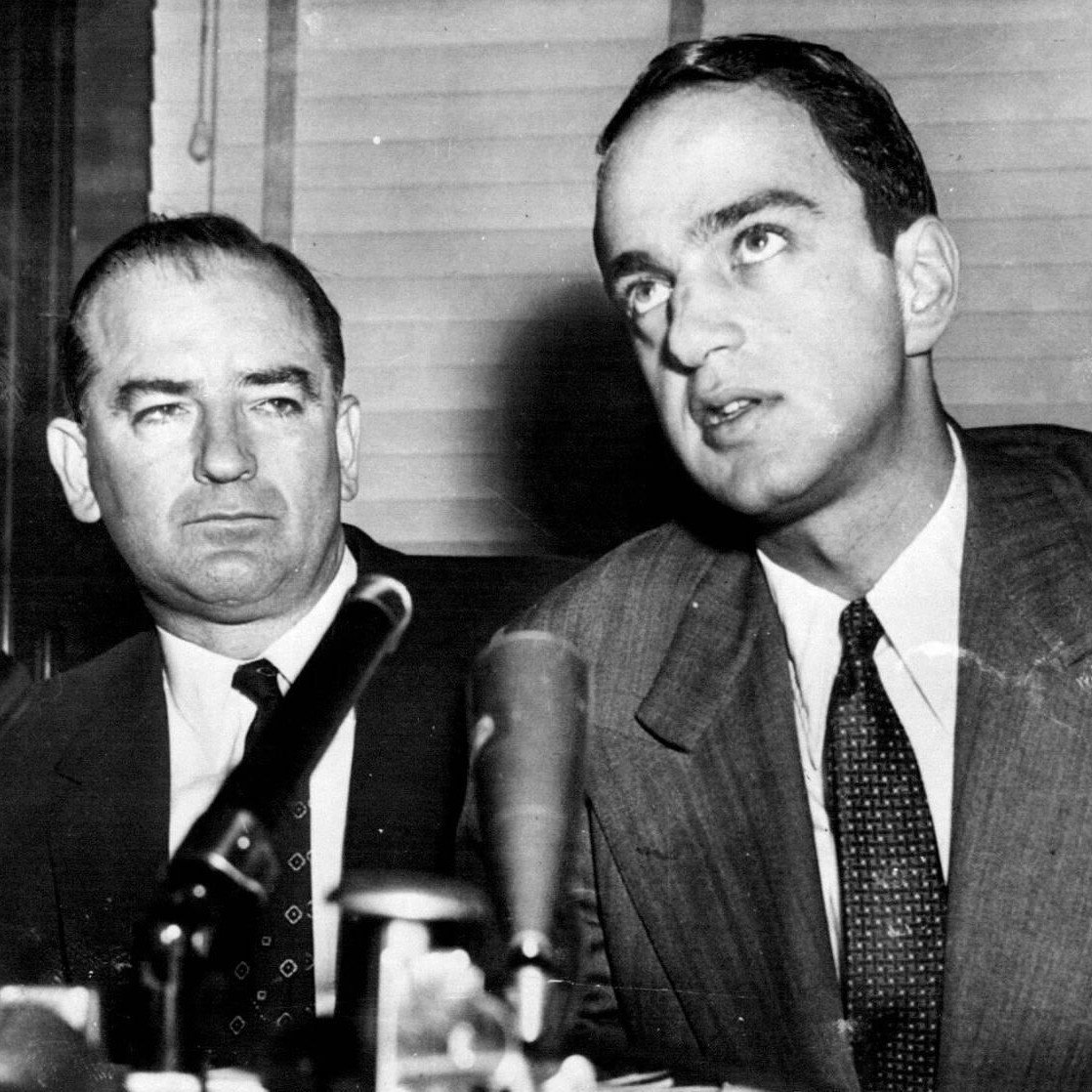
Senator Joseph McCarthy (left) and Roy Cohn at the Army-McCarthy Hearings, March 12, 1954. Photo courtesy of the Associated Press.
Last weekend some 20 million Americans were interrupted from cheering their favorite NFL football teams and eating snacks in front of the television by an ominous message from their president. In a black-and-white commercial with an edgy soundtrack and a visual of him walking towards the camera, Donald Trump is heard in a voiceover warning of a war for America’s future.
“This is the final battle,” Trump intones in an ad mirroring a commercial aired during his 2024 presidential campaign. “With you at my side we will demolish the Deep State. We will expel the warmongers from our government. We will cast out the communists, Marxists and fascists. We will throw off the sick political class that hates our country. We will rout the fake news media, and we will liberate America from these villains, once and for all.”
If roughly half the audience were surprised to find themselves accused of villainy from the presidential bully pulpit, and lumped in with “communists, Marxists and fascists,” they were likely even more astonished to learn that they had paid for the privilege with their tax dollars. In clear lettering prominently displayed at the bottom of Trump’s commercial was the tagline “Paid for by the U.S. Government.”
Much of the recent backlash to Trump’s “public service announcements” costing an estimated $20 million centered on the likelihood that they represent an illegal misuse of public funds. A federal judge has ruled that the Trump administration must end the political advertising campaign. Less remarked upon is the recent eager embrace by Trump and some of his most prominent allies, down in public opinion polling approaching a mid-term election, of the venerable “Red Scare” political playbook of tarring their political opponents as “communists,” which represents the crossing of another important norm and a significant coarsening of American politics nevertheless.
Of course, the Red Scare playbook was first perfected in the 1950s by Senator and provocateur Joseph McCarthy, R-Wisconsin, and his young chief counsel and New York lawyer Roy Cohn. Cohn would later serve as a lawyer, fixer and mentor for Donald Trump early in his career.
In a speech in 1950 with echoes in today’s political rhetoric, McCarthy warned that “Today we are engaged in a final, all-out battle between communistic atheism and Christianity. The modern champions of communism have selected this as the time. And ladies and gentlemen, the chips are down.”
McCarthy’s favored tactic was to hold up a piece of paper, often in front of cameras at hearings of the Senate Permanent Subcommittee on Investigations, and claim “I have here in my hand a list” of the names of hundreds of active members of the Communist Party and likely spies working in the U.S. federal government. The lists were not released and the number of alleged communists claimed by McCarthy constantly shifted, but just the inference that someone’s name might appear on one was enough to destroy careers and often ruin lives.
As Pulitzer-Prize winning historian Jon Meacham details in his excellent new book “The Soul of America: The Battle for Our Better Angels,” it was the darker spirits of reputational ruin that catapulted Joe McCarthy to fame and immense political power.
“McCarthy was something new in modern political life: a freelance performer who grasped what many ordinary Americans feared and who had direct access to the media of the day,” Meacham writes. “He exploited the privileges of power and prominence without regard to its responsibilities; to him politics was not about the substantive but the sensational. The country feared communism, and McCarthy knew it, and he fed those fears with years of headlines and hearings. A master of false charges, of conspiracy-tinged rhetoric, and of calculated disrespect for conventional figures, McCarthy could distract the public, play the press, and change the subject – all while keeping himself at center stage. Showcasing largely unfounded accusations of communist subversion, McCarthyism was about exaggerated threats at a time of real danger.”
Certainly, public fears of communism in the 1950s were not unfounded. Like Communist China today, the Soviet Union had acquired nuclear weapons and was building a fearsome military, it really did have spies working to uncover American secrets, and it harbored hegemonic ambitions against its democratic neighbors. McCarthy’s major talent was an instinct for tapping into those anxieties with a bombastic style that his followers loved and his foes had every reason to fear. For years that fear silenced even prominent would-be critics, even after McCarthy accused former Army General George C. Marshall, hero of World War II and the Marshall Plan, of treason.
“In the early 1950s legions of people were entranced by McCarthy’s Manichaean vision of life,” Meacham writes. “He spoke in the starkest terms, savoring superlatives. Everything was dramatic, contentious, perilous. So few things, McCarthy implied, stood between American freedom and communist slavery.”
In the end McCarthy was undone by his excesses. In a series of hearings involving McCarthy’s claims of communist infiltration of the U.S. military, the Army’s counsel Joseph Welch checked the senator for trying to impugn the loyalty-to-country of a young lawyer on his team. “Little did I dream you would be so reckless and cruel as to do injury to that lad,” said Welch. “You have done enough. Have you no sense of decency, sir, at long last? Have you left no sense of decency?”
By standing up to the demagogue, Welch clearly got the better of the televised exchange. Finally fed up with his reckless and frequently unproven charges, the U.S. Senate formally censured Joseph McCarthy later that year, finishing him politically and ending his reign of political terror. The fever that overwhelmed American politics for more than three years and produced the “Red Scare” sickness had finally broken.
A revealing postmortem of one of the darkest chapters in America’s modern history was given by Roy Cohn himself, McCarthy’s partner in communist witch hunting.
“I was fully aware of McCarthy’s faults, which were neither few nor minor,” Cohn said, as recounted in “The Soul of America. “He was impatient, overly aggressive, overly dramatic. He acted on impulse. He tended to sensationalize the evidence he had – in order to draw attention to the rock-bottom seriousness of the situation. He would neglect to do important homework and consequently would, on occasion, make challengeable statements.”
In the end McCarthy was mostly a salesman and a showman, and Cohn judged that his former boss lingered too long in the stage lights pitching his increasingly shrill story of “American peril.” “Human nature being what it is, any outstanding actor on the stage of public affairs – and especially a holder of high office – cannot remain indefinitely at the center of controversy,” said Cohn. “The public must eventually lose interest in him and his cause. And Joe McCarthy had nothing to offer but more of the same. The public sought new thrills…the surprise, the drama, were gone.”
James Kitfield is a Senior Fellow at the Center of the Study of the Presidency and Congress. He is the recipient of the National Press Club’s Edwin Hood Award for Diplomatic Correspondence, and the only three-time recipient of the Gerald R. Ford Award for Distinguished Reporting on National Defense.
CSPC in the News
Rubio Heads To NATO Allies As Russian Threat, Middle East War Shape Agenda
Published by Radio Free Europe/Radio Liberty October 5, 2026.
In an interview with Radio Free Europe/Radio Liberty, CSPC Senior Fellow Robert W. Gerber discusses the Arctic security stakes of Secretary Rubio’s visit to Iceland. He highlights Russia’s long-running pressure in the region and points to undersea cables and submarine activity as areas for closer U.S.–Iceland cooperation.
Read the full article here.