The CSPC Dispatch - Mar 27, 2026
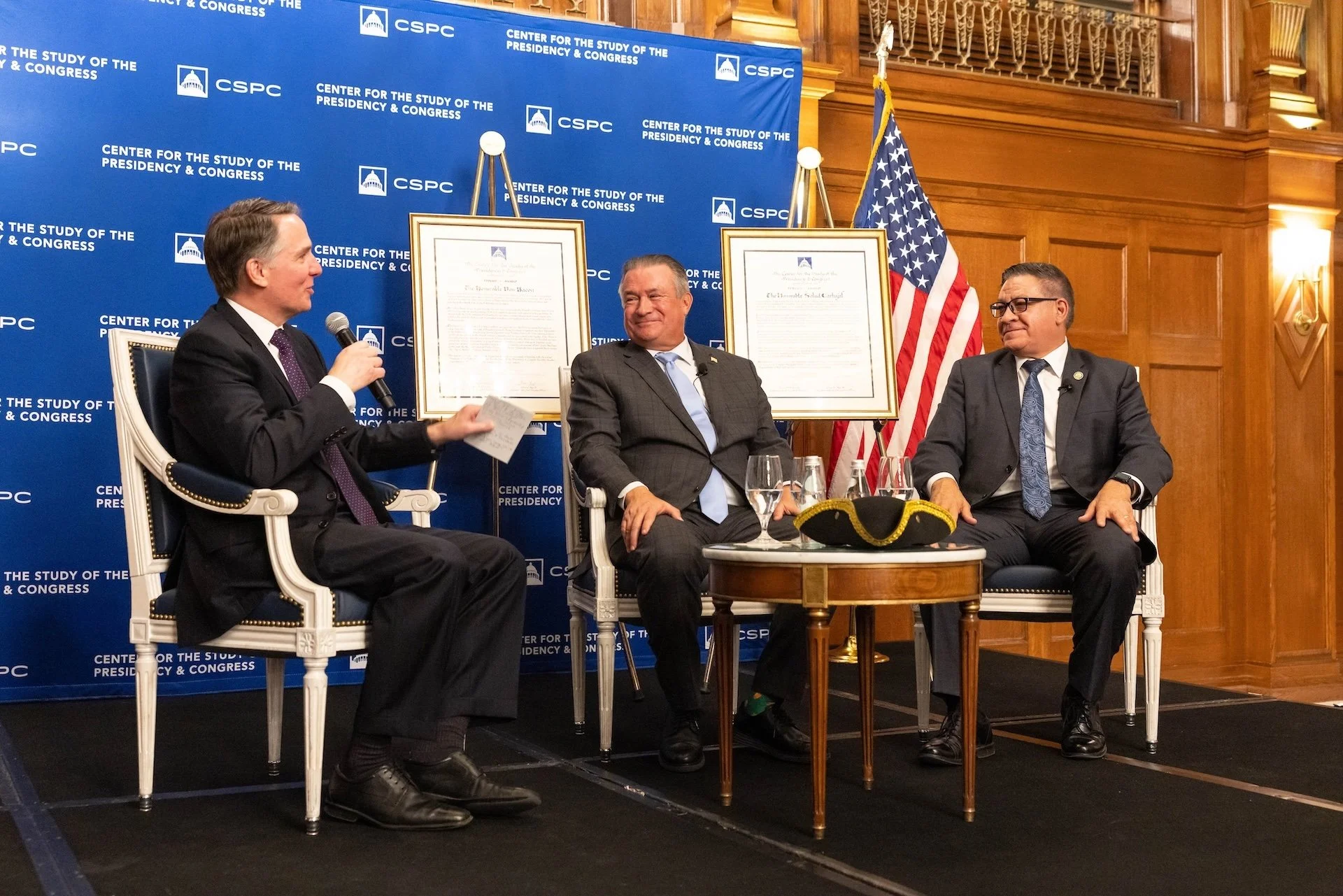
Earlier this week, the Center proudly hosted our 57th Annual Awards Dinner, honoring Representatives Don Bacon and Salud Carbajal with our Publius Award for their exemplary service and remarkable partnership across party lines. Their shared commitment to advancing U.S. national security interests, supporting the nation’s veterans, and strengthening alliances abroad reflects the very spirit of “Publius,” grounded in deliberation, compromise, and a belief in effective governance.
We were joined in celebration by members of the diplomatic community, business leaders, current and former government officials, and our own Presidential Fellows, whose presence made the evening all the more meaningful.
As we approach the 250th anniversary of the United States, moments like this serve as a powerful reminder that principled leadership and bipartisan collaboration are not only possible, but essential to the country’s future.
In this issue of the CSPC Dispatch, James Kitfield examines how the erosion of truth in modern conflict has reached a dangerous inflection point, as misinformation, political expediency, and digital amplification define warfare in the post-truth era and further erode public trust in government. Jeanne Zaino then turns inward, tracing a long but often overlooked history of structural reform efforts in American governance, revealing how generations of thinkers identified systemic flaws yet saw their proposals repeatedly ignored—leaving a legacy that resembles a graveyard of good intentions.
War in the Post-Truth Era
By James Kitfield
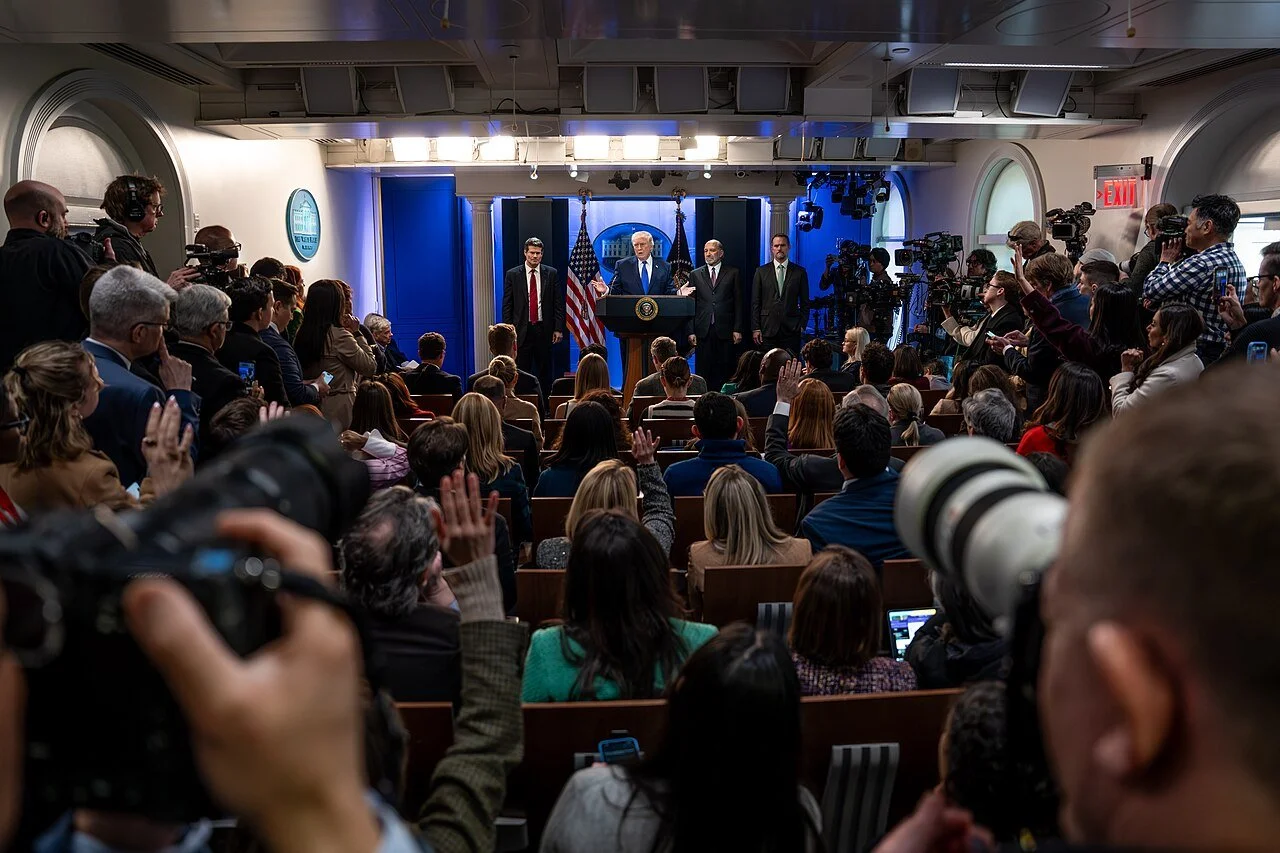
President Donald Trump delivers remarks in the James S. Brady Press Briefing Room of the White House on February 20, 2026. (Official White House Photo by Patrick B. Ruddy)
As has long been noted, the first casualty of war is truth.
In Vietnam, the Defense Department’s own history in the Pentagon Papers revealed that President Lyndon Johnson’s administration, and plenty of its top military commanders, purposely misled Congress and the public about progress in the war. History has not forgotten commanding General William Westmoreland assuring the country that the North Vietnamese army and Viet Cong insurgents were all but defeated and the “end [of the war] was in sight” in late 1967, just months before the Tet Offensive revealed the bloody reality. Nor has it forgotten President George W. Bush and top administration officials conjuring misleading images of nuclear “mushroom clouds” associated with Saddam Hussein’s nonexistent stockpiles of weapons of mass destruction to justify a preemptive war-of-choice in Iraq in 2003. For many months President Joe Biden and his administration denied mounting evidence that their complete withdrawal of U.S forces from Afghanistan would result in a return of the Taliban, until a chaotic U.S. retreat and ignominious defeat for the U.S.-backed Afghan government befell the country in August 2021.
In each of those instances, fabrications, falsehoods, and willful ignorance left an indelible stain on presidential legacies and led to a pronounced decrease in public trust in the U.S. government, as well as a growing cynicism in the electorate that has helped fuel our current hyper-polarized politics. Consider that since the start of the Iraq War in 2003 each Gallop poll inquiring about the country’s direction has shown that a majority of the public remains dissatisfied with it.
America’s current war in Iran doubles down on that record of perfidy, with President Donald Trump and his administration raising the question of what the public is supposed to believe when the commander-in-chief continually proves himself an unreliable narrator in matters as serious as war and peace, life and death?
In announcing the conflict Trump repeated the false claim that U.S. attacks last summer “obliterated” Iran’s nuclear program, for instance, yet he has cited that program to paint Tehran as an imminent threat. That claim was subsequently rejected by his own counterterrorism chief, who in his recent resignation letter wrote that “Iran posed no imminent threat to our nation.”
Not to be outdone in offering conflicting narratives to justify the war, Secretary of State and National Security Adviser Marco Rubio initially claimed the United States attacked Iran “proactively in a defensive way” based on the assumption it would strike U.S. forces in the region after Israel began its own imminent attack. Rubio reversed himself the next day, publicly playing down Israel’s role in prompting the strikes.
During Trump’s first term, when the Washington Post fact checker counted more than 30,000 false or misleading claims by the president, Oxford Dictionaries began referring to the phrase “post truth politics” (which it named Word of the Year in 2016). Trump casually shrugged it all off as “fake news.”
Today the Washington Post has stopped even bothering to fact-check the president’s false and misleading statements, and America is confronting the first major war of the post-truth era. And oh, what a tangled web has been weaved now that the stakes are existential. Trump recently claimed that a strike on an elementary school during the first hours of the war that killed roughly 175 people, most of them children, “was done by Iran.” That is before the U.S. military investigated and initially concluded that an errant American Tomahawk missile was most likely to blame. The commander-in-chief has also recently claimed that U.S. forces have “destroyed 100% of Iran’s Military capability, ” and “good” and “productive talks” with Iranian officials are ongoing to end the conflict, even as Iran denies talks are even taking place, the conflict continues to rage with military strikes from both sides, and the administration mobilizes additional reinforcements to deploy to the region. So it goes when there are unreliable narrators on both sides of a conflict.
When apparently fake videos depicting a U.S. aircraft carrier burning in the ocean appeared online, Trump naturally blamed “Iran, working in close coordination with the Fake News Media,” while offering no proof or even evidence of such collusion. Nevertheless, he insisted on social media that “those Media Outlets that generated it should be brought up on Charges for TREASON for the dissemination of false information”.
In this post-truth era, citizens increasingly receive their news through social media streams polluted by deliberate disinformation and propaganda designed to “influence public opinion, undermine the truth, and sow discord,” according to a 2024 United Nations Global Risk Report that ranks mis- and disinformation as top global threats. The authors estimate that disinformation typically spreads six times faster on social media than the truth, it accelerates instability and the erosion of democratic processes potentially leading to violence, and the corruption is about to get a lot worse as Artificial Intelligence and realistic “deep fakes” accelerate the distortion of fact-based reality.
Despite that flood of disinformation, war has a way of stripping away the varnish of convenient falsehoods to reveal the hard truths that lie beneath. Leaders with an eye on their legacy should be sobered by the knowledge that history has a long memory, and no one should ever be asked to fight, let alone die, for a lie.
James Kitfield is a Senior Fellow at the Center for the Study of the Presidency & Congress, and a three-time recipient of the Gerald R. Ford Award for Distinguished Reporting on National Defense.
At 250, Graveyard of Good Intentions: A Brief Look at the History of American Structural Reform
By Jeanne Zaino
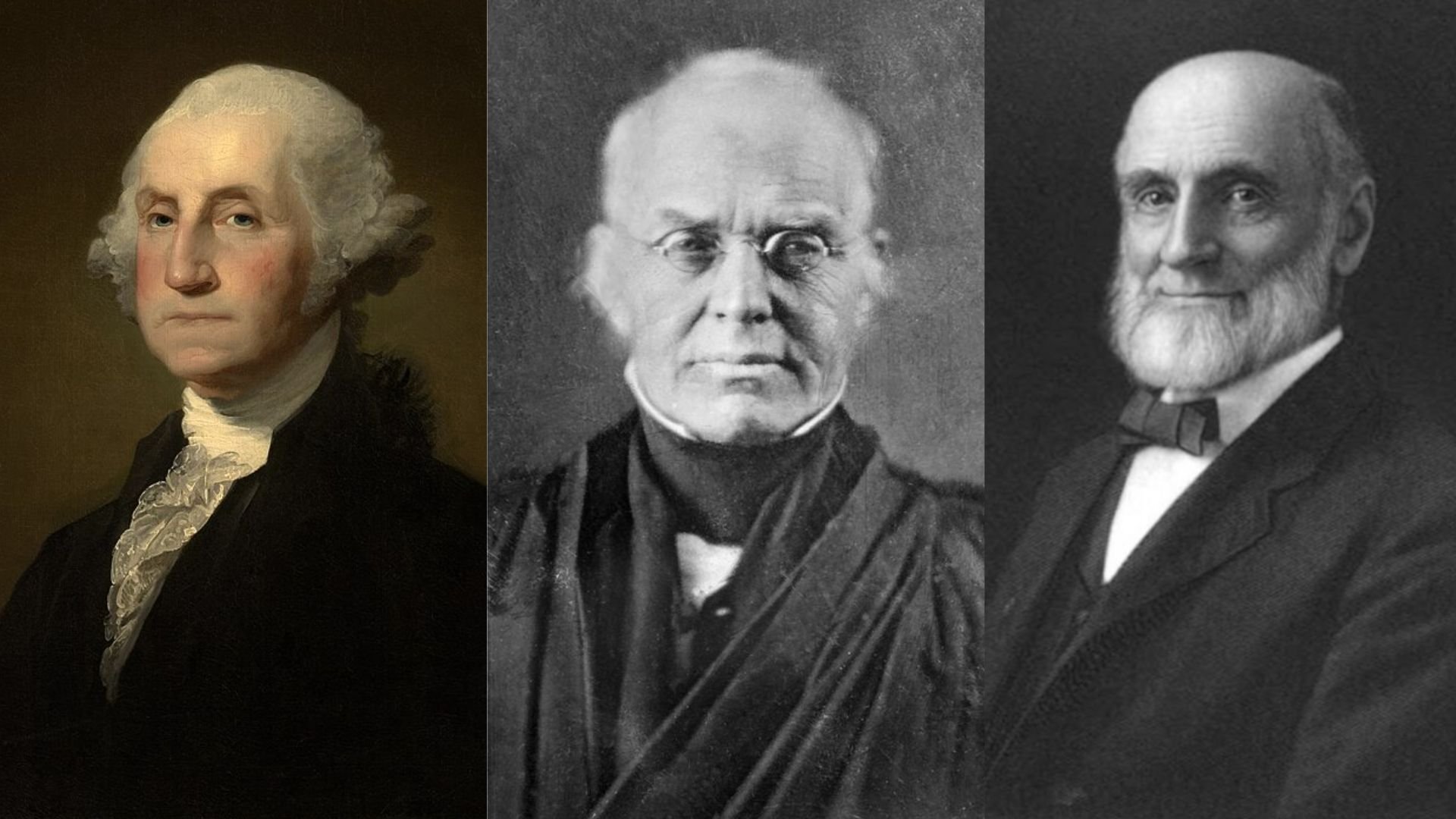
George Washington (1732–99), Supreme Court Justice Joseph Story (1779–1845), and Gamaliel Bradford (1831–1911).
As we celebrate 250 years of American Independence, this series of essays in CPSC’s Dispatch, beginning last July, have been devoted to making the case that well-thought out, peaceful revision is the only way we can ensure the system lasts another 250 years.
During a year devoted to celebrations, ‘reform-talk’ can be difficult because it demands acknowledgement that all is not well and there is work to be done. Moreover, it requires that we collectively accept that for all the achievements of the Framers, the system they created was far from perfect.
Often this suggestion is met with pushback from those who suggest it is unpatriotic. As I noted in the first piece in this series, “Honoring the Framers Means Reverence & Reform,” nothing can be further from the truth. To a one, the Framers agreed with Alexander Hamilton’s argument in the final Federalist Paper, #85, that he never expected “to see a perfect work from imperfect man.”
George Washington echoed this in a letter to his nephew, Bushrod Washington, in 1783:
“The warmest friends to and the best supporters of the
Constitution, do not contend that it is free from imperfections;
but these were not to be avoided, and they are convinced if
evils are likely to flow from them, that the remedy must come
thereafter.”
Both not only acknowledged the imperfections in the original constitution, but the fact that the remedies “must come thereafter” and at the hands of those to whom they left this experiment in governance.
The Framers may have been the original proponents of reform in the “thereafter,” but they were not alone. As the Founding period receded from memory, a new generation of thinkers came to the forward to claim this mantle.
I will devote the next few pieces in this series to these advocates of reform, many of whom toiled in the shadows, away from public view, even though their work on reimagining and revitalizing the system, is among the most important and impactful in our nations history.
Amongst the most well-known of this early (i.e. pre-Reconstruction) reformers was Supreme Court Justice Joseph Story. His book, Commentaries on the Constitution of the United States, is devoted to constitutional critique, change and adaptation. Story was the first of many American reformers to argue that the greatest challenge facing the system was the strict division between the executive and legislative branches which makes accountability and responsiveness difficult.
This is why he was so troubled by the ‘Ineligibility or Emoluments Clause’ (Article I, Section 6, Clause 2) which barred members of the Executive or Judiciary from serving in Congress, and vice-versa. As he wrote, the clause “does not appear to have met with any opposition in the Convention” but it should have because as a result,
“the executive is compelled to resort to secret and
unseen influence, to private interviews, and private
arrangements, to accomplish its own appropriate
purposes; …One consequence of this state of things is,
that there never can be traced home to the executive any
responsibility for the measures, which are planned, and
carried at its suggestion….If corruption ever eats its way
silently into the vitals of this republic, it will be, because
the people are unable to bring responsibility home to the
executive through his chosen ministers.”
By way of a remedy, Story proposed allowing Cabinet members to serve in or appear before Congress.
This idea was later taken up by George H. Pendelton who introduced a bill in Congress in the second half of the 1800s, advocating in favor of allowing certain members of the cabinet to occupy seats in Congress and participate in debate on matters relevant to their departments.
Several years later, Gamaliel Bradford addressed Pendelton’s bill in the Annals of the American Academy noting how mystifying it was that both the bill itself and the report that accompanied it were largely ignored by Congress.
“It seems somewhat strange that a measure thus
unanimously endorsed by a committee of both
parties, presenting advantages so obvious, and with so
complete a demonstration of its accordance with the constitution
should never since have received the slightest attention from
either the House of Congress, or from the executive.”
Strange as it may have seemed to Bradford, the fate of the bill of which he was writing (Senate Bill 227) has been the fate of many of the most promising structural reform proposals – statute, amendment, or otherwise; a reality that helps explain why the system today is less secure and certain to survive another 250 years than it should be.
Jeanne Sheehan Zaino is professor of Political Science, Senior Democracy Fellow at the Center for the Study of the Presidency & Congress and Visiting Democracy Fellow at the Ash Center for Democratic Governance and Innovation, Harvard Kennedy School. This piece draws on themes in her latest book, American Democracy in Crisis (Palgrave, 2025), and her Substack newsletter, The New Realist. It is the eighth in a series on reform marking America’s Semiquincentennial.
CSPC IN THE NEWS
Joshua Huminski on Britain and the Trump Corollary
Published on March 26, 2026.
In Britain’s World, Joshua Huminski explores how the UK should navigate the “Trump corollary” to the Monroe Doctrine, suggesting it “keep calm and carry on” while aligning its national interests with an increasingly mercurial Washington.
Read the full article here.
Letter to Editor: Glenn Nye on Neutralizing the Fringe to Help Congress
Published on March 16, 2026.
In a letter published today in The Virginian-Pilot, CSPC President & CEO Glenn Nye responds to the paper’s recent editorial on Congress reasserting its constitutional role. Drawing on his experience representing Virginia’s 2nd District in Congress, he notes that political incentives in the current system—particularly low-turnout primaries—often empower partisan fringes and make bipartisan cooperation more difficult.
Read the full article here.
Robert Gerber on U.S. Diplomacy at the Top Of The World & Greenland’s Future
Published on February 28, 2026.
In an interview with Overt Defense, CSPC Senior Fellow Robert W. Gerber explores Greenland’s growing strategic importance amid rising great power competition in the Arctic. He highlights the island’s geopolitical value, resource potential, and the complexities of U.S.–Greenland relations as global interest in the region intensifies.
Read the full interview here.