The CSPC Dispatch - April 10, 2026
Welcome to the CSPC Dispatch.
In this issue, Robert W. Gerber examines how rising corruption in the United States is undermining economic competitiveness, eroding public trust, and weakening the institutional guardrails necessary to sustain effective governance at home and leadership abroad. Victoria Flick then turns to the international stage, exploring how the war in Iran is exposing deepening fractures within NATO, as diverging expectations of U.S. leadership, allied obligations, and the alliance’s strategic purpose test the credibility of the transatlantic partnership.
Tackling Corruption to Preserve Competitiveness, Prosperity, and Trust In Government
By Robert W. Gerber
“The time to guard against corruption and tyranny, is before they shall have gotten hold of us.”- Thomas Jefferson, Notes on the State of Virginia II, 1782-1786.
From the early days, the founders were deeply concerned about all the ways that corruption—exploiting public position for private gain—could undermine the union. As we approach the nation’s 250th anniversary, this is an opportunity to reassess their warnings and consider what can be done today.
The United States fell to its lowest score ever on the 2025 Corruption Perception Index (CPI), which is published by Germany-based NGO Transparency International. Over a period of four years, the U.S. ranking fell from 24th least corrupt to 29th among 187 countries. Global corruption is also trending upward, according to the report. The CPI cited permissive U.S. campaign finance rules and eroding judicial independence as factors in the U.S. score. These results may not surprise avid news readers. In the 2024 presidential race, conservative media outlets put a spotlight on stories that Biden family members might have profited from Joe Biden’s presidency. Biden’s pre-emptive pardoning of family members on his final day in office affirmed these concerns for many voters. In his first term, President Donald Trump faced several lawsuits alleging that he had violated the Constitution’s Foreign Emoluments Clause but the cases did not end in a judgment against the President. In 2025, Forbes magazine commented that, “No president in U.S. history has used his position of power to profit as immensely as Trump,” citing foreign investments in his family’s cryptocurrency businesses and new real estate licensing deals signed with government-affiliated entities in Saudi Arabia, India, and the Gulf States. While Presidents are not subject to most government ethics rules, Senate Finance Committee Democrats are currently investigating whether the President’s son in law Jared Kushner has solicitated foreign investments for his private corporation while traveling on official government business and negotiating on behalf of the United States. Watchdog organizations were alarmed that early in his second term, President Trump eliminated inspector generals across most government agencies. The Department of Homeland Security’s Inspector General is, however, probing a no-bid $200 million contract that former Secretary of Homeland Security Kristi Noem reportedly awarded to a family connection.
Instances of federal officials exploiting their public positions for private gain would likely anger but not surprise the founders, who thought extensively about the need for competing institutions to hold such ambitions in check—not only among the Executive, Legislative and Judicial branches but also among federal, state, and local governments. But Congress has its own corruption problems, stemming in part from the ability of Members to trade individual corporate stocks with few barriers even when members’ legislative powers and access to information bear directly on stock values.
Why does corruption matter? Public officials risk long term damage to the U.S. economy when they fail to maintain guardrails against corruption – the same guardrails the United States has promoted overseas for a generation. Furthermore, perceptions of corruption erode public trust and participation in government. These represent political liabilities for elected leaders, and strategic vulnerabilities for the nation.
Global Competitiveness: The United States has often been a leader in – and beneficiary of – global anti-corruption efforts. The Foreign Corrupt Practices Act (FCPA), signed into law in 1977, was a groundbreaking measure that created consequences for domestic and foreign companies listed on U.S. stock exchanges that are found to have bribed officials in exchange for preferential treatment. The FCPA inspired a number of major economies to adopt similar laws and led to the OECD Anti-Bribery Convention, which Congress ratified in 1999. The convention states that “all countries share a responsibility to combat bribery in international business transactions.” Nevertheless, the Trump Administration has narrowed enforcement of FCPA on the grounds that it disadvantages U.S. companies in international transactions. However, most recent FCPA enforcement actions have been against foreign firms. In the 2010s, both Boeing and GE urged stricter enforcement of the FCPA to help ensure a level playing field for global procurement opportunities and to protect the reputation of all American companies. Throughout modern history U.S. Embassies have been tasked with urging foreign governments to maintain protections against corruption, as this activity aligned with U.S. national interests. These could include laws formalizing anti-corruption norms, transparency rules, hiring of special prosecutors, or raising government wages to discourage bribery. President George W. Bush once said, “the culture of corruption…impedes our efforts to promote freedom and democracy, end poverty, and combat international crime and terrorism.”
Domestic Prosperity: According to the OECD, bribery “undermines good governance and economic development, and distorts international competitive conditions.” Corruption also undermines markets and creates inefficient allocation of capital, which diminishes overall societal wealth. Corruption within the financial sector can cause disastrous economic effects. For example, insider deals and a general abuse of financial sector integrity contributed to Iceland’s 2008 financial crisis, which produced an economic recession and prison sentences for 25 bankers.
Trust in government: Corruption breaches the “social contract,” i.e., the acceptance of the government by the governed. Research by the University of California at San Diego found that “public exposure to reports of Congressional stock trading significantly reduced Americans’ trust in Congress and their willingness to comply with the law — regardless of political affiliation." This loss of trust and legitimacy undermines Congress’ role in providing needed oversight.
Recommendations:
Congress can take steps to address their own appearance of corruption to give themselves more legitimacy to enforce Constitutional guardrails on executive branch activities. There is bipartisan legislation in Congress to ban Members’ stock trading of individual companies. Senate and House Members have introduced legislation to ban public officials from trading in “predictive markets” after a Polymarket account user profited from bets made on U.S. government actions against the Maduro regime in Venezuela.
The Department of Justice and the Securities and Exchange Commission and inspectors general across Executive Branch agencies should be fully resourced and empowered to enforce U.S. laws against corruption.
Success also depends on the U.S. business community holding themselves to the highest anti-corruption standards - as many have done with net zero pledges or preventing forced labor - and leveraging what Deputy Secretary of State Christopher Landau recently called the “incredible transformative potential” of U.S. private enterprise. The “Principles on Combatting Corruption,” published in 2019 by the International Chamber of Commerce and the Center for International Private Enterprise, offer a useful roadmap for companies to avoid bribery, extortion or solicitation, trading in influence, fraud, and money laundering.
Voters and consumers also have a key role to play in demanding that their representatives and the companies they deal with adhere to anti-corruption norms.
Robert W. Gerber is a retired U.S. diplomat and a CSPC Senior Fellow.
When Article 5 becomes a Question Mark
By Victoria Flick
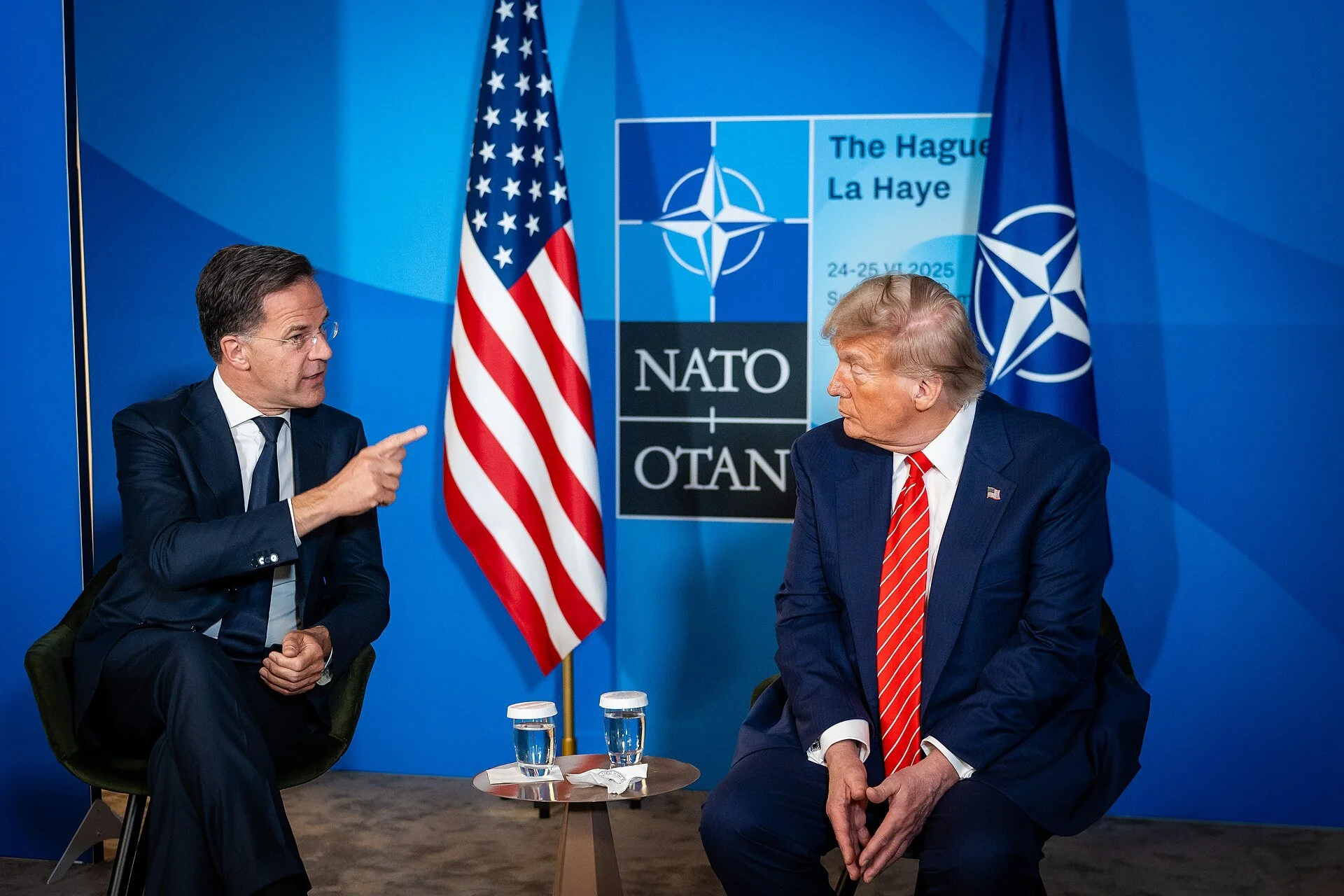
NATO Secretary General Mark Rutte speaks with president of the United States of America at the NATO Summit in The Hague.
Six weeks after the Iran war began on February 28, 2026, its global consequences are becoming impossible to ignore. With the Strait of Hormuz effectively blocked and energy prices surging worldwide, the conflict is no longer confined to the Middle East. A fragile two-week ceasefire and ongoing U.S.-Iran talks have done little to stabilize an increasingly volatile situation that continues to draw in new actors. Yet beyond its economic and geopolitical fallout, the war is exposing something deeper: the growing uncertainty surrounding not only the effectiveness, but the very cohesion, of the North Atlantic Treaty Organization (NATO) in an era shaped by renewed questions about U.S. leadership and allied trust.
While NATO is not formally entering the war, the conflict is still becoming a major test of transatlantic trust, burden-sharing, and strategic alignment. NATO officials have backed the goal of preventing Iran from acquiring nuclear weapons and have responded defensively when an ally was threatened, but they have also made clear that NATO is not joining the war (Reuters, March 2, 2026). President Trump does not see eye to eye with this decision and has grown increasingly frustrated with NATO and Europe over this decision. NATO’s inaction in the Iran war has led Secretary of State, Marco Rubio to echo President Trump’s stance, stating that the United States will reassess its relationship with NATO after the war concludes, while U.S. Ambassador to NATO Matthew Whitaker confirmed that Washington is already reevaluating its membership (The Hill, April 5, 2026). Moreover, in Washington, alliance solidarity is increasingly interpreted in global terms, if the United States acts, allies should follow. In European capitals, NATO remains what it was designed to be: a geographically bounded, defensive alliance. The Iran war has made that divergence impossible to ignore.
In order to understand why there is such a misalignment between the United States and other NATO members, it is important to look at President Trump’s (oftentimes troubled) relationship with the alliance from the very beginning. Since his first term in 2017, President Trump has raised awareness of the lack of defense spending by other NATO countries which once again elevated the issue of “burden sharing”. In 2014, at the Wales summit, NATO countries had agreed to each spend 2% of their GDP on their defense budget by 2024. Eleven years later, at the 2025 Davos summit, President Trump unilaterally increased this 2% guideline to a mandatory defense spending of 5% per country (though 1.5% of this could be on security-related spending). This new level was formalized at the NATO summit in The Hague in June 2025. As of April 2026, none of the NATO countries are spending 5% (with the United States itself spending “only”around 3% of its GDP on defense) and all 32 countries are spending 2% or more of their GDP on defense (Atlantic Council). This constitutes a considerable increase from just six countries meeting the 2% target in 2021, however, not enough to make President Trump value the alliance.
European leaders have struggled to present a unified response to the war in Iran, instead adopting a range of differing positions. The United Kingdom initially restricted the United States from using its Diego Garcia military base, but has since shifted toward providing defensive support in the Middle East. France has emphasized the need to remain within the bounds of international law while still deploying military assets to safeguard its interests in the region. Meanwhile, Germany’s Friedrich Merz has been notably reluctant to criticize Washington’s conduct, stressing that Iran poses a significant security threat and signaling that Berlin remains broadly aligned with the United States (Council on Foreign Relations, March 6, 2026).
In particular, the refusal by some European allies to grant the United States access to key basing rights has drawn sharp criticism from the Trump administration and reignited questions about NATO’s relevance to U.S. strategic interests, both now and in the future. At the same time, President Donald Trump’s repeated doubts about the United States’ commitment to Article 5 have deepened uncertainty within the alliance, placing its credibility under renewed strain. NATO’s power has always rested less on military capability than on political certainty. When Donald Trump openly questions the United States’ commitment to Article 5, he does not dismantle the alliance, but he weakens the very foundation that made it an effective deterrent. Alliances do not fail only when they collapse, they fail when they become uncertain. Once adversaries begin to question whether the United States would honor its commitments, and once allies begin to ask the same question, the deterrent value of the alliance begins to erode long before any formal rupture occurs.
Moreover, repeated threats by President Donald Trump to pursue control over Greenland have further strained transatlantic relations, deepening European concerns about the reliability of U.S. leadership within NATO. As a territory of Denmark (itself a NATO member) such rhetoric has been perceived not merely as unconventional, but as fundamentally at odds with the alliance’s core principle of mutual respect for sovereignty.
NATO’s only direct involvement in the conflict came in early March, when an Iranian ballistic missile was intercepted over Turkish territory. Following the incident, NATO Secretary General Mark Rutte praised the actions of Supreme Allied Command Europe and reaffirmed the alliance’s commitment to monitoring the situation and defending its members (NATO Statement, March 5, 2026). Beyond this defensive response, however, the broader European reaction to the U.S. and Israeli war against Iran has remained deeply divided. The European Union (EU) has once again struggled to articulate a unified strategy, underscoring the persistent gap between Europe’s potential influence on the global stage and its ability to act cohesively in moments of crisis.
What the Iran war has shown is the dramatic misalignment between how the United States under President Trump views NATO and its obligations, and those of actual NATO countries, who perceive these to be very different. This divergence is not merely strategic, it is existential. Alliances rely on shared expectations, and when those expectations fracture, the alliance may persist institutionally while weakening functionally. In the bigger picture, the war may accelerate a redefinition of U.S.-NATO relations around burden-sharing, regional responsibility, and the question of whether NATO is a strictly Euro-Atlantic defense pact or a more flexible instrument of American power.
This week’s visit by NATO Secretary General Mark Rutte to the White House on April 8 comes at a crucial time in U.S.-NATO relations. Long regarded as one of Europe’s most effective diplomats, and a rare figure able to find common ground with President Donald Trump, Rutte now faces a far more difficult task: bridging a widening transatlantic divide at a moment of crisis (The Hill, April 8, 2026). After the meeting, Rutte reported that the president was “clearly disappointed” (The Washington Post, April 8, 2026) with the alliance and the allies refusal to get involved in Iran, especially with helping to secure the strait of Hormuz. In posts following the meeting, President Donald Trump argued that NATO allies had abandoned the United States and once again revived his ambition to take control of Greenland—a move likely to deepen tensions and draw sharp criticism from European partners. However, Trump did not take any radical actions, such as announcing the U.S.-withdrawal from the alliance, as many had feared. Nevertheless, while the alliance may endure institutionally, without renewed trust between Washington and its European partners, its role as a credible and unified force risks slipping further into question.
Victoria Flick is a Research Fellow at the Center for the Study of the Presidency & Congress.
CSPC IN THE NEWS
Bravado Isn’t a Strategy: Why the Iran War Has No Endgame
Published on March 19, 2026.
In The Fulcrum, CSPC Senior Fellow Jeanne Zaino argues that the Iran War demonstrates how overwhelming military force without a coherent political strategy or plausible endgame leads to prolonged conflict, limited gains, and no clear path to victory.
Read the full article here.
Joshua Huminski Hosts Anthony Vinci on Coffee & Conflict
Released on April 2, 2026.
SVP Joshua Huminski is joined by Anthony Vinci, author of The Fourth Intelligence Revolution, to explore how intelligence is rapidly expanding beyond government into everyday life, examining how AI, data, and global competition are reshaping espionage—and questioning whether U.S. institutions are equipped for this new, blurred landscape.
Read the full article here.