The CSPC Dispatch - Mar 13, 2026
In this issue, Robert W. Gerber explores why, despite withdrawing from many international organizations, the Trump administration has maintained U.S. support for the World Bank and International Monetary Fund, institutions that continue to serve as instruments of American economic influence and strategic competition. Kate Pintarelli examines the administration’s tightening pressure campaign against Cuba, where an oil blockade and economic coercion are aimed at forcing political change while intensifying hardship for ordinary Cubans and raising the geopolitical stakes in the Caribbean.
U.S. Multilateralism Lives on at the World Bank and IMF
By Robert W. Gerber
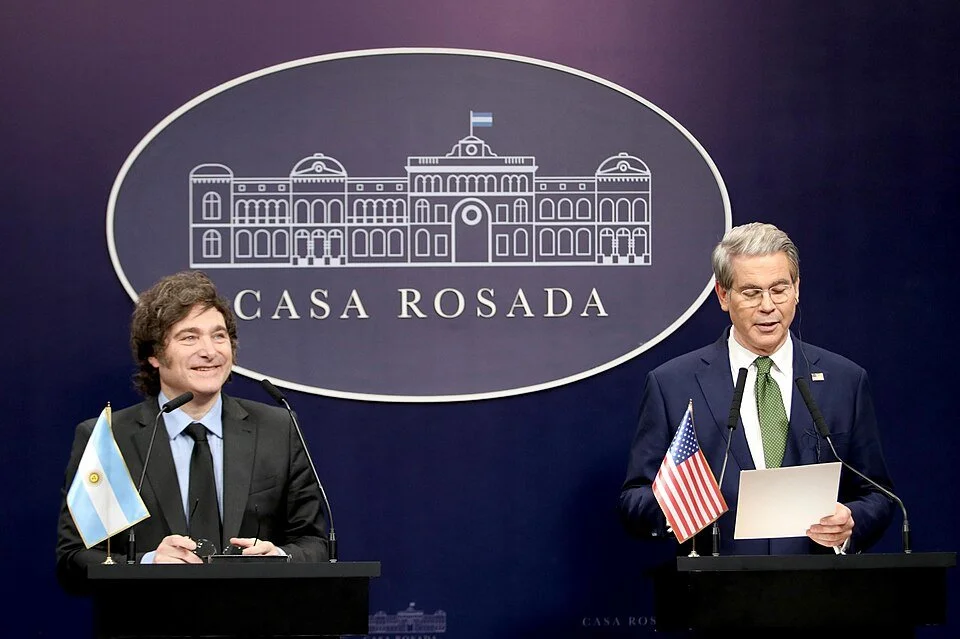
US Treasury Secretary Scott Bessent with Argentinian President Javier Milei on April 15, 2025. (Phil Roeder, CC BY 2.5 AR)
Buffalo wings and beer go well together. “America First” and multilateralism do not pair as well. It was no surprise that in one of the first acts of its second term, the President Trump began the process of withdrawing the United States from 60+ international organizations, including the World Health Organization and UNESCO, on the grounds that they undermined U.S. interests of sovereignty. During a press availability on the U.S.-Israel war against Iran, Secretary of Defense Pete Hegseth said that the United States would act “regardless of what so-called international organizations say.” On the economic front, most trade lawyers would agree that the Trump Administration’s “reciprocal trade” tariff initiative conflicts with basic World Trade Organization principles.
However, U.S. multilateralism is alive in the form of U.S. support for the World Bank and International Monetary Fund (IMF). Why is this, and will it last? Secretary of Treasury Scott Bessent told an audience of financiers last Spring, “I wish to be clear: America First does not mean America alone. To the contrary, it is a call for deeper collaboration and mutual respect among trade partners.” He has kept the United States in the World Bank Group and the International Monetary Fund and maintained U.S. contributions at 80% of Biden Administration funding levels. This support for global development assistance is remarkable when viewed in the context of the Administration’s decimation of bilateral aid programs.
Also notable is that “Project 2025,” the Heritage Foundation paper which has served as a guidebook for many Trump 2.0 policies, called on the U.S. government to withdraw from the World Bank and the IMF. Project 2025 authors labeled these organizations as “expensive middlemen” and wrote that “International organizations such as the OECD, the World Bank, and the International Monetary Fund espouse economic theories and policies that are inimical to American free market and limited government principles.”
The World Bank and IMF emerged from the 1944 Bretton Woods Conference to help bring stability to a war-ravaged world. The IMF and World Bank are both headquartered in Washington DC, which benefits the United States even though foreign representatives pay no taxes here. (District residents who have to suffer road closings every year during the “Bank/Fund Spring Meetings” might have a different opinion.) Historically, the United States has used its leverage as the largest shareholder at these organizations to bolster its own foreign policy interests and to foster institutional reforms and policy changes. This has also been the case under the second Trump Administration. The United States has declared that the Bank should focus on its “core missions” and increase its efficiency and effectiveness. The European Council on Foreign Relations said – rather skeptically – that the U.S. definition of core missions would equate to “…U.S. interests rather than action on global challenges like climate change, health, and development. European governments on the other hand see progress on these issues as essential for global stability.” So far, the reality has been more nuanced. The United States has managed to consolidate the Bank’s climate and gender programs into one office, but it has not eliminated these programs. In contrast to U.S. government websites, the Bank still features publications with climate references. For example, the April 2025 State of Social Protection Report notes that, “Strong global headwinds from climate change, food insecurity, conflict, and displacement challenges are picking up force, driving up levels of poverty and vulnerability and heightening demand for social protection and labor market programs.”
In addition to being the largest shareholder, the United States also has the privilege of nominating an American for World Bank Group president (a European gets to run the IMF).Former Mastercard CEO Ajay Banga currently holds the Bank presidency. President Joe Biden nominated Mr. Banga for a five-year term that ends in 2028. President Trump has not tried to remove Mr. Banga, which is notable given the dismissal of most other Biden-nominated officialsin that served in Washington and overseas. In fact, Trump nominated Mr. Banga to serve on his“Board of Peace” executive board.
The United States is represented at the World Bank by the U.S. Executive Director, who represents the United States on the Board of Directors of the World Bank Group, and serves under the Secretary of Treasury’s Office of International Affairs. The current Executive Director is Peter Wisner, a Senate-confirmed Treasury Department civil servant who previously served as Senior Advisor to the Executive Director – also under President Biden.
Bessent has said the institutions perform critical roles in the international system. He signaled he wants to see the WB/IMF increase pressure on China’s trade surpluses and eliminate its developing country status. He also wants the Bank to de-prioritize debt forgiveness and called on the IMF to emphasize its economic surveillance programs. Bessent clearly sees the World Bank and IMF as providing a counterweight to Chinese global economic influence. One of the PRC’s influence tools is the Asian Infrastructure Investment Bank (AIIB), which is headquartered in Beijing and competes with the World Bank.
Will the Trump Administration use the World Bank Group ($1.1 trillion in available funds) and IMF (with $1 trillion at its disposal) more rigorously as a tool for its unilateral transactional foreign policy, like supporting Argentina or pressuring Brazil? Probably so. The IMF recently announced a $20 billion debt relief package for Argentina, which helps Argentine PresidentJavier Milei, a Trump political ally.
And yet, there could be conflict ahead. In April, the IMF will issue a report on the impact of the war against Iran on the global economy. Earlier this year, IMF President Kristalina Georgieva praised America’s economic strength and forecasted continued growth this year and “positive spillover effects” for the global economy. She cited the strong performance of the U.S. private sector but also warned that the federal government’s budget deficit and tariff policies created headwinds to economic growth. Since then, the IMF has noted that the war against Iran has created “disruptions to trade and economic activity, surges in energy prices, and volatility in financial markets.” If the IMF issues a dourer forecast, Ms. Georgieva could incur the ire of President Trump.
As a developer, Trump knows the value of having an initial big-name investor, i.e., the United States, mitigate project risk and “crowd in” other investments. In this regard, he may see the Bank (or the IMF) as a kind of slush fund where U.S. contributions can leverage far greater commitments from other members for reconstruction projects in places like Gaza, Iran, or Venezuela. How the World Bank will compete with–or compliment–the President’s newly created “Board of Peace” is another question entirely. Furthermore, it is fair to ask how World Bank members would react if Trump tries to steer the intuition’s contracts toward U.S. companies that are linked to Trump Administration officials, which has reportedly happened under the Trump Administration?
As Trump faces budget pressures from the Iran war, the “Golden Dome” missile shield project, and other extraordinary expenditures, it will be tempting to say, “let’s get the World Bank/IMF to pay for it.” Will other members go along in the interest of preserving the institutions, or to position themselves favorably with the Trump Administration? We will know more about U.S. intentions when Bessent speaks at the Bank/Fund meetings in April and learn more about member reactions in the following months.
Robert W. Gerber is a retired U.S. diplomat and a CSPC Senior Fellow.
America’s Tightening Grip on Cuba
By Kate Pintarelli
President Donald Trump ran in 2024 on keeping the United States out of unpopular “forever wars,” but since taking office he has leaned heavily into using the U.S. military to target countries he sees as challenging the security interests of the United States. In the past year, Trump has ordered military operations in Iraq, Nigeria, Somalia, Syria, Yemen and Iran. He has also attacked alleged drug boats in the Caribbean, killing more than one hundred alleged drug runners, and notably bombed Venezuela earlier this year and imprisoned the country’s leader, Nicolas Maduro. Even as the U.S. military continues its widespread attack on Iran in recent weeks, it has also continued a naval blockade of oil to Cuba. The goal appears to be encouraging political change in the communist run country.
In placing the oil blockade on Cuba, the administration has cited its close ties to Iran, Russia, and China. Cuba had previously relied heavily on oil shipments from Venezuela. However, since Nicolás Maduro’s removal, these oil transfers have stopped. From late 2024 to late 2025, Venezuela sent Cuba 70,000 barrels per day of crude oil and refined products worth as much as $1.3 billion.
The United States has also threatened a 10% increase in tariffs on products entering the United States from any country that sent oil to Cuba, which is meant to discourage all oil transfers. Mexico stopped sending oil to Cuba because of the administration’s threats, leaving many Cubans suffering amid an economic crisis. President Trump has stated, “I’m very interested in the people that were treated so badly by Castro and the Cuban authorities, they have been treated horribly. So we’ll see how it all turns out. But Cuba and us, we are talking. In the meantime, there’s an embargo. There’s no oil, there’s no money, there’s no anything.”
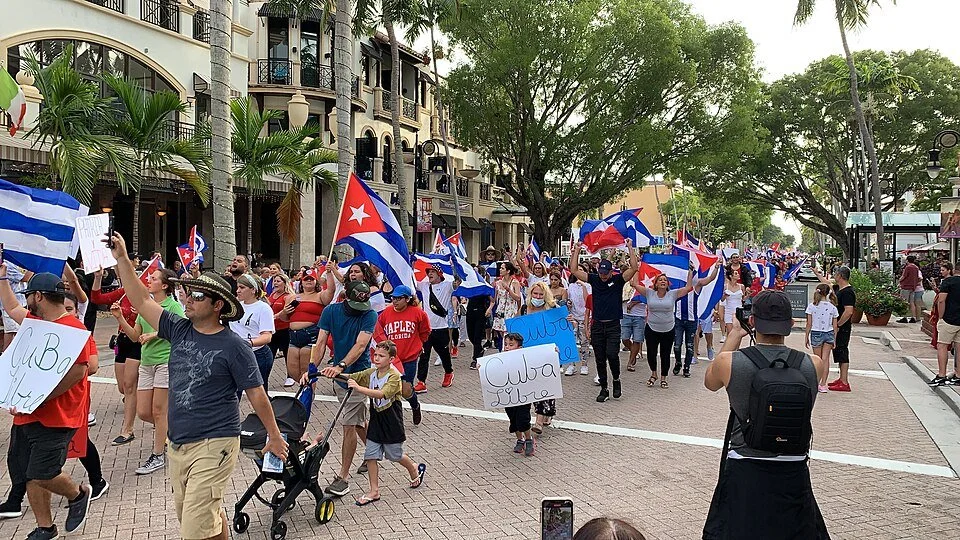
Aircraft have been unable to leave the island nation because of the lack of sufficient fuel. Many parts of the island are no longer fully operational, with citizens forced to live among filth because garbage trucks lack the fuel to operate. As gas prices have continued to rise, reaching as high as $8 per liter, or around $30 a gallon, Cuban citizens have had to make fueling appointments at gas stations to prevent extremely long lines. In 2024, the average monthly salary in Cuba was only about $16. The country also faced a major blackout on March 4th. For most Cubans, just getting by has become a daily struggle.
President Trump has since allowed U.S companies to send fuel to private businesses in Cuba. The United States also sent $6 million in humanitarian aid that will be distributed by Catholic churches in order to prevent the government from interfering.
Tensions in Cuba also escalated after a Florida tagged speedboat carrying ten people opened fire on Cuban soldiers on February 26th. The passengers were Cubans living in the United States who killed four Cuban soldiers in the attack. In response, Cuba filed terrorism charges against six of the passengers in the speed boat. Secretary of State Marco Rubio stated this was not a U.S. operation and no U.S. government personnel were involved.
The United States must also consider the implications its actions against Cuba could have on its interactions with Russia. Russian President Vladimir Putin has criticized the Trump administration’s Cuba blockade, saying the restrictions are unacceptable. Russia and Cuba have historically been close allies, and while Russia’s focus remains on its ongoing war with Ukraine, losing influence in Cuba would be a significant strategic loss. Cuba is important to Russia because it lies only around 90 miles from the U.S border. Russia may be unwilling to allow the United States to weaken its influence over its ally without some response.
Speaking to CNN on March 6th, President Trump stated that Cuba “is gonna fall pretty soon”. But he has also said that while Iran is the priority for the United States as of right now, “they (Cuba) want to make a deal, so I’m going to put Marco (Rubio) over there, and we’ll see how that works out.”
Meanwhile, Cuban citizens continue to bear the brunt of these policies as they wait for further decisions. Fuel shortages, blackouts, and rising prices are making everyday life extremely difficult on the island. One Cuban said, “We can’t take it anymore. People can’t feed their families.” Some critics of the policies here in the U.S. argue that attempts at regime change abroad may also distract from problems going on within the country. If that is the case, Cuba could potentially become the next major focus of the administration’s strategy of imposing its will in the Western hemisphere, with military might if necessary.
Kate Pintarelli is an intern at CSPC and currently studying International Relations.
CSPC IN THE NEWS
Joshua Huminski Appears on Fault Lines Podcast
Released on March 6, 2026.
SVP Joshua Huminski joined Lester Munson, Morgan Lorraine Viña, and Algene Sajery S. on the Fault Lines podcast to discuss the first week of the war with Iran and the conflict’s potential trajectory. The panel examines Iran’s expanding drone and missile strikes across the region, reports of Russia providing targeting intelligence, and the possibility of assistance from Ukraine based on its experience countering similar battlefield technologies.
Listen to the full episode here.
Alberta Separatism Would Harm Both Canada and the United States
Published March 9, 2026.
Randy Boissonnault, former Canadian Parliament Member and CSPC Presidential Fellow alum, alongside Christopher Hernandez-Roy, writes on the implications of a growing separatist movement in Alberta. Canada, a confederation of 10 provinces and three territories, has seen its share of separatist sentiment, particularly from the French-speaking province of Quebec. In recent months, however, a separatist movement in the oil- and mineral-rich province of Alberta, in Western Canada, has been gaining momentum. Long-held grievances in the province are bubbling to the surface, just as President Trump has been musing about Canada becoming the 51st state.
Read the full article here.