
The CSPC Dispatch - June 26, 2026
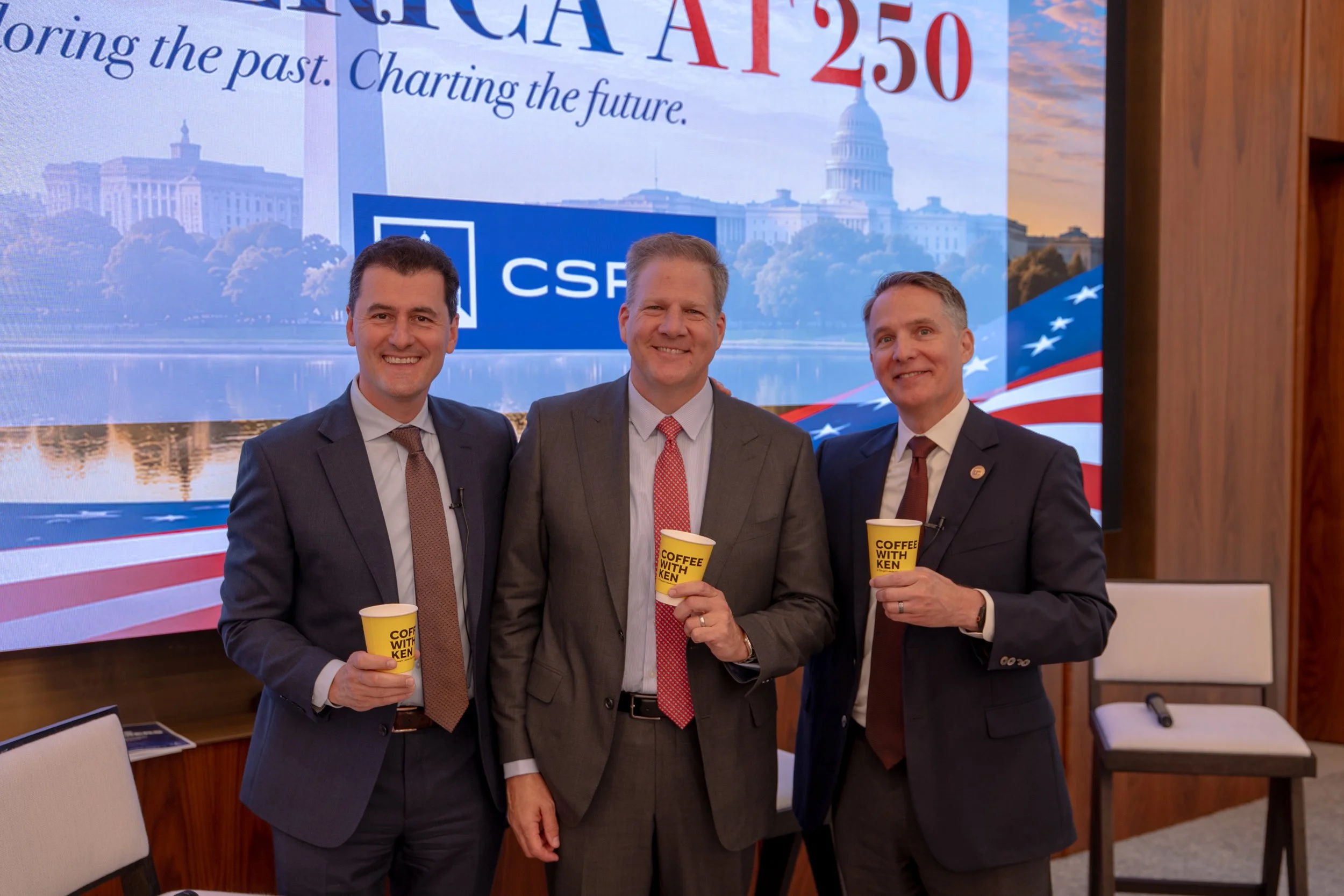
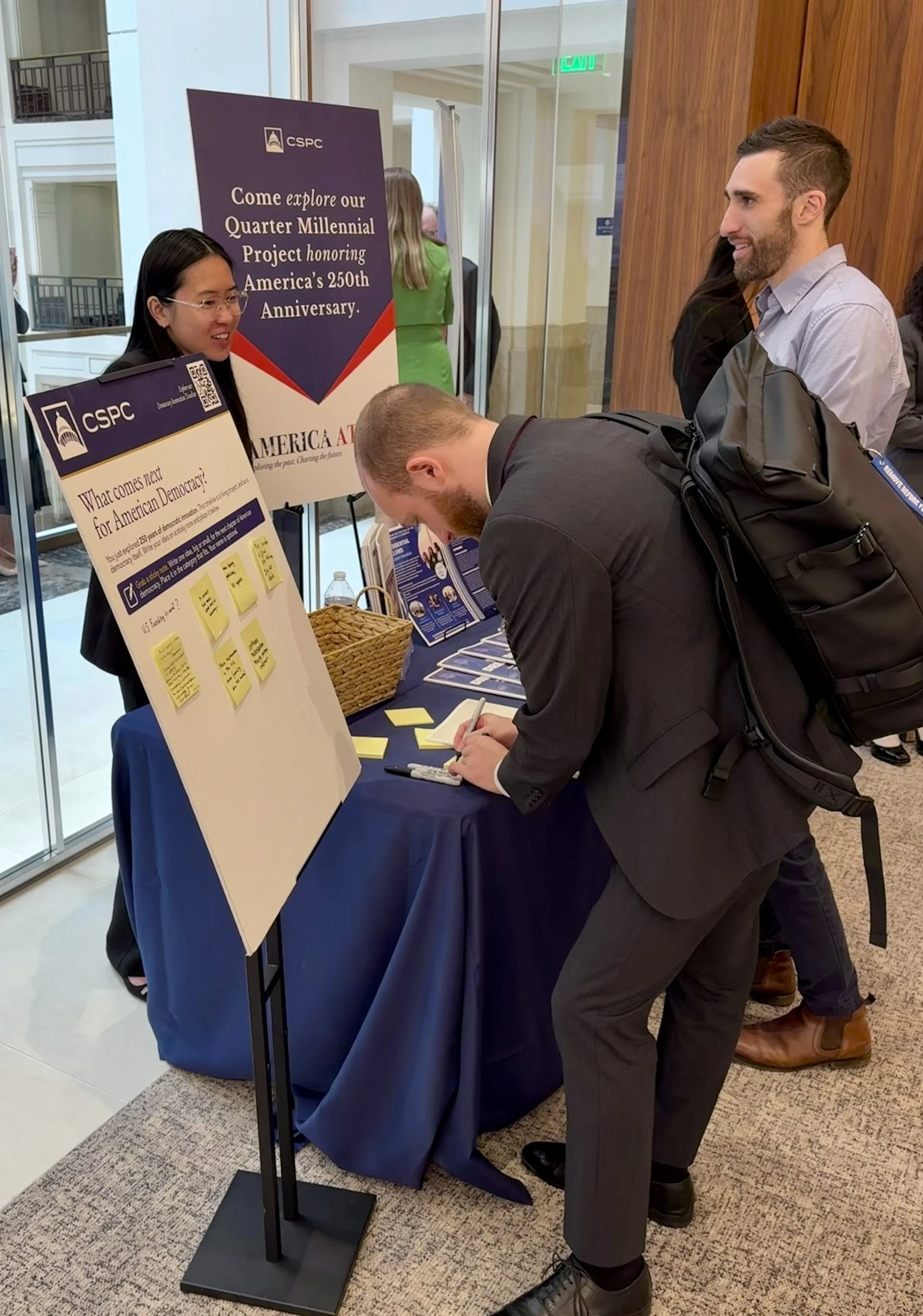
It’s been a busy season here at CSPC! Last week, we welcomed leaders, scholars, educators, and members of our network for America at 250, a special convening marking the nation’s approaching semiquincentennial. We were honored to hear from former Governor Chris Sununu, John Farrell and Michelle Jaconi, with conversations moderated by Ken Biberaj and James Kitfield. The event also served as the launch of The Dreamers, a new digital anthology from our Quarter Millennial Project that explores the lives and contributions of innovators, scientists, engineers, and visionaries whose ideas helped shape the American story over the past 250 years.
We are also pleased to welcome two distinguished leaders to CSPC’s Board of Counselors. Shawn Golhar, Managing Director and Global Head of Policy Advisory Banking at Barclays, brings deep expertise at the intersection of public policy, geopolitics, regulation, and markets. Joining him is Iain Martin, co-founder and director of the London Defence Conference, whose work has helped foster dialogue on some of the most pressing security and defense challenges facing democratic nations. We are grateful for their willingness to support CSPC’s mission and look forward to their contributions in the years ahead.
In this issue of the Dispatch, James Kitfield interviews Lt. Gen. Piotr Błazeusz, Poland’s Military Representative to NATO, on Russia’s escalating hybrid campaign against the Alliance and the lessons NATO can draw from Ukraine’s resilience. Jeanne Sheehan Zaino continues her series on democratic reform, revisiting Lloyd Cutler’s enduring argument that America’s constitutional structure makes effective governance increasingly difficult. Finally, Carolina Viera examines how the 2026 FIFA World Cup has become a case study in the tension between geopolitics and the unifying promise of international sport.
On the Frontlines of Russia’s Shadow War: Polish NATO Representative Lt. Gen. Piotr Błazeusz
by James Kitfield

Polish Lt. Gen. Piotr Błazeusz at the George C. Marshall Center for Security Studies in Germany on Feb. 6, 2026. (Photo courtesy of the US Department of Defense)
Last week a dissident Russian artist and critic of strongman Vladimir Putin was shot dead on the streets of a Polish city as he walked his dog. He was the latest in a long list of exiled Russians and Putin critics to meet an untimely death in Europe, whether from shootings, poisonings or mysterious falls from high windows. They are presumed casualties in Russia’s shadow war targeting NATO allies for their support of Ukraine, a campaign that has included assassinations, bombings, cyberattacks, and attempted rail derailments. As a country on the alliance’s eastern border with Russia, Poland has seen more than its share of these attacks, which helps explain why Warsaw has become NATO’s biggest spender on defense per capita, with a defense budget that amounts to nearly 5 percent of gross domestic product (GDP).
As Russia continues its war of aggression against Ukraine and hybrid conflict targeting NATO, the Center for the Study of the Presidency & Congress (CSPC) recently hosted Lt. Gen. Piotr Błazeusz, Poland’s Military Representative to NATO. The following excerpts from that on-the-record discussion have been edited for clarity and length.
On Russia’s Escalating Shadow War Against NATO
“Unfortunately, the Russian threat is escalating in our opinion, and they are constantly threatening not only Poland, but the wider NATO alliance. Moscow closely monitors our responses (to its provocations), and if they don’t see much reaction, they devise new ways to provoke and test us even further. This is all part of what I call Russia’s ‘New Total War.’ Even during the Cold War, Russia proved extremely good at such active measures, and they are now perfecting these methods and constantly using them against us. Some analysts call this Russia’s ‘hybrid war,” but in actuality it is just a new phase in Moscow’s New Total War. Their goal is to sow chaos that destabilizes our democratic countries, in hopes that our reaction will be to elect more pro-Russian leaders.”
On NATO Adopting a More Proactive Posture with Russia
“I’m a big proponent of NATO being more proactive and offensive in its response to Russian provocations. Unfortunately, right now we’re just reactive. We should avoid just a Tit-for-Tat response if possible and instead find weak spots to exploit against the Russian threat. For a historical example, I would point to the U.S. Strategic Defense Initiative (SDI) back in the 1980s. When the Soviet Union decided that the United States was really going forward with a ‘Star Wars’ defense against ICBMs, they became much more willing to engage in arms control discussions and agreements. Today we know that the Russians still worry about anti-ballistic missile (ABM) systems, because that reduces their ability to threaten and attack. Maybe we should play on those ghosts that Russia sees in terms of ABM systems, in ways that could create a strategic dilemma for them.”
“The larger point is that NATO has a lot of smart people, and we need to sit down and discuss what actions we can take that cause the Russians to worry. Perhaps we could exercise certain capabilities that put Russian assets at risk, just like Moscow does with us, and see how Russia reacts. Or we might communicate publicly to Moscow that we know what they are up to in certain areas that they think are secret. Because if you want to deal effectively with the Russians, you need to put aside our Western mindset a little bit and look at things from their perspective. They understand only strength. And when we react to provocations by asking them to sit down and have a dialogue, they consider that a sign of weakness. Of course, having that discussion inside NATO is difficult, because some nations will raise the issue of potential escalation.”
Learning Lessons from Ukraine’s Success Against Russia
“What the Ukrainians are accomplishing is phenomenal, and they continue to get better and better. Their deep strikes inside Russia show that despite Russian forces having one of the best electronic defense systems, the regime is not capable of defending its entire territory. With some creative techniques such as employing diversions in their drone attacks, the Ukrainians have been able to penetrate Russian defenses. The Ukrainians are also carefully picking targets like oil and gas refineries that cause a lot of trouble for Russian society and finances, and they are developing a new version of the Flamingo (long range cruise missile) with an extended range of up to 800 kilometers. NATO should definitely learn from the Ukrainians in terms of their ability to smartly take the fight to Russia.”
On Russia’s Conventional Threat to NATO
“At this moment we don’t think Russia is capable of launching a frontal attack on NATO. They’ve suffered too many losses in Ukraine. But the moment a ceasefire or peace agreement is achieved in Ukraine, we believe Russia will start reconstituting its military in order to further their strategic objectives. These objectives are not a secret. If you carefully read Putin’s speeches and public ultimatums going back some years, you can easily see that the strategic objective is the end of NATO. And the challenge with Russia is that it will not give up. They will use all available tools to keep the pressure on until they achieve their objectives. And their toolbox is extremely well integrated. They do not rely on just one instrument of power. All of their instruments of coercion are working towards the same goal, and they are using all available resources to achieve it. And in some instances, they are a little bit too successful.”
On Poland’s Defense Buildup
“As you know, Poland’s reaction to this growing threat is to spend a lot more money on our defense. We’ve taken out a number of loans to speed up the modernization of Polish military forces (Poland has borrowed more than $50 billion in defense funds from a European Union ‘Security Action for Europe,’ or SAFE, program – editor’s note). We also accepted additional strategic risk by donating a lot of military equipment to Ukraine that came directly from our operational military forces. That was a conscious decision taken after Russia’s 2022 invasion. We decided that ultimately it was in our interest to support the Ukrainians at that pivotal moment, so that they could repel Russian military forces. Of course, today the Ukrainian forces are in a much better place, but it was crucial at the very beginning of this conflict that they have additional tanks and missiles to fight back.”
On “Red Line” Restrictions Placed on Ukraine’s Use of Western Weapons
“Almost all of those initial ‘red lines’ (placed on Ukraine’s use of Western weapons) have been crossed by now. I think we Europeans and the United States now understand that we should not place red lines limiting how these weapons are used, because Russia was very smart in playing on the politics surrounding those decisions. As soon as we raised the issue, Russia would immediately escalate their rhetoric and make threats to respond with nuclear weapons, which they knew frightened some of our allies. So the Russians used these red lines very smartly.”
On Poland’s Major Defense Purchases from South Korea
“We have made major defense purchases from South Korea, mainly because they were able to deliver the weapons we need in a very short timeframe (Polish purchases have included South Korean artillery pieces, grenade launchers and a $6.5 billion deal for K2 Black Panther tanks – editors note). The South Koreans have also allowed us to enter the data from those platforms directly into our command-and-control system, which not all countries offering to sell similar weapons were willing to do. If you buy weapons from South Korea, manufacturers are willing and able to supply all the data you need to quickly put them to use. We approached many countries in our weapons purchases, including the United States, but unfortunately the delivery dates were often too far into the future. We were driven by urgency and felt we really needed to get a certain amount of equipment right away. In that sense our cooperation with South Korea has been quite successful.”
On Countering Russian Cyberattacks
“We are closely cooperating with the United States in the cyber domain, and our cyber command is extremely busy even as we speak fighting the war in cyberspace. The Russians are constantly trying to hack not only our military computers, but also civilian computer systems. They are quite good at getting bits of information from hacks that you might not think are important, and then they save that data and connect the dots to other bits of information, until they form a pretty good picture about some highly classified computer systems that are difficult to breach directly. The Russians are also constantly trying to hack our banking and railway systems and power grid. They are always probing, and whenever we are slow to respond in protecting those systems, they attack to weaken our government.”
James Kitfield is a Senior Fellow at the Center for the Study of the Presidency & Congress, and a three-time recipient of the Gerald R. Ford Award for Distinguished Reporting on National Defense.
At 250, We Need to Do Better Forming a Government
By JeannE Zaino
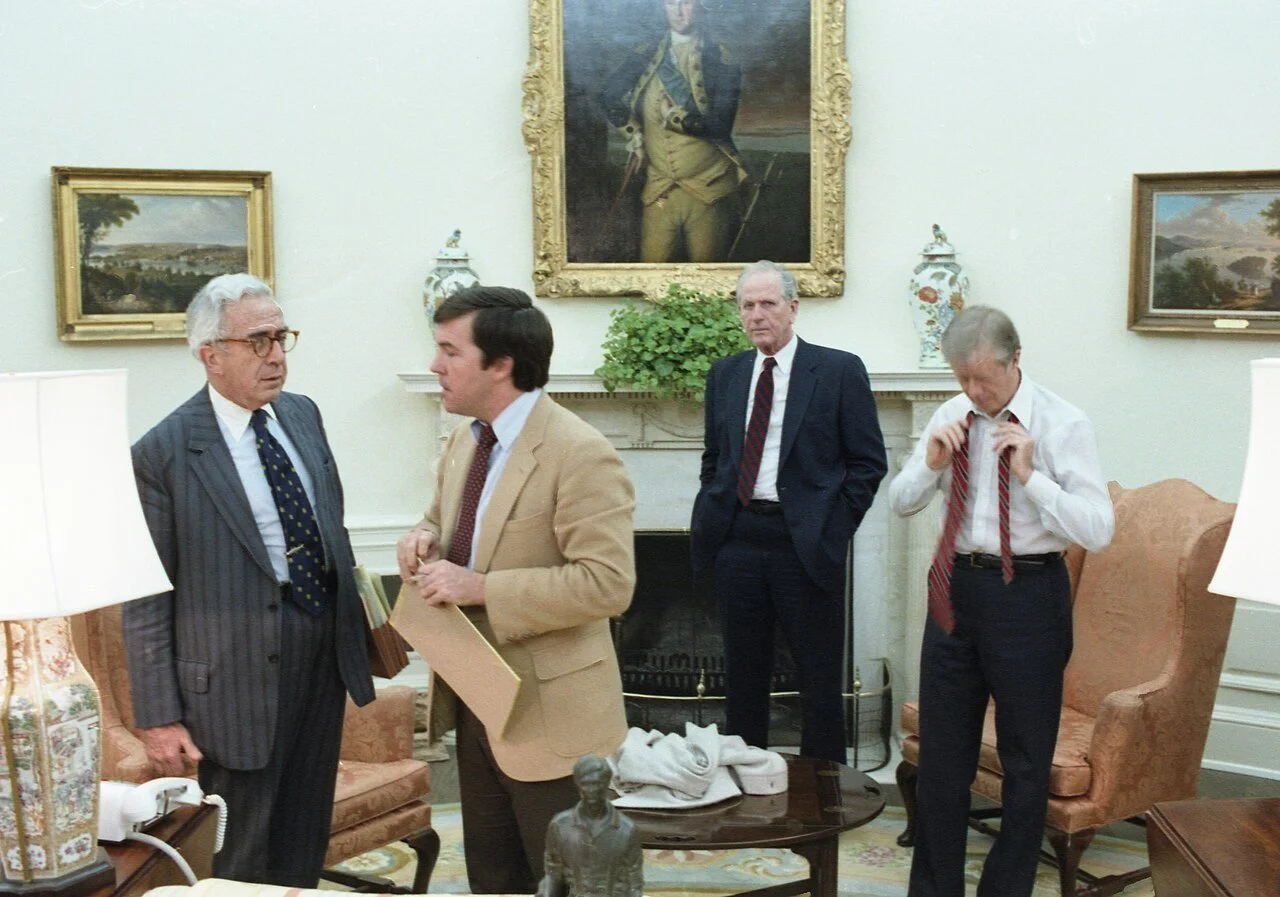
Lloyd Cutler (far left) with President Jimmy Carter (far right) in 1981. (Photo courtesy of the Jimmy Carter Presidential Library)
“I was taken immediately to the King... He looked at
me searchingly... and then said, ‘I suppose you don’t
know why I have sent for you...‘I want to ask you to
form a Government.’ “
- Winston S. Churchill, The Gathering Storm (1948)
Lloyd Cutler was a partner in the Washington DC law firm of Wilmer, Cutler, and Pickering who went on to serve as White House Counsel for two presidents, Jimmy Carter and later, Bill Clinton. In April 1980, Cutler delivered the Strasburger Lecture at the University of Texas Law School that was adapted into an article published in Foreign Affairsa few months later.
In that lecture and subsequent article Cutler reflects on his time in the Carter administration and like so many others who have served in the Executive branch, bemoans how difficult it is in our divided system to ‘form a government,’ to get things done. This sentiment informs the article’s title, “To Form a Government.” As Cutler (1980, 126-127) writes,
“a particular shortcoming in need of a remedy
is the structural inability of our government to
propose, legislate, and administer a balanced program
for governing. In parliamentary terms, one might say that
under the U.S. Constitution it is not now feasible to
‘form a government.’”
In the article, Cutler is clear that his experiences during the Carter administration informed this view. The separation between the first and second branches is a “structure that almost guarantees stalemate.” By way of example, he cites one of the many issues he was intimately involved in during his time in the Carter White House, SALT II. “We elected President Carter [to]... complete and sign a SALT II Treaty,” Culter wrote, which Carter “and his Cabinet regarded as very much in the national security interests of the United States... but because we do not ‘form a government’ it [was] not possible for President Carter to carry out this major part of his program.”
Cutler was of course referencing the fact that the Constitution requires the Senate to approve treaties and Carter was unable to secure Senate ratification by the two-thirds necessary, leading him to withdraw the accord from consideration in January 1980.
Cutler’s interest is not in addressing the advice and consent clause but rather showing that Carter’s “inability to ratify SALT II is replicated regularly over the whole range of legislation required to carry out any President’s overall program.” The result, he argues is stalemate, frustration, and an inability to address critical issues facing the public.
Cutler’s piece is well worth reading in full because it underscores how many people who have studied the issue view the greatest problem facing the U.S. as structural. By and large, most have agreed that the key challenge in need of a remedy is the structural divisions built into the system, beginning with the enormous division between the First and Second branches.
Toward the end of the article Cutler lays out seven proposals that could assist in addressing this divide and making “our structure work somewhat more in the manner of a parliamentary system.” Parliamentary envy amongst those from presidential systems is nothing new. It is also likely not to be particularly appealing to Americans today as we look across the pond and see the political state of our closest parliamentary ally, the United Kingdom. It is also likely to be a tough sell given there is so much concern in the U.S. over the last several years about the aggrandizement of executive authority.
These concerns are merited and yet, neither justifies turning our backs on the ‘modest’ proposals made by Cutler and so many other reformers over the years. Cutler ends his article by noting that his goal is not to convince readers about the “virtue of any particular” reform proposal because he himself is “far from persuaded.” Instead, his interest is in underscoring three key points:
(1) We need to do better than we have in ‘forming a Government’…this need is becoming more acute.
(2) The structure of our Constitution prevents us from doing significantly better.
(3) It is time to start thinking and debating about whether and how to correct this structural fault.
Almost half a century later, his points continue to resonate, particularly the first two – we can do better, the need is acute, and the problem lies with our constitutional structure. The only caveat I would add is to his final words. Contra to what Cutler writes, it is no longer “time to start thinking and debating” but – on our 250th anniversary - well past time.
Taking Culter’s words seriously on the ‘acute’ need for structural reform the biggest challenges we face are not in generating ideas for types of reforms. When it comes to actual and workable reform proposals, there are many, as Cutler and so many of the other pieces I have referenced in this series demonstrate. Instead, our greatest challenges are two-fold: (a) how to convince the American public that the need for reform is real and (b) how best to effect the changes. This is why, in the next part in this series, I turn from the content of proposals for change to methods of realizing them. In the American system there are essentially three options: constitutional change via the ‘regular process,’ constitutional change via the Con-Con, or extra-constitutional change.
Jeanne Sheehan Zaino is professor of Political Science, Senior Democracy Fellow at the Center for the Study of the Presidency & Congress and Visiting Democracy Fellow at the Ash Center for Democratic Governance and Innovation, Harvard Kennedy School.This piece draws on themes in her latest book, American Democracy in Crisis (Palgrave, 2025), and her Substack newsletter, The New Realist. It is the eleventh in a series on reform marking America’s Semiquincentennial.
World Cup 2026: Ideals of Global Sportsmanship vs. Geopolitical Acrimony
By Carolina Viera

The Iraq national team faced the Norway national team in a 2026 FIFA World Cup group-stage match held at Boston Stadium (Gillette Stadium) in the United States. (CC BY-SA 4.0)
As the world watched his every move and cheers roared from the stands, one man left the field in tears. Cape Verde's 40-year-old goalkeeper Josimar José Évora Dias had just done what some viewed as impossible: The player known as "Vozinha" earned a stunning 0-0 draw during Cape Verde’s first-ever World Cup appearance against none other than Spain, the reigning champion and a favorite to win the tournament. It was one of those genuinely improbable sporting moments for which the World Cup is deservedly famous.
Yet, in the middle of his celebration, Vozinha looked up and thought not of the cheering crowd, but rather of his mother. "I also cried because my mum didn't manage to be here because of the visa," he said afterward. "Because of the money we had to pay for the visa, we didn't manage to get it done on time."Cape Verde had been included on a list of 50 countries whose citizens needed to post bonds of up to $15,000 to enter the United States, a requirement introduced by the Trump administration to curb visa overstays.
Vozinha's mother's initial exclusion was not an isolated incident. Omar Artan, a referee who was set to make history as the first Somali official at a World Cup, was denied entry into the United States after an additional inspection at Miami International Airport, despite reportedly holding a valid visa. U.S. Customs and Border Protection claims they denied him due to "vetting concerns.”Meanwhile, Iran's national team was forced to relocate its base camp from Arizona to Tijuana, Mexico, and is working through the logistical barriers of being permitted to enter the U.S. only just before each match, and having to depart immediately after the game.
Fans from countries such as Jordan, Morocco, and Haiti have also faced steep visa rejection rates, with many of them losing money already spent on airline flights, game tickets and hotels. “A friend of mine (in Senegal) got a ticket through the lottery via FIFA - he couldn't make it because he didn't get a visa. That's how bad it is," said Mahmoud Toure, who moved to the United States 25 years ago from Senegal.
These are not simply logistical inconveniences suffered by individuals or targeted nationalities. Rather, they are clear indications that geopolitics are once again tarnishing the ideal at the heart of the World Cup, the world’s premier sporting event.
FIFA's primary mission is "to improve the game of football constantly and promote it globally in the light of its unifying, educational, cultural, and humanitarian values." Its "Football Unites the World" campaign, launched at the 2022 Qatar World Cup, declared the tournament a vehicle for unity, diversity, and shared passion. The whole premise behind the World Cup, the Olympics, and other major international sporting tournaments is that sport can do what diplomacy often cannot: bring rival nations into the same stadium, under the same rules, and unite them with the common language of fair competition.
Of course, that ideal has too often been sorely tested by geopolitical reality. The 1936 Berlin Olympics were staged by Adolf Hitler's Nazi regime and designed as a showcase of "Aryan" supremacy, for instance, transforming the games into a global propaganda exercise meant to prove German superiority. That message was notably debunked, however, by track-and-field star Jesse Owens, who won three individual gold medals and a fourth in the relay. The success of Owens and other African American athletes was seen as an embarrassing blow to Hitler's Aryan propaganda. In that case, a sporting event rose gloriously above the political messaging surrounding it.
During the Cold War, geopolitics sometimes won out over sport. In 1980 the United States led a contingent of over 60 nations which boycotted the Moscow Olympics in response to the Soviet Union's invasion of Afghanistan. Four years later, the USSR and 14 Eastern Block allies boycotted the 1984 Summer Olympics in Los Angeles, citing "security concerns" and "chauvinistic, anti-Soviet hysteria." Athletes at the time often described feeling like "pawns" in a larger geopolitical struggle that robbed them of a chance to compete against one another after years of training.
In recent times, the unifying ideal behind international sporting events is once again being tested. The 2018 World Cup in Russia unfolded amid geopolitical tensions following Moscow’s annexation of Crimea and resulting Western sanctions, for instance, with some critics claiming that the Russians were attempting to use the tournament as a form of “sportswashing” of its illegal behavior. Similarly, the 2022 World Cup in Qatar was explicitly promoted under FIFA’s “Football Unites the World” campaign, even as organizations such as Human Rights Watch and Amnesty International highlighted deplorable migrant labor conditions in Qatar’s stadium construction, and other human rights concerns.
The 2026 World Cup has once again highlighted the tensions between acrimonious geopolitics and the unifying power of international sporting events, and it remains an unfolding story. After the news broke that Vozinha’s mother couldn’t witness her son’s life-changing moment in the spotlight because she couldn't afford the $15,000 visa bond, for instance, a public outcry was raised. Thus moved to action, Secretary of State Marco Rubio worked with House Minority Leader Hakeem Jeffries to resolve the visa issue, and Vozinha's mother was soon on her way to Miami in time for Cape Verde’s next match.
In the case of Vozinha and his mother, a single human-interest story revealed the power of sport to sometimes overcome the grinding machinery of acrimonious geopolitics. The world watched as a goalkeeper wept on a football pitch far from his home and his mother’s arms, and it raised its collective voice with moral clarity. The unifying ideal behind international sport is not dead. It is definitely contested, and in that contest, sport still wins more often than it loses.
Carolina Viera is an intern at the Center for the Study of the Presidency & Congress a rising junior at the Pennsylvania State University double majoring in Political Science and Journalism: Digital & Print, and a minor in Business and the Liberal Arts.
New Publications
Burden sharing: Preparing Britain and America for a multifront crisis
Published by the Council on Geostrategy on June 17, 2026.
In this report published by the Council on Geostrategy, SVP of National Security and Intelligence Programs Joshua Huminski, alongside authors William Freer and James Rogers, set out how the UK-US alliance must evolve to meet a new era of threats.
Read the full report here.
The Dreamers: Profiles of American Innovators and Changemakers at 250 Years
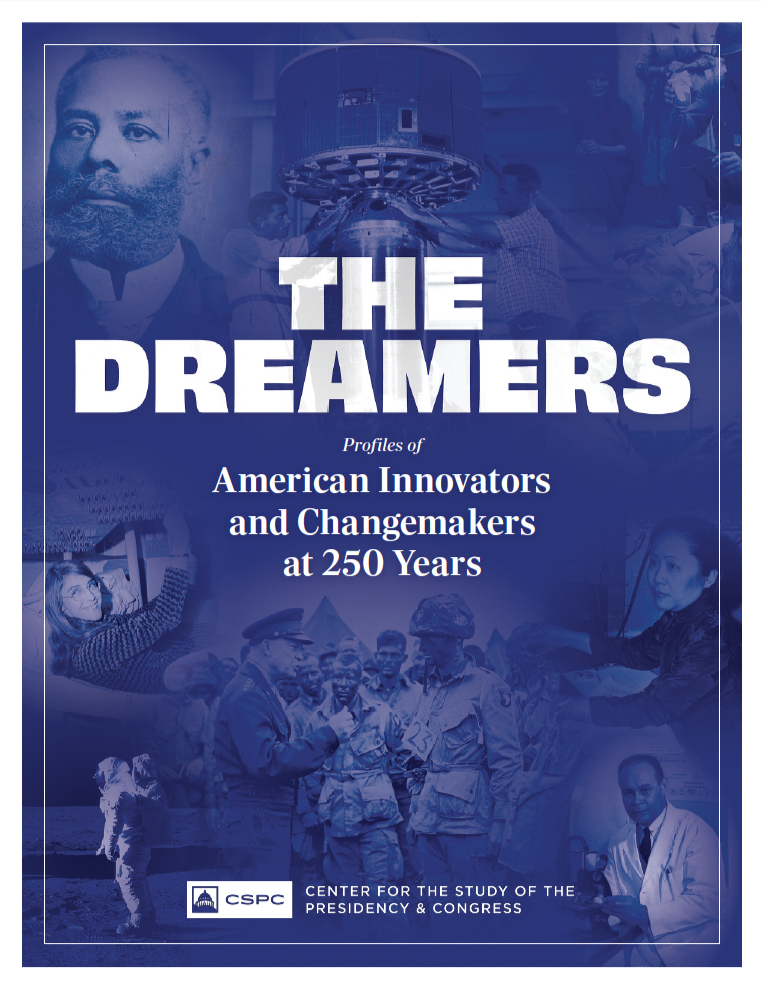
Published by CSPC on June 18, 2026.
As part of CSPC’s Quarter Millennial Project,The Dreamers highlights the innovators, scientists, engineers, entrepreneurs, and visionaries whose ideas helped shape the nation. Through engaging profiles, readers can explore the lives and contributions of both well-known figures and often-overlooked pioneers, including Chien-Shiung Wu, Charles Drew, Margaret Hamilton, and many others.
Explore the publication here.