
The CSPC Dispatch - Feb 13, 2026
In this issue, CEO & President Glenn Nye explores how allies must rethink deterrence in an era of uncertain U.S. security guarantees. Victoria Flick analyzes mounting political pressures on the Federal Reserve and their implications for institutional independence. Ben Pickert reflects on how technological change is reshaping the nature of shared truth itself, and Kate Pintarelli considers whether U.S. intervention in Venezuela will advance democratic self-determination or repeat the strategic missteps of the past.
We are also pleased to share CSPC’s latest report, Preparing for a Denied Environment: Building a Resilient PNT Architecture, released as part of the Center’s National Security Space Program. Drawing on a high-level tabletop exercise with leaders from defense, industry, intelligence, and academia, the report examines vulnerabilities to positioning, navigation, and timing (PNT) systems and outlines recommendations to strengthen resilience, enhance redundancy, and reinforce deterrence. As the U.S. economy, military operations, and critical infrastructure increasingly depend on trusted PNT signals, the report underscores the urgent need for a system-of-systems approach, stronger public-private collaboration, and clear national leadership to ensure preparedness in contested environments.
A New Era of Deterrence
By Glenn Nye
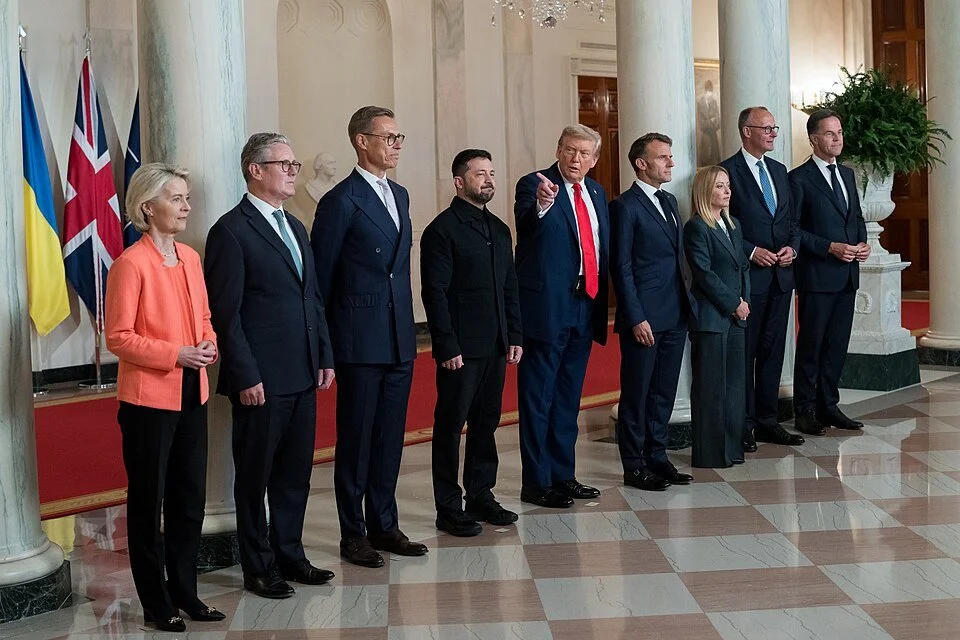
President Donald Trump poses with President Volodymyr Zelenskyy and European leaders before their multilateral meeting, on August 18, 2025, in the White House.
America’s withdrawal from traditional alliance arrangements is forcing rapid re-thinking of deterrence strategies from Europe to the Pacific. With President Trump’s public questioning of alliance commitments, including NATO’s foundational Article 5, leaders in Europe and Japan have no choice but step up their deterrence plans, in both capabilities and willingness to act.
European leaders must ask themselves: as regional dynamics become unmoored from traditional security arrangements, do they intend to be the predominant power in Europe, with Russia on the back foot, or allow Russia to be the dominating force while Europeans live in perpetual fear? The good news is they have everything they need to end up on the correct side of the ledger, if they can find the will, and soon.
Committing to spending 3.5% of GDP on core defense will be very helpful in changing the strategic balance in Europe over the long term, but they cannot afford to wait until that time to start changing the deterrence equation. Rapidly budgeting large sums of money for defense will be difficult for European governments. But European countries do not need to build the hefty Cold War force or try to match Russia soldier-for-soldier or artillery piece for artillery piece. They need to invest in a modern, sophisticated, long-range missile strike force that could eviscerate Russian energy infrastructure and make sure the Russians understand what they can do to a one-industry economy. Trans-Atlantic collaborations like the Rheinmetall-Anduril partnership are already starting to point in that direction.
Europeans could change the game significantly in the near term by responding much more strongly to Russian provocations. Start boarding shadow fleet vessels that are trying to circumvent sanctions. Anytime a Russian drone “accidentally” enters NATO territory, there should be a swift and strong response. Same for cyber intrusions, undersea cable harassment, or grey zone incursions.
In Ukraine, a game changer is desperately needed. If Putin is indeed an existential threat to Europe due to his westward expansion in Ukraine, as many European leaders have repeatedly stated, then countries in the coalition of the willing should put some forces in Western Ukraine immediately. After all, it makes no sense to give the Russian dictator a veto over European security policy by waiting for him to sign some illusive agreement when the threat is existential in nature. Europeans should make it clear to Putin that any attack on their forces would be met with a swift and painful response. In the meantime, start showing those capabilities and willingness. Yes, this approach comes with risk, but there is more risk in showing weakness to the dictator than showing strength.
Of course, this will be challenging for Europeans. Democracies lack the speed of authoritarian decision making, and this is a collection of countries, each with its own domestic politics and leaders who grew up under the blanket of U.S. protection and now have to rapidly change mindset. But they do have very strong cards to play if they are willing to play them and coordinate their action better. Leaning in is also more likely to put them on a respected footing with the current American president. Sending forces to Greenland in response to President Trump’s provocations is showing a weak hand. Standing up to Russia with determination would be playing the strong hand, the very essence of deterrence.
Europeans should also make it clear that attacks on Ukrainian civilian infrastructure are now off-limits, to strengthen Zelensky’s negotiating hand. There should be an explicit threat to transfer long-range missiles to Ukraine every time Putin strikes a civilian power plant, hospital, school, or housing block. President Trump should give a Tomahawk missile to Ukraine every time this happens as well, expanding his call on Putin for a one-week humanitarian pause in civilian strikes to a demand for permanent cessation with immediate consequences.
Next steps should also include a conversation to clearly reiterate nuclear umbrella coverage to non-nuclear European states, a conversation that would need to include the Americans and nuclear-armed Europeans, but which should, if done correctly, actually lead to a reduction in nuclear tensions. This would help address Russian threats of nuclear arms use, though European defense doctrine, if properly resourced, should be able act as a powerful deterrent to Russian aggression relying only on conventional weapons and expert asymmetric tactics. Europe can then communicate to Russia that the goal is not to escalate but to achieve stability through newfound clarity.
In the Asia-Pacific region, Japan will need to act boldly. It does not have the advantage of a multitude of regional allies with which to coordinate. Japan will need to keep the world focused on the threat from China and hope that Europe can neutralize the Russia threat quickly and without too much reliance on improving relations with China as a hedge to U.S. indifference. Decisive action will be made easier by the success of Prime Minister Takaichi in dramatically strengthening her party’s control of the Diet in recent elections. She will have a much easier time enacting plans to rapidly increase Japan’s defense budget. Her recent hawkish comments about Taiwan naturally drew strong condemnation from the Chinese government. But her stance echoes comments made by former Prime Minister Taro Aso at a speech in Washington hosted by CSPC in 2024, where he stressed the importance of showing a national “will to fight” as an integral part of deterrence strategy.
Resolutely demonstrating the will to fight is as important to a deterrence plan as having weapons: a lesson Europeans would be wise to heed. It is also the surest way to settle the question of where the balance of power in Europe will lie in a new era of regional power competition.
Glenn Nye is CEO & President at the Center for the Study of the Presidency & Congress.
When Politics, Probes and the Federal Reserve Collide
By Victoria Flick
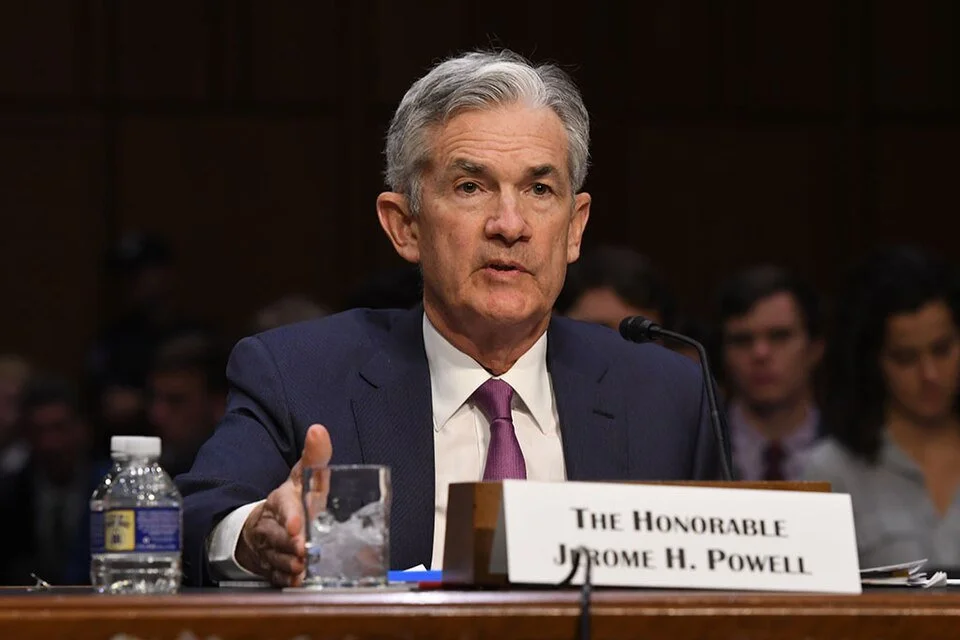
Chairman Powell testifies to the Senate Committee on Banking, Housing, and Urban Affairs on July 17, 2018.
Recent developments at the Federal Reserve (Fed) ignited debate across the political spectrum and pushed the boundaries of central bank independence into largely uncharted territory. A contested leadership transition—from current Chair Jerome Powell to President Trump’s nominee Kevin Warsh—coincided with active federal investigations involving Powell and Fed Governor Lisa Cook, as well as heightened partisan involvement in an institution designed to operate at arm’s length from politics. Together, these developments have placed unprecedented strain on the Fed’s credibility and governance. They also raise fundamental questions: what happens if the Fed is left without a confirmed chair, how much authority does the Senate Banking Committee wield in the appointment process, and what are the consequences when partisan considerations delay or derail that process? This article seeks to clarify these uncertainties and examine their institutional implications.
Jerome Powell joined the Federal Reserve Board in 2012 and has led the institution as Chair since February 2018. His term as Fed Chair is up this May, but his position on the board does not formally end until 2028. Therefore, Powell faces a daunting question: whether to break with tradition by remaining on the Federal Reserve Board after stepping down as Chair for the remainder of his term, or to follow the example of most of his predecessors and leave the institution at the conclusion of his chairmanship. Traditionally, Fed chairs have resigned from the board entirely when stepping down as Chair. The only Fed Chair who decided to stay on the board past his term was former Fed Chair Marriner Eccles in 1948. Regardless of Powell’s decision, one current Fed governor, Stephen Miran—whose term has expired—is expected to step down once President Trump appoints a new governor. As a result, Powell’s decision to remain on the Board would not prevent the president from nominating a new member or selecting a new Chair. In the short term, this may not immediately alter the balance of votes. However, if Powell stays, he would occupy a seat that would otherwise become available for another presidential appointment. Over time, that additional appointment could shift the composition of the Board and potentially influence future interest rate decisions. While the current voting majority may not change right away, the longer-term implications for the direction of monetary policy could be significant. Thus, remaining on the Board would therefore carry political implications for Powell. During the last vote on interest rates, only governors Miran and Waller voted in line with the president’s desire to lower interest rates. The president’s desire for aggressive rate cuts have been the main source of his clashes with Powell. While the president wants to lower interest rates to stimulate economic activity in the short term, Powell said his ultimate goal is to “continue to set interest rates based on evidence and economic conditions” and has repeatedly pointed to the Fed’s dual mandate of maintaining price stability and maximum employment.
Regardless of whether Powell chooses to remain on the Board, his term as Chair concludes in May 2026, and President Trump has announced former Fed Governor Kevin Warsh as his intended replacement. At 35, Warsh became the youngest governor on the Fed’s seven member board, serving there from 2006 to 2011. Warsh openly criticized the Fed’s current policy stance, arguing repeatedly that it is no longer the institution he joined in 2006 and that significant changes are needed to reverse course. He also contended that inflationary pressures will subside as artificial intelligence (AI) boosts productivity, thereby expanding the economy’s productive capacity. His wager that AI can fuel growth without reigniting inflation mirrors President Trump’s own view that inflation has been subdued and that an accelerated AI buildout will power the next phase of expansion. As Warsh put it, “AI will be a significant disinflationary force, increasing productivity and bolstering American competitiveness.”
However, at this point hurdles remain to push Warsh’s confirmation through the Senate. Most of these concerns relate to the ongoing FBI investigation into Fed Chair Powell regarding the renovation of the Federal Reserve’s headquarters in Washington, D.C., as well as allegations of mortgage fraud involving Fed Governor Lisa Cook, whom President Trump dismissed in the fall of 2025. Cook’s legal battles have been ongoing culminating in the Supreme Court’s involvement in the case in January 2026, where arguments focused on the definition of “cause” and whether the president can remove members of independent, multi-member agencies. The FBI’s criminal investigation into Powell examines whether he misled Congress about the scope of the Fed’s renovation project and marks what some describe as a significant escalation in President Trump’s ongoing pressure campaign. Following the revelation of the FBI investigation, senator Thom Tillis (R-NC) released a statement that “I will oppose the confirmation of any Federal Reserve nominee, including for the position of Chairman, until the DOJ’s inquiry into Chairman Powell is fully and transparently resolved”. This introduced a legislative roadblock as it could delay a possible confirmation hearing and extend uncertainty. For the nomination to advance out of the Senate Banking Committee, it must secure a simple majority (13 of 24 votes), after which it proceeds to the full Senate for confirmation, where it again requires a simple majority (51 votes). While so far, no other GOP committee member publicly vowed to oppose the nomination, all 11 democratic members of the committee have publicly urged delaying or opposing Warsh’s confirmation hearing. Thus, if Tillis votes no and all Democrats oppose the nomination, the committee vote would tie 12-12, meaning the nomination could not be reported favorably out of committee. If committee action is blocked, Warsh’s nomination would likely remain stalled unless a sufficient number of senators (at least 51) vote to discharge the nomination from committee or leadership negotiates to resolve the impasse in committee. This means that while Senate Majority Leader Thune (R-SD) could attempt to bypass committee approval, doing so would be both procedurally complex and politically challenging, making Kevin Warsh’s confirmation considerably more difficult.
These procedural hurdles in confirming a new Fed Chair could result in a temporary vacancy at the top of the institution. Although the Federal Reserve Act does not contemplate the Federal Reserve operating without leadership, there have previously been instances in which the Vice Chair has served as Acting Chair until a successor was confirmed by the Senate. One such instances took place in 1948 with the transition from Marriner Eccles to Thomas McCabe. During that short window, leadership continuity was maintained internally. While not a dramatic power vacuum, it is an example of an interregnum period where formal chair authority shifted before a successor was fully established. The same scenario could arise in 2026, in which case Philip Jefferson, the Vice Chair of the Board, would assume Powell’s duties on an interim basis. The Federal Reserve would continue to operate without interruption, and monetary policy decisions would still be determined by majority vote within the Federal Open Market Committee (FOMC).
What, then, does all of this mean for the American public? The question is not merely who will serve as Fed Chair, but what that the choice signals about the Federal Reserve’s independence and its role within the broader architecture of American economic governance going forward. Leadership uncertainty at the central bank does not remain confined to Washington; it reverberates through financial markets, where institutional ambiguity often translates into volatility. The decisions made in the coming months will shape more than the trajectory of interest rates—they will help define the norms that underpin the exercise of economic power in the United States. Will the Fed’s institutional independence emerge intact, or will precedent shift in ways that endure beyond this moment? And in an era of deep political polarization, is this a temporary episode of turbulence—or the beginning of a more lasting transformation?
Victoria Flick is a Research Fellow at the Center for the Study of the Presidency & Congress.
Seeing the Same Thing
By Ben Pickert

A person uses their index finger to scroll through a list of news articles on their smartphone.
While entering my high school one morning in 2015, my friend Josie rushed up to me from a cluster of our friends and showed me her phone. On the screen was a photo of a striped dress.
“What color is it?” she asked, our friends watching.
“What?”
“The dress. What color is it?”
“Um… blue and black?”
The group erupted into a mix of cheers and groans. I didn’t understand what I had just participated in. To me, the color of a dress, like the color of most things, was an objective fact. (And I will add: I have since been vindicated.) Within a day, the dress was everywhere; an argument so ubiquitous that it briefly collapsed the internet into a single conversation. What I quickly learned was that I had taken a side. I stated what I saw, and it was treated not as an observation, but as an opinion.
At the time, it felt novel and fun. In retrospect, it feels more like a rehearsal.
This year, the deaths of Renee Good and Alex Pretti in Minnesota have stirred a shocking amount of debate over what happened. I say shocking because, in a narrow sense, we do know. Both incidents were captured on high-quality video from multiple angles and widely circulated. That has not stopped the arguments. The footage has not functioned as public evidence so much as partisan content, flooding social media with captions and commentary, the subject of endless analysis, moral framings pre-attached. On an internet that coined the phrase “pics or it didn’t happen,” photo and video became an unreliable narrator.
What is happening is not because we lack information. It is because we no longer share it.
We were promised the internet as an information revolution; a modern Library of Alexandria built for universal access. In a technical sense, that promise has been fulfilled; the information is there. But we no longer encounter it together. We have retreated into separate rooms, each mistaking its contents for the whole.
The early internet was a chaotic commons where people disagreed in fewer spaces. Today, as it has grown, our experience of the internet is divided by the people we follow, the forums we join, the subscriptions we pay for, and algorithms that learn our preferences and build our feeds. These systems do not only provide us with information, they curate our inputs. Over time, our inputs have narrowed.
Online, we are now shown two things: first, we see arguments and interpretations that affirm our prior beliefs. This constitutes the overwhelming majority of what we encounter. Second, when we do encounter opposing views, they are typically stripped of context, represented by their most inflammatory or unserious advocates. The result is not exposure to disagreement, but to caricature. Reality does not compete well with spectacle, and contempt is alluring.
This fragmentation is reinforced not only by algorithms, but by economics.
As a student at Indiana University, I had the chance to speak with a visiting opinion editor from The New York Times. During that conversation, a friend asked whether paywalls might contribute further to this fragmentation. The response focused on the necessity of funding quality journalism. Without revenue, there can be no reporting.
While true, this left me uneasy. Paywalls exist for good reason: quality journalism requires resources, and subscriptions sustain the institutions capable of producing it. But they also shape who encounters that work. When verified reporting sits behind a paid subscription, access becomes uneven, determined as much by cost as by curiosity. In the space left open, free alternatives rush in. Social media platforms, partisan commentators, and political personalities offer interpretations of the news at no cost, often designed for persuasion rather than education. Many have built large audiences by positioning themselves as substitutes for traditional outlets, providing certainty where reporting provides complexity. The result is not an absence of information, but an imbalance in exposure. People receive abundant narratives, but fewer shared facts. Even tools designed to counter this fragmentation are shaped by it. Services like Ground News promise comparative, level-headed understanding, yet I most often see them used not to expand perspective, but to monitor and contest the other side. Even corrective tools are quickly absorbed into silo logic.
This is the backdrop against which projects like Grokipedia emerge.
In September 2015, Elon Musk announced he and xAI were working on Grokipedia, an open AI encyclopedia modeled after Wikipedia (which will be turning 25 years old this coming week). The project has since launched, and its appeal is obvious. It is fast, authoritative in tone, and frictionless. Much of the information it generates is drawn directly from Wikipedia itself, but Grokipedia is billed as a correction, as Wikipedia is “a smear machine for the Left,” according to a comment Musk promoted in response to the announcement.
Wikipedia’s most important feature is not neutrality, but transparency. On nearly every entry, a public “Talk” page shows contributors document disagreements, interrogate sources, negotiate conclusions, and track edits in full view. That process—messy, contested, and slow—is the point.
In practice, Grokipedia removes the visible process and presents its output as a finished product. At the top of each entry, the site announces that the article, written by Grok, has also been fact-checked by Grok. When the work of establishing truth occurs inside the black box of an LLM, the very process that makes knowledge trustworthy disappears from view. Grokipedia treats epistemic conflict not as something to be worked through, but as something to be resolved through firmer control. An AI-generated encyclopedia designed to affirm the worldview of a single individual strikes me not as a solution, but as a retreat.
I do not know how to tear down the information silos that define our digital lives. More honestly, I am not sure how to tear down my own. I am not above this dynamic. I have built my silo brick by brick. I say I want a stronger shared reality, but what I often want more is confirmation that I am already right.
When I think back to that morning with the dress, what has stayed with me is not the argument, but the certainty. I saw blue and black, and I assumed the matter was settled. It did not occur to me that seeing clearly and understanding completely were different things. That distinction feels harder to hold onto now. We are surrounded by images, evidence, and answers, and yet agreement feels further away than ever. Not because the truth is gone, but because the work of reaching it together has been easy to abandon in our disparate corners of the library.
A shared reality does not disappear all at once. It fades as we begin to curate truth alone, selecting what to see, what to hear, and what to shut out, and as we build the systems around us to do the same.
Ben Pickert is Executive Assistant to the President & CEO at the Center for the Study of the Presidency & Congress.
Learning from History: Will America Liberate Venezuela or Repeat Past Mistakes?
by Kate Pintarelli

Demonstration of Venezuelans in Quebec on July 28, 2024.
Since the United States’ military operation in Venezuela last month that resulted in the capture of Venezuelan President Nicolás Maduro, questions about who will lead the country next have dominated international discourse. President Donald Trump held a press conference after the operation and stated that the United States would temporarily“run” Venezuela. Many observers expected opposition leader Maria Corinia Machado, the Nobel Peace Prize recipient whose party is widely believed to have won the 2024 election, to be named as President of Venezuela. However, instead of backing Machado, the Trump administration is currently working with Venezuela’s interim President Delcy Rodriguez, who previously served as vice president and loyalist to strongman Maduro.
President Trump has claimed Rodriguez is “willing to do what we think is necessary to make Venezuela great again,” and he has threatened a second military strike if the current government does not comply with the demands of U.S. officials. “Actually everything that Delcy Rodriguez is currently doing is because she’s complying with instructions she’s getting from the United States,” Machado has noted that the current dynamic blurs the line between the United States offering Venezuelans freedom or demanding direct political control and resource extraction.
In 2024, when Machado was barred from running and fellow opposition candidate Edmundo González Urrutia ran against Maduro, the opposition plausibly claimed that Madurostole the election. Leaders from around the world supported that claim and declared Edmundo González the true winner of the election. Even U.S. Secretary of State Marco Rubio declared Edmundo González the rightful President.
Yet, the United States has decided, at least for now, to work with Delcy Rodriguez, who has not been elected and therefore has no democratic claim to the presidency. According to theVenezuelan Constitution, an interim president can remain in power for a maximum of 180 days. After that the National Assembly must call a presidential election. If the Trump administration believes Venezuela has yet to become “great again” within 180 days, will it interfere with Venezuela’s constitutional process?
Looking back at history, the United States has intervened in the politics and governance of foreign governments in Latin America before, and the results were not encouraging.
Intervention in Chile
During the Cold War, the United States played a major role in orchestrating Chile’s seventeen-year dictatorship. In an effort to prevent the election of Salvador Allende, who U.S. officials believed posed a threat and was backed by foreign communist powers such as Cuba and the Soviet Union, Washington, D.C. spent a lot of money trying to influence the election. Despite the interference, Allende went on to win the 1970 election.
After the election, the Nixon administration began cutting aid to Chile. Then in 1973, a military coup d’état removed Salvador Allende from power altogether. General Agusto Pinochet was subsequently installed as Chile’s military dictator and ruled with an iron fist for seventeen years by instilling fear among the citizens of Chile.He rounded up Allende’s supporters, killing nearly 3,000 in a campaign of “disappearances.” Another 38,000 people became political prisoners, and roughly 200,000 people wereforced into exile, some becoming targets of Pinochet’s overseas assassination squads. When Chilean investigators later searched for the bodies of the disappeared, many were found buried, two bodies to each coffin. As for the economic impact on the average Chilean citizen, unemployment rose to 20% and wagesdropped 35% below 1970 levels.
Pinochet’s reign came to a halt in 1990, but he remained commander-in-chief of the Chilean Army for another eighteen years. Although a warrant was eventually issued, he was declaredmedically unfit to stand trial. Even after later being stripped of his immunity, Pinochet was never charged for the crimes he committed against Chilean citizens, who never saw justice.
After the Watergate coverup and Nixon’s eventual resignation, the U.S. Senate created a committee to investigate covert actions during the 1960s-70s. Investigators testified that President Nixon instructedCIA director Richard Helms to prevent Allende’s inauguration by planning a preemptive coup. President Nixon’s Secretary of State Henry Kissinger stated, “I mean, we helped them… created the conditions as best as possible.” The committee revealed a long-running campaign of secret operations aimed atundermining Salvador Allende’s government. Although the United States did not directly carry out the coup, it actively supported efforts to overthrow Allende.
Difficult Choices Ahead
Life inside Venezuela under Maduro was brutish, and he will not be widely missed.Only 77% of the population had access to piped running water under his reign, for instance, forcing many citizens to rely on street water for cooking and drinking. Many children were unable to attend school due to the shortage of water and food. Under Maduro’s rule, oil-rich Venezuela also suffered one of the most dramatic economic contractions ever, with GDP shrinking nearly 80%.
When Maduro was arrested, Venezuelans expressed mixed reactions. Many were hopeful that the change could lead to a better future, with one person saying, “I’m very, very happy. They finally captured the dictator.” Others, however, expressed skepticism and fear for what could come next. Many of the nearly 7 million Venezuelans who fled Maduro’s regime in search of a better life are now left to wonder what will become of their home country.
The Trump administration and the American people also face difficult choices ahead. The United States can support free and fair elections and an eventual democratic transition that allows Venezuelans to decide their own future. Or we can decide that our national security takes precedence over the interests of the Venezuelan people to decide their future.
Kate Pintarelli is an intern at CSPC and currently studying International Relations at Virginia Tech.
CSPC IN THE NEWS
NSI Experts Weigh In: The End of a New START in Nuclear Deterrence
Originally published in The SCIF on Feb 12, 2026.
CSPC’s Glenn Nye and Joshua Huminski contributed to the National Security Institute’s analysis on the future of nuclear deterrence and arms control after the New START Treaty expired last week, concluding fifteen years in force.
Read their full analysis here.
New Episode of Coffee & Conflict Podcast with Joshua Huminski
Originally released on Feb 5, 2026.
In the latest episode of Coffee & Conflict, SVP for National Security and Intelligence Joshua Huminski spoke with Franz-Stefan Gady about his book, How the United States Would Fight China: The Risks of Pursuing a Rapid Victory. The book examines how Washington envisions a future conflict with China and why those assumptions—particularly expectations of a short, decisive war—may be dangerously outdated.
Listen to the full episode here.