
The CSPC Dispatch - Feb 27, 2026
In this issue, Jeanne Zaino examines how structural division in the Madisonian system often produces legislation only after years of delay and in compromised forms that fall short of their original ambitions, from the Affordable Care Act to federal gun reform. Jordan Reyes turns to election administration, exploring how the Constitution’s decentralized framework for voting, while protective against centralized abuse, has generated inconsistency, confusion, and controversy in an era of razor-thin electoral margins.
At 250, Dilution of Policy By Design
By Jeanne Zaino
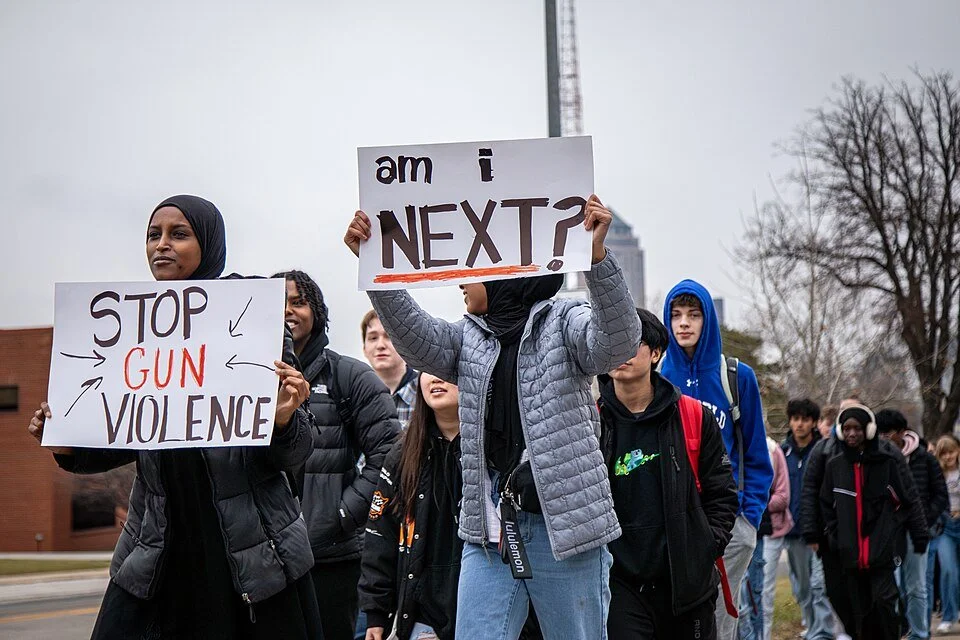
A few days after a school shooting in Perry, Iowa some students in Des Moines and area suburbs held a walkout and participated in a protest at the State Capitol. (Phil Roeder, CC BY 2.0)
According to an Urban Institute Report, approximately 4.8 million people lost health insurance as a result of the failure of Congress to extend advanced enhanced Affordable Care Act (ACA) premium tax credits that expired at the end of last year. Mississippi, South Carolina, Tennessee, Texas and Georgia are the top five states facing the steepest coverage losses (from 65%-39%). The enhanced ACA subsidies, introduced during the pandemic which Congress let lapse at the end of last year, were designed to address high insurance premiums and deductibles, as well as limited options in the Obamacare marketplaces.
Among the many questions to be asked is, how did we get here? Why did we find ourselves in this position during COVID and again in the aftermath? Why didn’t the ACA as originally adopted insure against high premiums and deductibles? Why were options limited in the marketplaces?
In the last column, I wrote about one of the repercussions of all the divisions in the American political system – lack of responsiveness and the inability to deliver for the people. A third repercussion that is not as often discussed is what we see in the case of the ACA – dilution.
“Over the past two-hundred years, this system has worked repeatedly to frustrate and divide popular majorities,” writes political scientist William E. Hudson. “As a result, many popular programs and policies have failed to be enacted or have been put into place only after years of debate, discussion, and compromise, which dilute their effects.”
Madisonian divisions built into the system in the interest of protecting liberty not only make responsiveness and execution difficult, but when policy is finally passed it is often watered down or diluted to such an extent it does not look like what people voted for.
A good example of this is what occurred in the context of health care reform in the early part of the 21st Century. During the 2008 campaign Barack Obama promised to deliver a government-run ‘public option’ that could compete with private insurers. The bill that ultimately passed (i.e., the ACA or Obamacare) instead used a market-based structure often referred to as ‘Romenycare’ after former Governor of Massachusetts Mitt Romeny (R) who pioneered this approach. In addition to the adoption of the private market exchanges as opposed to the public option, the ACA was also more reflective of Romeny’s vision other ways, including individual mandates and reliance on private insurers.
The bill that emerged from Congress in 2010 and which President Obama signed into law, is a good example of what we mean when we talk about policy being ‘diluted’ in that it diverged a good deal from candidate Obama’s promises. In the aftermath of its passage, the bill remained controversial as the GOP tried numerous times (unsuccessfully) to overturn it; even those supportive of reform conceded it was beset with issues, including the fact it relied on private insurers, was too incremental, lacked aggressive controls, had high out-of-pocket expenses, lacked aggressive price controls, did not include a public option, and so on. Ultimately, during the pandemic, Democrats publicly recognized the need to address some of its shortcomings and did so by passing enhanced subsidies but refused to fund those for as long as necessary and instead left the subsidies and more importantly, Americans who need insurance, vulnerable.
Another policy area in which we have seen dilution recently is gun control. As the data shared by Statista shows, the number of mass shootings in the US increased dramatically from 1982-2025. Among the most horrifying was the 2012 rampage at Sandy Hook Elementary School in Newtown CT which left 27 dead, including 20 six- and seven-year-old children. At the time many thought Congress would finally pass gun control, but that did not happen.
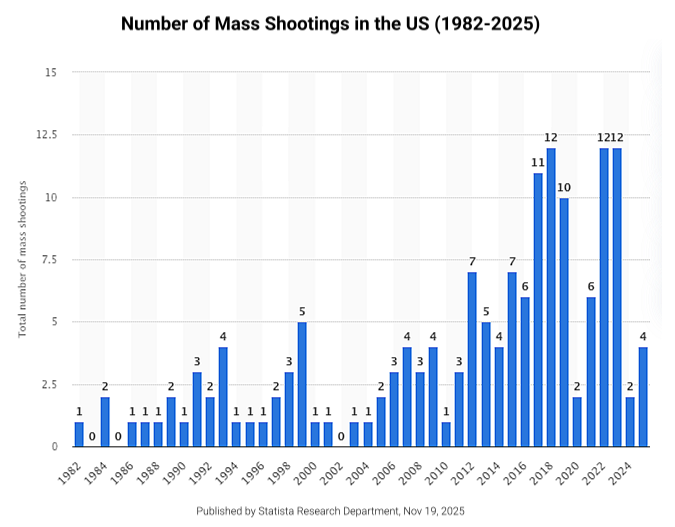
In the decade following the Sandy Hook massacre, the Gun Violence Archive reported that mass shootings in the U.S. nearly tripled.
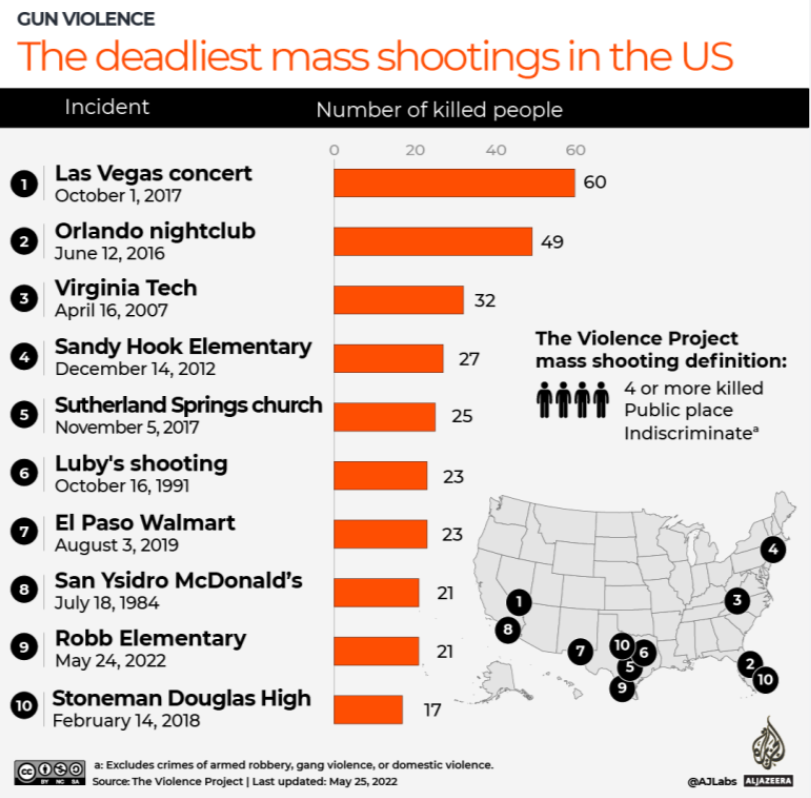
One of the most horrifying post-Sandy Hook mass shootings occurred at another elementary school, this time in Texas. On May 24, 2022, a gunman walked into Robb Elementary School in Uvalde with two assault rifles and fatally shot nineteen (19) third and fourth graders and two teachers, in addition to wounding seventeen (17) others.
The horrors of that day, like those at Sandy Hook more than a decade earlier and thousands in between, prompted renewed calls for the federal government to act. One month to the day after the horrors at Robb Elementary, Congress finally acted, passing The Bipartisan Safer Communities Act (BSCA). While many heralded the bill for breaking the decades long log jam as it pertains to federal action on guns, most also agreed that given the level of gun violence plaguing the nation, it was a “modest bill” which focused more on mental health than gun control; according to experts it fell short in several critical ways, including failing to raise the age to purchase guns, ban assault weapons, or expand universal background checks.
The BSCA is indicative of many policies and programs in the Madisonian system. It takes decades of debate, discussion, compromise (and in this case horrific death of children and other innocent people) to finally get action on an issue. After this protracted struggle, the policy prescriptions which emerge are often diluted, watered-down, and tempered to the point of not only being dissatisfying to most observers, but far less effective than serious minded policymakers envisioned.
Like limited responsiveness and ill-execution, policy dilution results when a political system is structurally divided as ours is. While there were good reasons for doing that in the late 18th Century (the protection of liberty), on the 250th anniversary of American Independence, a major question to be asked is whether this amount of division still makes sense in the modern era?
Jeanne Sheehan Zaino is professor of Political Science, Senior Democracy Fellow at the Center for the Study of the Presidency & Congress and Visiting Democracy Fellow at the Ash Center for Democratic Governance and Innovation, Harvard Kennedy School. This piece draws on themes in her latest book, American Democracy in Crisis (Palgrave, 2025), and her Substack newsletter, The New Realist. It is the seventh in a series on reform marking America’s Semiquincentennial.
Defending Voting Rights, and Getting the Vote Right
By Jordan Reyes
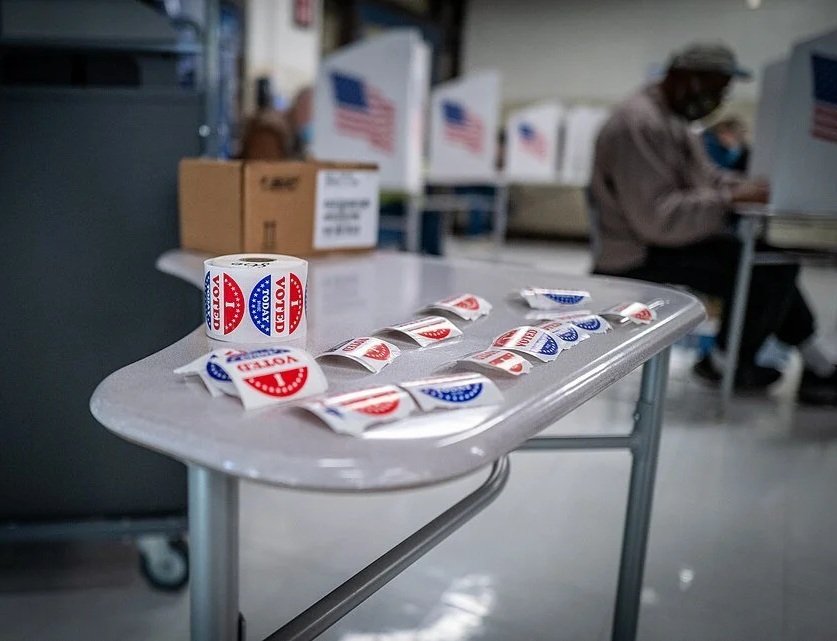
Unused ‘I Voted’ stickers at a polling location in Iowa on Election Day 2020, as many voters cast ballots by mail due to COVID-19. (Phil Roeder, CC BY 2.0)
The U.S. Constitution does not mandate a single method of voting. Instead, Article I, Section 4 assigns states the authority to regulate the “Times, Places and Manner” of elections, subject to congressional oversight. That design reflects a deliberate choice, one that will have a major impact on upcoming primary elections in anticipation of important midterm elections in November. With control of the House and the Senate currently depending on razor-thin margins, the decentralized nature of U.S. elections will inevitably receive scrutiny and likely become a focal point of controversy this election cycle.
Over the past two decades, for instance, many states have expanded access to absentee and mail voting. Eight states, including Oregon, Washington, and Colorado, conduct elections almost entirely by mail, with a ballot automatically sent to the addresses of all registered voters. Other states broadened eligibility during the COVID-19 pandemic, temporarily allowing “no excuse” absentee voting, expanding drop box access, and allowing certain counties to conduct mail-in voting.
As of 2024, fully 28 states allowed for no-excuse absentee voting, and research on turnout suggests that expanded mail access can modestly increase participation by around 2%. Though this might seem insignificant, in close elections with historically low numbers of ballots being cast, a few percentage points in either direction can literally alter the balance of power in Congress.
Midterm cycles only intensify this dynamic. Unlike presidential elections, which generally produce larger turnout and clearer margins, midterms regularly feature close congressional races that nevertheless can determine committee leadership, oversight power, and the legislative agenda. During the 2022 midterms, several House races weren't called until weeks after election day, not because of fraud, but because states with late-starting ballot processing simply took more time to count legal votes. The public’s lack of understanding about that vote-counting process and the decentralized nature of the system created confusion that can be used to sow doubt about the legitimacy of the election.
A major part of the problem is that states can't agree on when vote counting should start. In some jurisdictions, officials may begin verifying signatures and preparing ballots before Election Day, as long as the early results are not released. In others, processing cannot begin until polls close on Election Night itself. As a result, a race can seem decided by midnight in favor of one side, and then tilt in the opposite direction as mail ballots are counted in the following days. While legitimate, this dynamic can erode trust in the outcome and create fears that the election is somehow fraudulent.
Allowing election workers to begin counting mail-in ballots before Election Day would seem like an easy fix, yet a number of states have refused to make that change, as the debate surrounding fraud and federal overreach continues. That is exactly the kind of inconsistency the Constitution’s Elections Clause was written to address, but despite having the authority, Congress has not acted.
Security concerns are also part of this debate, though post-election audits on vote-by-mail have consistently found no fraud at a scale sufficient to change outcomes. In states with long-standing vote-by-mail systems, safeguards like signature matching and bipartisan observation are routine. The U.S. military has also successfully managed effective mail-in-voting processes for decades, and they were most recently updated in 2010. That is not to argue that there is zero fraud in the system, there certainly is, just that mail-in-voting does not inherently create more of it.
The fundamental question at the center of this important debate is whether vote-by-mail should exist at all. On that matter, the Framers were clear that the states have primacy over elections in order to prevent any single point of control from being captured or abused. The states have chosen to expand vote-by-mail as a reliable feature of American elections, and an important one at that. Through the Constitution, the Framers also granted Congress the discretionary power to bring more order to a decentralized voting system, if that is required to guarantee consistency and legitimacy. Whether Congress chooses to use that power is the only question left.
Jordan Reyes is an intern at CSPC and a senior at the George Washington University.
CSPC IN THE NEWS
James Kitfield on NPR's 1A: Friday News Roundup
CSPC Senior Fellow James Kitfield will appear this morning on NPR’s 1A Program in their Friday News Roundup during the International Hour.
Tune in between 11am-12pm here or your local NPR station.
CSPC’s PNT Report Featured by Inside Towers
Originally published in Inside Towers on Feb 16, 2026.
CSPC’s latest report on positioning, navigation, and timing (PNT) was featured in Inside Towers Digital Infrastructure News. Drawing on a high-level tabletop exercise with leaders from defense, industry, intelligence, and academia, the report examines vulnerabilities to positioning, navigation, and timing systems and outlines recommendations to strengthen resilience, enhance redundancy, and reinforce deterrence.
Read the full report here.
Jeanne Zaino on Wave Capital’s Guest Speaker Series
Released on Feb 19, 2026.
CSPC Democracy Senior Fellow Jeanne Zaino joined host Garrett Boorojian to analyze the state of our nation during increased polarization. Zaino notes that the constructs of Congress and The White House need to be reimagined (and redesigned) to prevent any future unconstitutional overreach.
Listen to the full episode here.
Joshua Huminski Hosts Anna Arutunyan on Coffee & Conflict Podcast
Released on Feb 19, 2026.
SVP Joshua Huminski is joined by Anna Arutunyan, author of Rebel Russia: Dissent and Protest from the Tsars to Navalny, to explore Russian history through the lens of rebellion and dissent. Arutunyan traces the recurring dance between rebels and rulers—from the Tsars to the Soviet era to the present—and explains why uprisings so often appear to fail, yet still leave lasting marks on the Russian state.
Listen to the full episode here.