
The CSPC Dispatch - May 8, 2026
Welcome to the CSPC Dispatch.
This week, CSPC President & CEO Glenn Nye examines Europe's defense landscape, arguing that Germany, with its growing military ambition and economic weight, is uniquely positioned to lead the continent in deterring Russian aggression at a critical moment. CSPC Senior Fellow and retired U.S. diplomat Robert W. Gerber explores the legal doctrine of "arbitrary and capricious" review, examining how courts scrutinize executive agency action. And CSPC intern Kate Pintarelli takes a close look at the growing uncertainty surrounding U.S. commitment to NATO, asking whether President Trump could withdraw from the alliance, and what the consequences would be.
We are also pleased to share CSPC's latest report, Quantum Cryptography: Assessing Technological Advancements and the U.S. Landscape, released as part of the Center's National Security Space Program. Drawing on a high-level tabletop exercise with leaders from defense, industry, intelligence, and academia, the report examines the current state of the transition to quantum cryptography and the evolving role of quantum key distribution (QKD) in the U.S. landscape. As quantum computing threatens to break the public-key cryptography securing global communications, financial systems, and national security infrastructure, the report underscores the urgent need for a hybrid approach to post-quantum cryptography, stronger public-private collaboration, and clear national leadership to ensure preparedness in the quantum era.
Germany Holds the Key To European Defense
By Glenn Nye

German soldiers stand at attention at the German Armed Forces Proficiency Badge challenge award ceremony on Naval Air Station Sigonella, Oct. 15, 2023.
The recent election of a new prime minister in Hungary signals that the European Union (E.U.) is likely entering a period of greater internal cohesion and solidarity, particularly when it comes to opposing Russia. For years, divisions within the E.U. —often amplified by Budapest’s closeness with Moscow —have complicated efforts to present a unified front. A shift in Hungary’s leadership promises to change that dynamic.
European leaders now have new opportunities to establish a clear deterrent to Russian aggression. First, they can provide more long-range strike capabilities for Ukraine to hold at risk Russian energy infrastructure and warfighting assets, significantly raising the pressure on Moscow to end its war of aggression. Providing Ukraine additional air defense assets and even some ground forces would further signal to Putin that the neighborhood is changing in ways that defy his bullying.
Another opportunity lies in steps that Europe can take to win the asymmetric, “grey zone” conflict that is already well underway. With cyberattacks, disinformation, military incursions and covert sabotage operations, Russia has long engaged in a campaign to undermine European stability and resolve. Europe has the tools to compete—and to win—in this space, but doing so will require greater coordination, faster decision-making, and the political will to respond more assertively to provocations. Publicly calling out Russia for submarine activity near sensitive undersea cable infrastructure will almost certainly not be enough.
At the recent London Defense Conference, one panelist offered a blunt formulation: Europe should handle Russia so that the United States can focus on China. While overly simplistic, especially given the current American focus on Iran and the Middle East, the argument captures a strategic reality that is quickly taking hold: Because the United States is increasingly oriented toward other challenges, Europe must step up and take primary responsibility for deterring Russia.
Another panelist struck an even more urgent note, warning that Europe may be missing a once-in-a-generation opportunity to reshape the balance of power on the continent. By failing to act decisively enough to help Ukraine defeat Russia in the near term, Europe risks allowing the conflict to harden into a protracted stalemate—one that preserves Russia’s capacity to threaten its neighbors and undermines Europe’s long-term security and stability. The window to change that trajectory will not remain open indefinitely.
These observations point to a clear and uncomfortable conclusion: Europe must move faster, act more decisively, and accept greater near-term risk to achieve a more favorable long-term security dynamic. Defense budgets are helpfully rising in Europe, but there is still a risk that our allies are preparing primarily for a World War III–style contingency rather than fully engaging in the hybrid war that Russia is waging today.
Germany’s new military strategy underscores this challenge, as well as the significant progress being achieved. Berlin has now explicitly committed to becoming Europe’s strongest conventional military by 2039 and to assuming greater responsibility for European defense—clearly identifying Russia as the primary threat. This is a welcome and positive development. Germany’s willingness to step forward, invest, and help organize European defense is essential if allied countries are to be the predominant force in Europe in the future, and not Russia. Germany’s intelligence service is also re-orienting itself toward the hybrid threat Russia poses. All across Europe, that war is already visible: Russian-linked sabotage operations targeting critical infrastructure, transportation and communications networks represent just one provocative element.
The maritime domain also offers both a challenge and an opportunity. Russia’s so-called “shadow fleet” of oil tankers continues to evade sanctions, generating revenue for the Kremlin while creating both environmental and security risks. European countries have begun to respond—Germany’s seizure of a sanctioned tanker was a notable step.
In practical terms, Europe should begin to define and enforce clearer thresholds for action, including the coordinated seizure of shadow fleet vessels operating in European waters, agreed-upon consequences for cyberattacks, and more assertive responses to airspace and maritime incursions. These calculated steps would not represent escalation so much as a shift toward active defense in a conflict that Russia has already launched. For democracies, it is also important that collective responses not remain classified or “in the shadows,” as public support is dependent on governments signaling resolute responses that match the seriousness of the threat. Vague references to unspecified responses, or simply calling out provocative behaviors, are insufficient to the challenge.
Given its economic weight and more assertive defense posture, Germany is well positioned to lead this effort, though it will have to accept a much larger leadership role than was traditional in the post-WWII era. For example, Berlin will need to coordinate burden sharing that pairs its economic heft with French nuclear protections, Polish tank forces, British naval presence, and Baltic missile capabilities. By spearheading responses across these domains, Berlin could lead a Europe that proactively seizes this critical moment to confidently chart its own path to future security.
Europe need not match Russia system for system, nor mobilize for a Cold War-style standoff. But at this critical inflection point, the continent’s democracies must find the political will to leverage their collective economic strength and technological sophistication and achieve a new security balance, and they must act now while the opportunity still exists. Replacing the heavy hand that the United States played in securing Europe in the post-World War II era won’t be easy, but the alternative is a prolonged “gray zone” conflict on the continent, an increasingly disengaged America, and a Europe that remains perpetually reactive to Russian threats and aggression. That is a far more dangerous path—and one that Europe still has time to avoid.
Glenn Nye, a former Member of Congress from Virginia, is President and CEO of the Center for the Study of the Presidency and Congress
Arbitrary and Capricious
By Robert W. Gerber

This year marks the 80th anniversary of the Administrative Procedures Act (APA). Despite its unglamorous name, which conjures up bureaucrats toiling in drab government offices, the APA has played a vital role in checking executive branch power and preserving the principle of open government.
Congress passed the APA in 1946 out of concern that dozens of new agencies created under President Franklin D. Roosevelt would amass unacceptable powers. The drafters wrote that their intent was “to improve the administration of justice by prescribing fair administrative procedure.” (The text of the legislation resides on the current U.S. Department of Justice website.) I stumbled upon the APA while reading in February 2025 that Secretary of State Marco Rubio declared in a Federal Register notice that his changes to immigration policy and trade policy would not be subject to the APA. The law is multifaceted. It instructs federal executive branch agencies to provide a 30-day notice and comment period before adjudicating or deciding on an agency rule, regulation, or decision. Agency actions cannot exceed the jurisdiction (or scope) of the relevant federal statute, nor can such actions be “arbitrary and capricious.”
I confess that I had to look up the word “capricious.” According to Miriam-Webster dictionary, it can mean governed or characterized by sudden irrational and unpredictable impulses or whims. As a legal term, it represents something not supported by the weight of evidence or established rules of law.
Courts subsequently decided that an agency decision would be illegal under the APA if it is unsupported by substantial evidence or unwarranted by the facts. A 2021 case (FCC v. Prometheus Radio Project) affirmed that an agency decision must be “reasonable and reasonably explained.” Agencies must also weigh whether there are interests competing against policy concerns and agencies may not settle on predetermined outcomes. The APA exempts actions related to foreign affairs, the military, and internal agency functions, and it does not apply to “general statements of policy.” The APA may also be used to challenge an agency when it fails to implement a statute.
The law enables a federal court to put a “stop work order” on an agency rule if a judge decides the agency violated any of the APA provisions in adjudicating the rule. The APA also guarantees the right of individuals to pursue judicial redress for harm incurred.
Many presidential administrations have run afoul of the APA. A court struck down President Bill Clinton’s ban on federal agencies contracting with companies that replaced striking workers. (Chamber of Commerce v. Reich). During the Biden Administration, a federal appeals court declared that the 2022 Department of Energy (DOE) effort to regulate dishwasher efficiency violated the APA because the agency rule was arbitrary and capricious and it exceeded DOE’s authority. In 2025, a federal court declared that the Biden Administration’s refugee limits violated the APA. During President Trump’s first term, APA violations were a factor in the majority of court rulings against federal agencies, according to the Institute for Policy Integrity at New York University Law School.
The Administrative Procedures Act at Work
Earlier this year President Trump issued an executive order that prohibited the Department of Interior (DOI) from issuing permits for onshore or offshore wind projects in federal waters or land before completing a “comprehensive assessment and review of Federal wind leasing and permitting practices.” DOI then issued a memo that created a three-tiered approval process (ending with the Secretary) for wind energy projects, created a new standard to evaluate a project’s “capacity density,” and barred wind and solar developers from using an agency database to evaluate environmental impact. A coalition of plaintiffs representing industry stakeholders filed a lawsuit against the rule, claiming economic harm. On April 21, a Massachusetts district court ruled that the plaintiffs had standing, would suffer harm, and were likely to succeed on the merits of their claim that the DOI memo violates the APA. The judge said “Plaintiffs have shown that the public interest favors preliminary relief from the Agency Actions because the Agency Actions “harm the public by delaying and preventing the development of wind and solar energy projects in the United States, which in turn threatens the public’s vital interest in maintaining a reliable, affordable, and resilient power grid, which is currently struggling to meet record energy demand.”
The Massachusetts court ruled that DOI’s action was arbitrary and capricious in that it failed to provide “adequate reasoning” for making wind energy projects subject to enhanced scrutiny and new standards. The court did not have to rule on the other aspects of APA like “notice and consent” or adherence to law to block DOI’s action. The judge dismissed the government’s argument that because the order stemmed from an Executive Order, it was not subject to the APA. Interestingly, the judgment also noted that the DOI memo’s 3-tiered review approach appeared to conflict with a separate E.O. that sought to remove impediments to energy development. This was the second time a court found that Trump Administration rules on wind energy violated the APA.
Workarounds
Despite the volatility in international fossil fuel markets and the surging need for electricity – driven largely by new data centers - the Trump Administration seems firmly committed to blocking solar and wind projects by any means necessary. It is appealing the Massachusetts District court decision on the DOI rule. The Administration also announced an “innovative deal” with TotalEnergies wherein the government would pay $1 billion to compensate the French company if it abandons its East Coast offshore wind project leases and invests in natural gas projects. DOI said the action was necessary because offshore wind was “expensive and unreliable” and raised national security concerns. The announcement also quoted Attorney General Pam Bondi saying that President Biden’s ideological and ineffective energy policies needed to be reversed. On May 4, the Financial Times reported the Trump Administration was seeking to block wind energy projects on private lands by subjecting them to Pentagon-led national security reviews.
The Administrative Procedures Act has played an important role in the last eight decades as a check on executive power, but it is not fail-safe. Presidents seeking to push the limits of executive power will pursue workarounds. Nonetheless, reading the APA reminds us that its authors believed that transparent process, policymaking based on reasonable analysis, stakeholder engagement, and a citizen’s right to redress were principles that needed to be codified in a democracy like the United States.
Robert W. Gerber is a CSPC Senior Fellow. He is not a lawyer but enjoys reading legislation.
Can or Should the United States Leave NATO?
By Kate Pintarelli
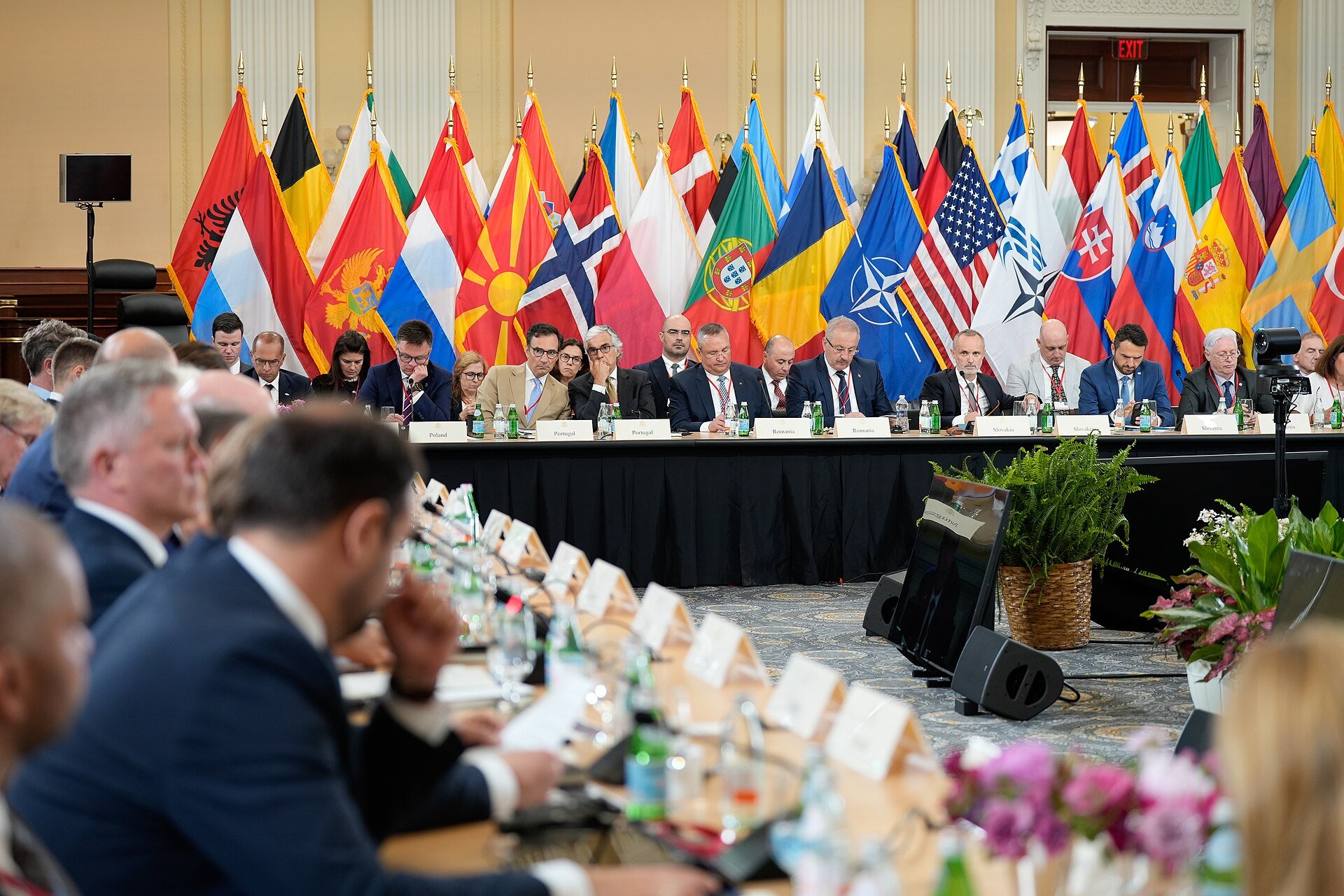
NATO Parliamentary Summit in the USA, July 8, 2024
President Trump has consistently criticized the disparity in defense spending among member states of the North Atlantic Treaty Organization (NATO). Although he is not the first U.S. president to voice frustration in this regard – President Barack Obama famously complained about allied “free riders” – President Trump’s rhetorical style and accompanying threats to withdraw U.S. support, have changed the tone of the debate. Earlier this year, tensions within the alliance increased further after Trump publicly suggested the possibility of acquiring Greenland. He argued that the United States might need to control the Danish territory to ensure the security of the U.S. and its NATO allies. This idea was met with strong disapproval from other NATO member states, including Denmark. Danish politicians responded that, if President Trump asked, the United States could instead increase its military presence in Greenland by adding troops or equipment. President Trump later denied any intention of invading Greenland; however his prior claims have left Danish citizens feeling unsafe.
President Trump has since also criticized NATO allies for not supporting U.S military initiatives, including recent operations in Iran and that some even restricted U.S. access to their airspace and military bases. The United Kingdom and France have also been reluctant to participate in measures like blocking Iranian ports in the Strait of Hormuz. Following these refusals to join American-lead operations, the president went as far as to suggest a U.S. withdrawal from NATO was no longer unthinkable, noting that it was already “beyond reconsideration.” President Trump’s reaction suggests that the perceived lack of support from NATO could have serious implications for the U.S. commitment to NATO. It also raises questions about whether a U.S. president can withdraw from the alliance, and what consequences this could have.
Can the President Withdraw from NATO?
Under current U.S. law, a president cannot unilaterally withdraw the U.S. from NATO. The 2024 National Defense Authorization Act (NDAA) includes provisions that limit the president’s ability to withdraw from NATO without receiving approval from the legislative branch, stating that the president “shall not suspend, terminate, denounce, or withdraw without advice and consent from the Senate.” Similar legislation was cosigned by the current Secretary of State, Marco Rubio. The president, therefore, would need a majority in the Senate to formally leave NATO. Such a majority is highly unlikely forthcoming.
Of course, the president could attempt to challenge or simply ignore the NDAA, withdraw from NATO, or try to stop funding the alliance all together. However, such actions would likely face legal challenges. Historically, the Supreme Court has been reluctant to get involved in matters involving treaty termination, however. For example, in the 1979 case, Goldwater v. Carter, Senator Barry Goldwater challenged President Jimmy Carter’s decision to terminate a defense treaty with Taiwan. The Supreme Court declined to make a final ruling, finding that the case was not ripe for judicial review. It is unclear how courts would rule in a case involving NATO.
While Article II of the U.S. Constitution grants the president the power to make treaties, it also gives the Senate a clear role, stating “He shall have Power, by and with the Advice and Consent of the Senate, to make Treaties, provided two thirds of the Senators present concur…”. However, the Constitution does not clearly lay out the powers for withdrawing from a treaty.
Why is the United States’ Alliance with NATO Important?
Since its founding, the alliance has been the most important pillar of American security policy in Europe and functioned as the main military component of U.S. strategy in the Cold War. Since the end of the East-West conflict, the Alliance has supported the United States in many ways, including in Afghanistan after the September 11th attacks. The response to September 11th also represents the first, and only, time NATO invoked Article V, its collective defense clause. At its peak, NATO contributed 50,000 troops who fought alongside American troops for nearly two decades.
Today, NATO membership continues to offer the United States substantial military advantages. Through NATO, the United States is able to access military bases throughout Europe, allowing it to operate closer to potential U.S. adversaries and to project power into nearby theaters. Compensating for the loss of these assets, would likely entail higher defense costs. Withdrawal would also diminish the United States’ global influence and its position as a global superpower, as other U.S. allies might start to doubt American commitments and reliability. Leaving NATO would not simply be a shift in policy. It would undermine U.S. national security, weakening the country at a moment it can least afford it.
Kate Pintarelli is an intern at CSPC and currently studying International Relations.
CSPC IN THE NEWS
Joshua Huminski on U.S. Troop Withdrawal from Germany on Times Radio
Released on May 5, 2026
SVP Joshua Huminski joined Times Radio's Darryl Morris to discuss the implications of the U.S. troop withdrawal from Germany for transatlantic security and the NATO alliance.
Listen to the full interview here.