
The CSPC Dispatch - Jan 16, 2026
In this issue, Robert Gerber reflects on the evolution of U.S. government intervention in the private sector, tracing a bipartisan shift from crisis-driven involvement to a more assertive, security-oriented industrial policy. Victoria Flick analyzes renewed U.S. interest in Greenland, unpacking the strategic, economic, and geopolitical logic behind the debate while underscoring the limits imposed by history, law, and Greenlandic self-determination. Maria Reyes Pacheco revisits the constitutional balance over war powers in the wake of U.S. action in Venezuela, highlighting how contemporary crises continue to test the boundaries between Congress and the presidency. Finally, Kate Pintarelli assesses Ukraine’s bid for accelerated European Union membership, weighing strategic imperatives against institutional, financial, and political realities within the EU.
Reflections on Government Intervention in the Private Sector
By Robert W. Gerber
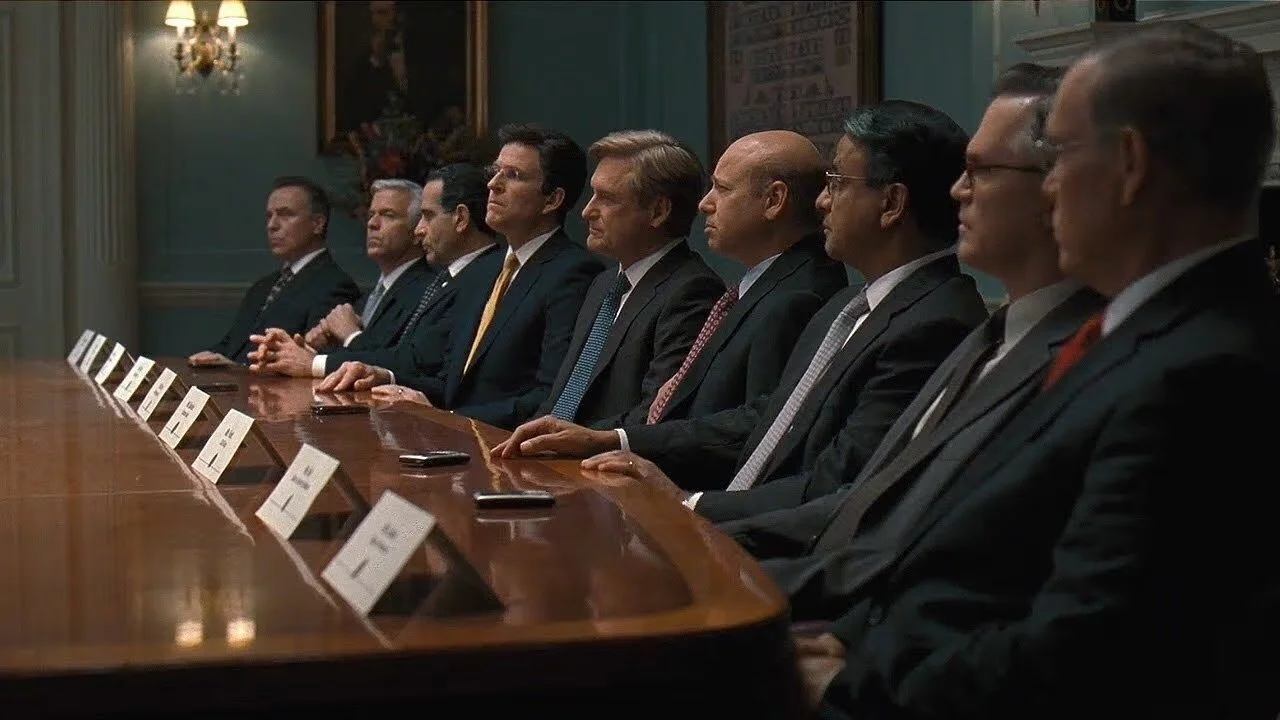
Skeptical bank CEOs are told they will partner with the U.S. government in Too Big to Fail. (Photo Credit: HBO films)
The 2011 film Too Big to Fail is a riveting historical drama about the 2008 financial crisis. In a pivotal scene, President George W. Bush’s Treasury Secretary Hank Paulson (played by William Hurt) consults with his team on a radical proposal to save the banking system from potential collapse: a forced capital infusion from the federal government, with Treasury purchasing preferred stock in each bank. Everyone has their doubts:
Assistant Secretary Neil Kashkari: “It’s un-American!”
Secretary Paulson: “If we make the government a stockholder…do we tell them how to manage themselves, what to buy and sell?”
Chief of Staff Jim Wilkinson: “You can’t just hand the banks massive piles of cash. Nobody’s going to go for it. To the Republicans, its nationalization. To the Democrats, it’s a bailout. And the banks are going to go ballistic!”
Times have changed since 2008. Trepidations about a government hand in private industry have melted away as supply chain concerns and competition with China have become top national security priorities. To boost domestic production, economic competitiveness, and its clean energy agenda, the Biden Administration embraced a form of industrial policy for semiconductors and batteries via the CHIPS and Inflation Reduction Acts. At the time, a number of economists and Senators, including Mitch McConnell, Marco Rubio, and Tom Cotton, warned that the Administration should not try to “out China China” by mirroring Beijing’s state-run non-market economy.
The second Trump Administration has taken government intervention in the private sector to the next level. Last summer, the U.S. government took a “golden share” in U.S. Steel as a condition of Nippon Steel’s purchase of the American company. This entitles the President to veto any major corporate reorganization and leaves the door open to broader U.S. government control. (Similar arrangements exist for Volkswagen in Germany and Heathrow Airport in the UK.) The Pentagon recently announced a $400 million equity stake in MP Materials, a critical minerals company. The Pentagon’s Office of Strategic Capital will receive “warrants” and the U.S. Department of Commerce will receive equity from investments in Vulcan Materials and its partner ReElement Technologies for the manufacture of rare earth magnets in the United States.
So far, free marketeers in Congress have not been troubled by these initiatives, with the exception of Senator Rand Paul (R-KY), who criticized the Trump administration’s September 2025 decision to take a 10% stake in semiconductor chip maker Intel. Senator Paul said the investment was “a step towards socialism.” Sen. Bernie Sanders (I-VT) endorsed the Intel deal. Since the announcement, Intel’s stock price has risen from $24 to $47 per share.
For a bit of context: while the United States is known as the world’s leading private sector-led market economy, the U.S. government has a long history of funding and subsidizing private enterprise. The Department of Defense, Department of Energy, and National Science Foundation have for decades given grants to companies to conduct R&D and commercialize their products. The rationale is that the government needs cutting edge technologies and should fill a funding gap for ventures where private capital sees too much risk. The Bureau of Economic Analysis estimates that federal subsidies for industries are around $123 billion per year - a conservative estimate that is variable based on the definition of a subsidy. The U.S. government is also the largest customer in the nation, which gives it a major role in companies’ success or failure.
The argument in favor of limited government intervention is that government should maintain an enabling environment for businesses rather than participating as a direct stakeholder, and that government investment can create moral hazard. The exception would be during a time of crisis, and even then, government intervention should be limited.
President Trump has a different approach, which some would argue runs counter to his pledges to reduce regulatory burdens on companies. The Trump Administration justified the Intel deal on economic security grounds and said that taxpayers would benefit from the government’s investment. Trump has intervened in markets – such as crypto currency – and supported price caps on pharmaceuticals and credit card interest rates. He has exerted other kinds of leverage over private companies to advance Administration goals and his personal priorities, like building a White House ballroom.
The Administration’s post-Maduro plans for Venezuela are anchored in the presumption that American energy companies will partner with the U.S. government, and that they will take on the role of rehabilitating the country’s broken energy infrastructure. In an event that mirrored the boardroom scene in Too Big to Fail, the White House recently assembled energy CEOs to secure support for its plan. In the movie, Hank Paulson explains the details of the Congressionally approved $700 billion TARP plan to bank CEOs and announces, “we expect you all to participate.” (They do, eventually.) The outcome of the recent White House meeting, and the future of Venezuela, are still to be determined. But it is likely that energy companies – who have a responsibility to their shareholders - might be weary to take on a risky and expensive Venezuela assignment without some U.S. government incentives or guarantees.
Exerting its oversight role, Congress could be asking several questions about the consequences of the Trump Administration’s embrace of expanded government intervention in the private sector. First, by what measure will the Administration determine that a taxpayer investment in a particular company is profitable? Second, does the specter of U.S. government intervention raise political risk for would-be foreign investors? Third, how will markets react when companies have a responsibility to the U.S. government that supersedes their responsibility to shareholders? And finally, who would have liability within a future government-private sector partnership for Venezuela reconstruction, and what will be the cost to taxpayers?
Robert W. Gerber is a retired U.S. diplomat and a CSPC Senior Fellow.
Why Greenland Matters: Strategic Importance to the United States
By Victoria Flick

Vice President Vance visits Pituffik Space Base in Greenland on March 28, 2025. (Photo Credit: U.S Space Force Staff Sgt. Jaime Sanchez)
In the aftermath of the United States’ January 3 capture of Venezuelan leader Nicolás Maduro, the administration of President Donald Trump has revived a recurring theme from the early months of his second term: the assertion that the United States should assume control of Greenland. President Trump has argued that this move would be based on national security concerns, particularly linked to Russian and Chinese activities in the region. However, there might be additional factors that play into this discussion, namely: location, rare earth minerals, and President Trump’s legacy.
It is necessary to examine why Greenland holds such strategic significance for the current U.S. administration. There are three primary factors driving the United States’ focus on the island.
First, its military significance to the United States. The Trump administration asserts that claiming Greenland would expand U.S. military reach in the Arctic significantly. Under the 1951 Defense Agreement between the United States and Denmark for Greenland, which has been amended and supplemented by an updated version in 2004, the United States has a legal obligation to defend Greenland from attack and maintain a military presence there. Since then there have been subsequent agreements and cooperation frameworks added during the 2020s that supplement or reinforce the defense relationship. Any act of hostility or coercion would breach these agreements and call into question the reliability of U.S. international commitments more broadly. However, the 1951 agreement is an executive agreement rather than a congressionally ratified treaty, and its provisions allow for review and modification by mutual consent with appropriate advance notice. Currently, the U.S. military only operates the Pituffik Space Base in northwestern Greenland which supports missile warning, missile defense and space surveillance operations for the United States and its North Atlantic Treaty Organization (NATO) partners. However, the 1951 agreement allows the United States to “construct, install, maintain, and operate” multiple bases across Greenland. Thus, if the Pentagon wanted to station more U.S. military personnel on the island, it could do so within existing legal frameworks.
Second, Greenland’s economic value to the United States—particularly its critical resources, its oil and gas reserves and rare earth mineral deposits—makes it a strategically significant region. Especially since the United States finds itself in a fierce competition with China, the world leader in rare earths processing, controlling 85% of global processing capabilities.The main issue with Greenland’s rare earth minerals supply is that they are largely inaccessible and would take many years to mine. While U.S. companies have the potential to be key players in the development of Greenland’s critical minerals, the real gap remains in processing. The mining sector is an extremely slow business, with some experts expecting that the construction of three to five mines might take up to or more than 10 years.
Third, Greenland’s overall geostrategic importance to the United States cannot be overstated. The Trump administration asserts that were the United States to possess Greenland, it could radically limit Chinese and Russian influence in the Arctic region in general. Owing to its location—two-thirds of its territory lying within the Arctic Circle—Greenland has been strategically important to the defense of North America since World War II, when the United States occupied the island to prevent a Nazi takeover. After a post–Cold War period of relative international cooperation, climate change has thinned Arctic ice, opening potential new trade routes and intensifying competition over Greenland’s natural resources. Thus, it appears that the fixation on Greenland has consistently reflected geopolitical signaling and military-strategic positioning, rather than a realistic plan to secure near-term supply chains for the technology sector. However, Russian and Chinese challenges in Greenland are more constrained than is often suggested; The Government of Greenland condemned Russia’s invasion of Ukraine and subsequently suspended cooperation with Moscow. China has explored potential investments in Greenland, though no major projects have ultimately proceeded, in part due to coordination between the United States and Denmark. If Arctic security is a primary concern, attention should probably be directed toward other strategically significant areas, including Alaska’s coastline and Svalbard, a Norwegian archipelago where Russia has undertaken visible military and symbolic activities, such as flying the Soviet flag.
For a variety of these reasons, the United States has a long history of seeking to acquire Greenland. Most recently, Secretary of State Marco Rubio affirmed that it was the administration’s intention to eventually acquire the island, as opposed to utilizing military force. The United State’s first attempt at purchasing Greenland occurred in 1867 immediately following its acquisition of Alaska from Russia. Other attempts had been made in 1910, 1946, 1955, 2019, and most recently in 2026 by President Trump himself. Nevertheless, the assumption that Denmark—or, more importantly, the people of Greenland—would eventually consent to a transfer of sovereignty to the United States is highly questionable and overlooks key historical realities. Such an expectation fails to account for Greenland’s long-standing pursuit of greater autonomy and self-determination. Notably, Greenland became the first territory to withdraw from the European Economic Community, the predecessor of the European Union, following disputes over fisheries policy—a departure that predated Brexit by decades. Since then, Greenland has continued to expand its self-governing authority, gradually assuming control over economic, environmental, and social policy areas from Denmark.
Statements by the Trump administration regarding Greenland prompted a joint response from several European governments, including the United Kingdom, France, Germany, Italy, Poland, Spain, and Denmark. In their statement, the countries emphasized that “Greenland belongs to its people, and only Denmark and Greenland can decide on matters concerning their relations.” Today, Greenlanders possess the legal right to hold a referendum on independence, and Danish officials have repeatedly affirmed that decisions about the island’s future rest with its roughly 57,000 inhabitants. Reflecting this position, a recent public opinion poll found that 85 percent of Greenland’s residents oppose the idea of incorporation into the United States.
Ultimately, however, Greenland’s future remains uncertain. Whether the preferences of its population—to remain aligned with Europe or to pursue full independence—will continue to outweigh the monetary or strategic incentives that a future U.S. administration might offer remains an open question. To date, Greenlandic political culture has demonstrated a consistent emphasis on self-determination and long-term sovereignty over short-term economic gain. Still, geopolitics rarely follow linear trajectories, and Arctic dynamics are evolving rapidly. While the prevailing trajectory points toward greater autonomy rather than external acquisition, history cautions against assuming inevitability—leaving room for outcomes that would once have seemed implausible, if not outright far-fetched.
Victoria Flick is a Research Fellow at the Center for the Study of the Presidency & Congress
Who Decides? Venezuela Revives a Longstanding Question on War Powers
By Maria Reyes Pacheco
U.S. Capital Building on September 5th, 2013. (Photo Credit: Martin Falbisoner)
Following the capture of Nicolás Maduro on January 3rd, congressional response has been mixed with reactions mostly following along party lines. The push to pass a joint resolution to block further military action in Venezuela without congressional approval indicated a slight shift for some Republicans who previously voted against a similar measure related to strikes on boats presumed to be carrying narcotics in November. On Thursday, January 8th, the Senate voted 52-47 in favor of the measure, led by Senator Tim Kaine (D-VA). The resolution was ultimately blocked on Wednesday after two Senators reversed their support, resulting in a tie that was broken by Vice President Vance.
The joint resolution invoked the War Powers Resolution (WPR), specifically the 1983 statute which allows either house to pass a joint resolution to require “the removal of United States Armed Forces engaged in hostilities outside the territory of the United States, its possessions and territories, without a declaration of war or specific statutory authorization.” The WPR was initially created to reassert Congressional authority over foreign wars, especially after prolonged involvement in Korea and Vietnam during the Cold War. The resolution passed (overriding a veto from President Nixon) in 1973. Key provisions of the resolution include consulting with Congress “in every possible instance” before involving the military in hostile situations, notification of military action after 48 hours, and a 60-day window of unilateral military action by the President. The initial resolution also gave Congress the ability to terminate unauthorized military operations through concurrent resolutions, which do not require presidential approval. In 1983, a Supreme Court ruling negated this statute’s legal effect without being presented to the president. Congress subsequently passed a new statute that required a joint resolution to terminate military action, which the president must sign and may veto.
The WPR has been contested at various times since its initial passage, with lawyers and administrations across both parties arguing its constitutionality. Much of the conflict between the branches stems from a constitutional duality. While the Constitution gives Congress the sole ability to declare war, it also designates the President as the commander-in-chief. The latter has been cited in 126 of the 128 reports filed to Congress 48 hours after military action not previously green-lit by Congress. The powers of the chief executive to manage foreign relations are also used as justification for their ability to deploy military force as part of their enumerated powers required to carry out foreign relations and maintain national security. From Clinton in Bosnia to Trump in Iran, presidents across parties have directly cited their constitutional authority as commander-in-chief and over foreign affairs to justify military interventions.
The nuance of where the president’s military power ends and begins traces back to the constitutional convention of 1787. Some delegates felt strongly about the risk of the president becoming an elected monarch if he was granted sole war-making powers, and thus advocated for these powers to be given to the legislative branch. Yet other delegates feared that Congress would be unable to act quickly in the event of an attack by foreign forces. As such, the delegations compromised by using the word “declare” rather than “make” war to “leav[e] to the Executive the power to repel sudden attacks.” The ability of the chief executive’s power to repel such attacks was then assumed in his title as commander-in-chief in Article II. Ideally, this shared balance over military power was hoped to enshrine the principle of checks and balances which the founders sought to instill throughout the constitutional text. However, on this issue (as on others) the brevity of Article I and II has led to a challenge of interpretation that continues today.
As many scholars have pointed out, the framers frequently viewed the question of presidential military power as one mainly focused on the defense against foreign attacks. However, as the United States expanded territorially and its political and economic interests spread, matters of security were no longer limited to the boundaries of the country. After WWII, as U.S. national security became intertwined with questions of regional stability and deterrence, many military interventions were still viewed as strategically defensive, even if they were overseas. It was under this context that the WPR was passed. Aside from the question of constitutionality, the WPR’s ability to empower the legislative branch has been critiqued since it primarily facilitates after-the-fact accountability as opposed to routine oversight or clarification on what military actions are separated between the two branches. Its ability to reel in presidential power is also bound to the polarization of the legislature since any joint resolution to stop military action could be vetoed by the President and only overridden by a super majority. In the present case of Venezuela, the small number of Republicans who voted for the measure indicates that had it passed in the House it ultimately would have been blocked by a veto from President Trump.
The present situation in Venezuela is distinct from the most recent examples when the WPR was invoked. Since 2001, the majority have been in connection to the Middle East and based on the previous Authorizations for Use of Military Force (AUMFs) passed by Congress in response to 9/11. With the exception of Haiti, the involvement in Venezuela marks the first reported use of military action not authorized by Congress in Latin America since the capture of Panamanian General Manuel Noriega in 1989, which by comparison was met with bipartisan support. While the capture of Maduro may go unchecked under the limitations of the WPR, further military involvement in the region as part of Trump’s renewed focus on the Western hemisphere may become a stress test for how long Congress is willing to sit on the sidelines.
Maria Reyes Pacheco is the Research & Operations Assistant at the Center for the Study of the Presidency & Congress.
Ukraine and the European Union: Can Membership be Fast-Tracked?
by Kate Pintarelli

Ukrainian President Volodymyr Zelensky with European Commission President Ursula von der Leyen on August 17, 2025. (Photo Credit: Dati Bendo/ European Union, CC BY-SA 4.0)
As negotiations over a potential end to the war in Ukraine are ongoing, the country’s potential accession to the European Union has frequently been raised as a conceivable factor in such efforts. In this view, membership in the European bloc would deepen Ukraine’s economic and security connection with Europe, as European nations are aiming to take on a greater role in Ukraine’s financial and security assistance. Ukraine officially filed its application for membership in February 2022, just days after the full-scale Russian invasion. Official candidate status was granted later that year, but discussions on a potentially fast-tracked process have remained ongoing.
The idea of joining the Union by 2027 has been viewed as an overly ambitious timeline by many European officials. EU enlargement commissioner Marta Kos has expressed hopes to see Ukraine join the EU near 2030. Even an accession by 2030 would represent an unusually fast process compared to other candidate nations. As a point of comparison, Turkey applied for membership in 1987 and has been in negotiations since 2005, with no clear end in sight. It would thus be a remarkable turnaround if Ukraine were to join within a decade of applying.
Hurdles to EU Accession
Pushing for membership by 2027 would require Ukraine to meet all seven prerequisite conditions for entry by the end of 2026. While Ukraine has made significant progress on many of these, there are many challenges that remain before it fully meets the EU standards in many areas.
One issue is Ukraine’s current state of martial law. Since Russia’s invasion in 2022, Ukraine has not held national elections. President Volodymyr Zelensky has postponed elections due to security concerns, stating Ukraine would require assistance from its allies to guarantee security for all voters. Additionally, Ukraine is facing a refugee crisis, with close to 6.9 million Ukrainian refugees displaced globally. Even if security conditions improve, ensuring voter participation from those outside the country would be a significant challenge.
Corruption remains another critical issue. Although Ukraine has implemented new anti-corruption institutions and passed reform legislation, allegations involving individuals close to the government have met disapproval from EU officials, who have stressed that addressing corruption is essential for continued progress toward EU membership.
American Influence on EU Decision-Making
Hungary is the only EU member state blocking Ukraine’s bid for membership. Despite the United States not being a member of the European Union, the EU remains a close ally. President Trump has met with Hungarian Prime Minister Viktor Orbán and offered Hungary exemptions from U.S. sanctions on Russian oil and has supplied nuclear fuel to the country. These offers could serve as an attempt to shift Hungary away from Russia. However, Hungary continues to maintain close ties with Russia. Prime Minister Orbán has argued that Ukraine’s membership would harm the entire Hungarian national economy.
Within the European Union, some diplomats have called accelerated membership for Ukraine by 2027 “nonsense.” A major concern is financial support. Currently, the EU cannot afford the support Ukraine would likely be entitled to upon accession. From President Trump’s perspective, the U.S. can better support Ukraine now, while Ukraine’s long term needs would ultimately fall to Europe. In the White House’s view, a timely end to the conflict between Russia and Ukraine would also reduce the need for further assistance and allow the United States to pass the baton on to its European allies.
At the same time, European leaders are eager to demonstrate that the continent can manage security within its own region. Still, many remain concerned that accepting Ukraine as a member now would open the door to financial obligations that they may not be prepared to shoulder in the future, including potentially reducing the funding available to other member states.
Public Skepticism Toward Ukraine’s Membership
Public opinion polls also show that citizens from EU member states remain skeptical about the idea of Ukraine’s membership. In Germany, citizens are divided on whether Ukraine’s membership would benefit the country. Across Europe, only 52% of respondents support Ukraine’s membership, while in Czechia, for example, support drops to just 28%. One concern driving this skepticism is the possibility that existing member states would stand to lose financial support due to payments to Ukraine. As such public opinion is thus at the moment not a strong driver to accelerate the membership process.
While 2027 officially remains Ukraine’s target for EU membership, the accelerated bid seems overly optimistic given current conditions. Ukraine’s ability to fully implement EU membership conditions and gain public support remains uncertain at best. As a result, even with strong American backing, accelerated membership could prove to be an unrealistic goal for now. While a place for Ukraine in the European Union may still seem possible over the long term, the question remains, when?
Kate Pintarelli is an intern at CSPC and student at Virginia Tech.
CSPC IN THE NEWS
Joshua Huminski contributes to NSI’s The SCIF on National Security Challenges in 2026
Originally published in The SCIF on Jan 6, 2026.
CSPC Senior Vice President Joshua Huminski was featured in the National Security Institute (NSI)'s latest expert roundup, “Looking Ahead to 2026 — The Defining Challenges for U.S. National Security.” As policymakers prepare for an increasingly complex global landscape, Joshua joins leading national security experts in assessing the challenges most likely to shape U.S. priorities in the coming year.
Read his full analysis here.
New Episode of Coffee & Conflict Podcast with Joshua Huminski
Originally released on Jan 8, 2026.
In the most recent episode of Coffee & Conflict, SVP for National Security and Intelligence Joshua Huminski spoke with author Ankit Panda to discuss his new book, “The New Nuclear Age: At the Precipice of Armageddon.” In the episode, Panda explains how nuclear weapons have returned to the center of global statecraft, and why risks today differ from the Cold War Playbook.
Listen to the full episode here.
Joshua Huminski writes on the strategic implications of the American operation in Venezuela
Originally published in Britain’s World on Jan 9, 2026.
In this year’s first edition of The Big Ask, SVP for National Security and Intelligence Joshua Huminski offered his analysis and insights on the recent American operation in Venezuela.
Read his full analysis here.