
The CSPC Dispatch - Dec 19, 2025
In this issue, Jeanne Sheehan Zaino examines congressional paralysis at America’s 250th anniversary, arguing that today’s legislative inaction is not institutional failure but the predictable result of a constitutional system deliberately designed to protect liberty by dispersing power. We also explore the second Trump administration’s emerging AI strategy, as Washington pivots toward deregulation and innovation-first policies, framing artificial intelligence as a central arena of geopolitical competition with China and a point of divergence with Europe’s regulatory model.
At 250, A System Conceived for Deadlock and Inaction
By Jeanne Zaino
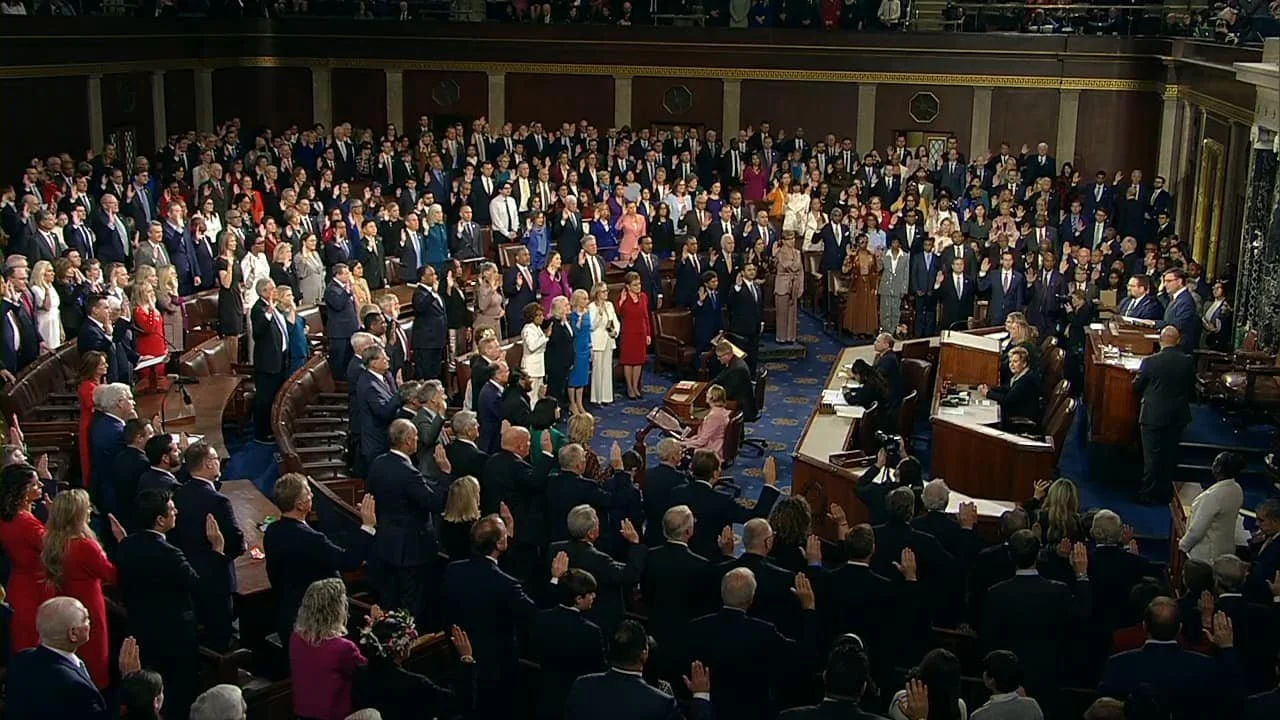
Swearing in of the 119th Congress on January 3, 2025.
The 119th Congress closes out the year as one of the least productive on record. According to the legislative tracking website GovTrack, as of mid-December, just 146 bills were enacted. By comparison, the 80th Congress (1947-1948) which President Harry Truman famously described as a ‘do nothing Congress,’ passed 906 bills. While the 119th still has a year to go, it would have to move at breakneck speed in 2026 to catch up. Given it is a contentious election year and congress will remain narrowly divided until at least January 2027, most legislative watchers are not optimistic that the second year of the 119th will be any more productive than the first – arguably it might be less.
While the number of bills passed is not the only mark of legislative productivity, as things stand today, the 119th is not only lagging behind the 80th, but most of its recent predecessors. If things continue at pace, it could earn the unenviable distinction as the least productive congress in modern history.
It is easy to blame those in congress for this sorry situation, but that would be short-sided and miss the fact that the system in which they are operating is working almost exactly the way it was designed. This is what Bernard Hennessy meant many decades ago when he said “our political system... was conceived for deadlock and inaction. And, despite some brilliant, if fitful displays of presidential leadership, remains today as it was conceived, a system for deadlock and inaction.”
During this 250th anniversary, it is important to reflect on the system the Framers created and understand why it was conceived “for deadlock and inaction.”
After their living under a King who they described as a tyrant, the Framers were committed to setting up something the world had never known, a large, extended republic. About three decades prior to the American Revolution, Charles Louis de Secondat, Baron de Montesquieu,wrote Spirit of the Laws. The book had an enormous impact on thinkers around the world, including the Framers of the US. In Spirit Montesquieu argued that the end, or purpose, of a free government was to ensure liberty or freedom. While we commonly define liberty today as freedom from governmental power, Montesquieu defined it more specifically as freedom from the state or “right to do everything the law permits” unencumbered by the state. This resonated with the colonists, many of whom (or their ancestors) came to the New World to escape governmental persecution and protect their right to worship. They then fought a bloody Revolutionary War to throw off a despotic government that was not respecting liberty.
Following Montesquieu, the Framers primary goal in setting up the new government was to protect liberty. We see this reflected in the Declaration of Independence: “We hold these truths to be self-evident, that all men are created equal, that they are endowed by their Creator with certain unalienable Rights, that among these are Life, Liberty and the pursuit of Happiness.”
The next challenge the Framers faced was how to design a free government which protected liberty. In Spirit Montesquieu counseled the best way to do this was by separating powers. The Framers adopted Montesquieu’s tripartite system of dispersing power among three branches in the Constitution. To this they added other forms of separation as well, including checks and balances, bicameralism, federalism, etc.
The Framers adopted this divided structure for good reason, to preserve liberty. When power is dispersed in this way, however, it makes it more difficult to get things done. The fact that it is often, except in times of crisis, difficult for our government to deliver has been the reality of governance in the U.S. since the birth of the nation; and it continues to be an enormous challenge today.
For anyone interested in governmental reform, the 250th Anniversary provides an important opportunity. The first step on the road to perfecting the system is understanding what the Framers did and why. Only then is it possible to make sense of the number of structural reform proposals that have been put forward by great thinkers over the last two and a half centuries.
While it is easy in this heightened social media environment to feel that our political challenges are unique, the fact is that the government has had difficulty delivering since the Founding. This is by design and stems from the Framers commitment to protecting something most Americans still hold dear, liberty.
The question for reformers today is not unlike the one faced by the Framers in the 18thCentury, how best to (re)design the system to ensure both liberty and responsiveness to the majority will?
Jeanne Sheehan Zaino is professor of Political Science, Senior Democracy Fellow at the Center for the Study of the Presidency & Congress and Visiting Democracy Fellow at the Ash Center for Democratic Governance and Innovation, Harvard Kennedy School. This piece draws on themes in her latest book, American Democracy in Crisis (Palgrave, 2025), and her Substack newsletter, The New Realist. It is the fifth in a series on reform marking America’s Semiquincentennial.
Inside Trump’s 2025 AI Strategy
By Victoria Flick
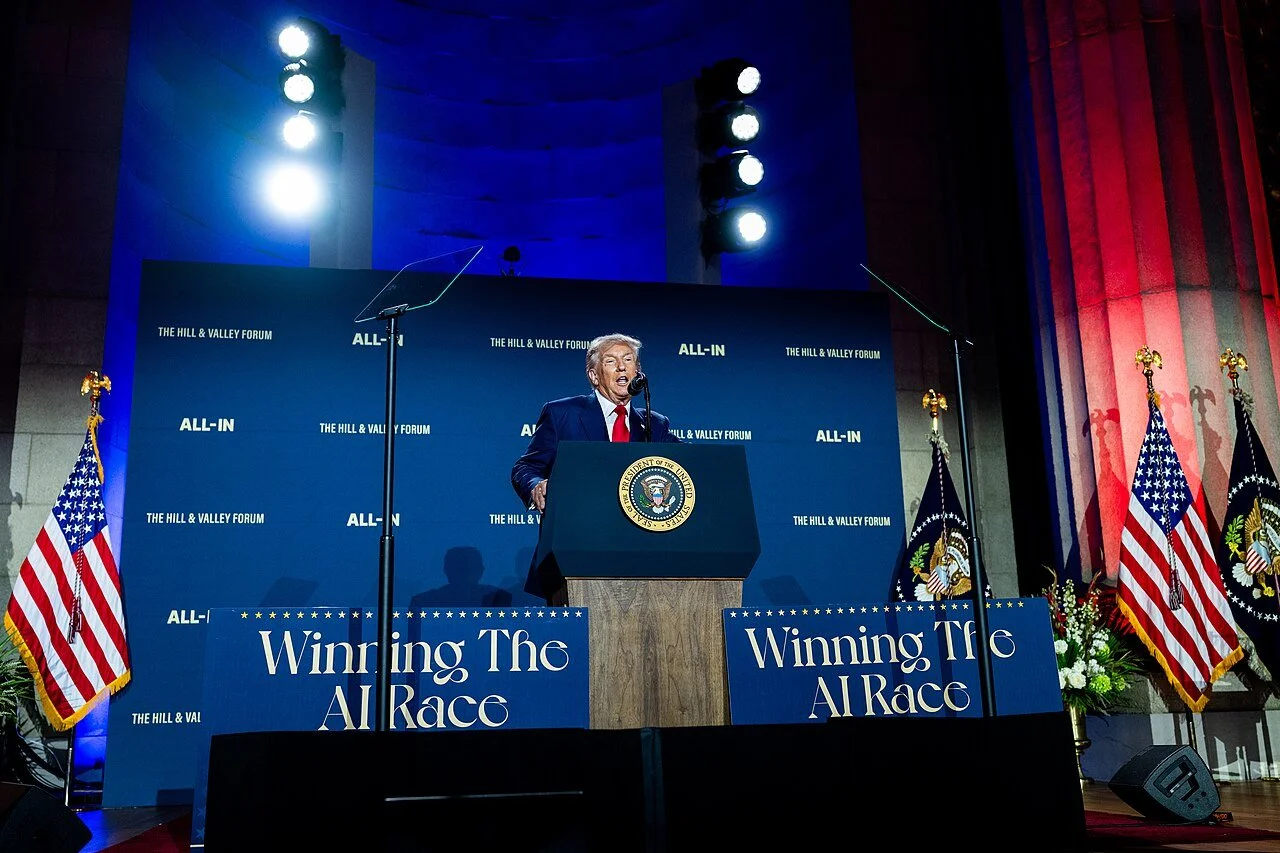
President Trump delivers remarks at the White House AI Summit at Andrew W. Mellon Auditorium on July 23, 2025. (Official White House Photo by Joyce N. Boghosian)
“Deregulation” and “Innovation-first” are two words that best describe the approach of the second Trump administration towards Artificial Intelligence (AI). Since taking office in January, the president has shifted U.S. AI policy away from strict ex ante regulation and mandatory safety reporting towards a less restricted and explicitly geopolitically competitive approach. AI is now treated as a strategic domain where the United States seeks “unquestioned and unchallenged” leadership amid an “AI alliance” of friendly states. This new approach highlights a sharp divergence between the European Union’s regulation-heavy AI framework and the comparatively light-touch approach taken by the United States.
President Trump’s first move upon resuming office was to repeal the Biden era Executive Order (EO) 14179 “on the Safe, Secure, and Trustworthy Development and Use of Artificial Intelligence”, which had instituted a variety of safety standards and tests. His presidential action “Removing Barriers to American Leadership in Artificial Intelligence” marked a significant shift away from regulation and safety requirements, aiming to set up a mostly market-driven approach.
In line with the administration’s push to deregulate the AI space, the administration has also consistently tried to limit state-level AI regulation. Two efforts illustrate this push for a single national AI framework: a draft executive order, later paused after bipartisan backlash, that would have pressured states by tying AI regulation to federal enforcement and funding, and the introduction of the “American Artificial Intelligence Leadership and Uniformity Act”, which seeks federal preemption but remains at an early legislative stage. These moves were capped offby another presidential EO in December, “Ensuring a National Policy Framework for Artificial Intelligence”, weakening state-level AI restrictions and delivering a victory for tech companies that have actively opposed regulation of the rapidly expanding industry. It gives broad authority to the attorney general to challenge state governments in court and invalidate laws deemed inconsistent with advancing U.S. global leadership in AI, potentially undermining dozens of AI safety and consumer protection measures. This order makes the regulatory environment more easily understandable, as there will not be a multitude of different sources to refer to, but only “one source”, but it has also faced concern and push-back from lawmakers of both parties. In addition, the attempt to limit the states’ ability to regulate AI also raises serious questions with regard to the future relationship between the states and the federal government. Accordingly, the order is expected to face legal challenges from states and consumer groups, with many legal experts noting arguments that only Congress has the authority to preempt state law.
To further drive this deregulatory approach, the Trump administration directed the White House Office of Science and Technology Policy (OSTP) to develop an “AI Action Plan”, which was released in July of this year. In it 90 policy positions across three main pillars are outlined: accelerating innovation, building U.S. AI infrastructure, and leading in international diplomacy and security. Overall, the U.S. AI Action Plan signals a clear pivot toward deregulation, underscoring Washington’s expectation that allies align with U.S. export controls and adopt “American AI stacks.” These stacks comprise U.S.-made hardware, software, models, and frameworks promoted for global export, in effect urging allies to build on American technology, reinforcing a strategic and American-led AI ecosystem across the full stack for leadership and security. This approach opens the door to deeper partnerships—but also risks friction with allies whose regulatory instincts more closely mirror the EU model.
The newest development in President Trump’s AI strategy is the newly released “Genesis Mission”, which is an initiative led by the Department of Energy and its 17 National Laboratories to create “the world’s most powerful scientific platform”. This shared platform brings together academic researchers and AI companies to develop advanced models using government-generated scientific data. By integrating supercomputing, AI, and quantum technologies into a unified research infrastructure, it is designed to accelerate scientific discovery, strengthen national security, and drive energy innovation. The platform will generate high-fidelity data for next-generation AI training, equip researchers to tackle the most complex scientific challenges, and shorten discovery cycles from years to months. In doing so, Genesis is supposed to serve both as a national engine for innovation and a real-world testbed for emerging AI, quantum, and robotics technologies. Private-sector partners named to date include Microsoft, OpenAI, Google, Nvidia, AMD, AWS, and Anthropic, though the specifics of their involvement have yet to be clarified.
The collaboration between the private and public sector also means that private companies will have access to previously inaccessible federal data sets, which is a point of contention in some policy circles. Critics are maintaining that data governance issues need to be taken into account, as in reality federal agencies often face significant obstacles to sharing even basic datasets, stemming from legal constraints, security considerations, and incompatible IT systems. Bringing these data sources together—including proprietary industry data—demands more than technical compatibility; it requires legal frameworks, security safeguards, and mutual trust that cannot be imposed by executive order.
The Trump administration’s push to accelerate scientific research and development, especially in emerging technologies, is driven in large part by intensifying competition with China. As reported by the Atlantic Council, early signs indicated that China’s new five-year plan will put a lot of emphasis on scientific advancement, and Beijing is continuing to pour substantial resources into STEM education, major research infrastructure, and AI-enabled research platforms. Given that China closely links technological progress with military development, these advances further intensify geopolitical competition between the United States and China.
Overall, the Trump administration’s AI strategy heavily emphasizes deregulation and innovation-first policies, framing AI as a core arena of geopolitical competition in which the United States seeks clear global leadership. By pivoting away from precautionary regulation and toward market-driven development, the approach aims to accelerate innovation and strengthen U.S. technological dominance, especially in contrast to the EU’s more restrictive regulatory model. At the same time, the strategy raises concerns about gaps in safety, accountability, and coordination with allies. Moreover, many practical questions remain unresolved regarding implementation, enforcement, and how a lighter regulatory framework will balance long-term risks with near-term competitiveness.
CSPC IN THE NEWS
Despite Uncertainty, NATO Shows Signs of Reinvigoration
Originally published in the Diplomatic Courier on Dec 10, 2025.
"This shift from NATO planning around what capabilities member states could provide, to Brussels actively setting targets for what capabilities member-states should provide will, over time, see NATO in a much stronger position and able to deliver greater effects across its areas of operation." - Joshua Huminski, SVP of National Security and Intelligence Programs.
Read his full analysis on the recent shifts in NATO here.
Joshua Huminski Discusses State of Ukraine Negotiations on the FarrCast
Originally published on The FarrCast on December 5, 2025.
On The FarrCast, Joshua Huminski joins Michael Farr to assess the progress—and persistent challenges—of Ukraine negotiations, including Russia’s ability to absorb the war’s economic and political costs.
Listen to the podcast episode here.
Joshua Huminski Discusses Expectations for Talks in the US & Europe with Ukraine on Times Radio
Originally broadcasted on The Times Radio on December 6, 2025.
Joshua Huminski joined Times Radio to discuss the talks between US and Ukrainian negotiators in Florida and expectations for ongoing talks with European leaders in London.
Listen to the segment here.