All Publications
Category
- Autonomous Vehicles 1
- Biographies 3
- CINCs 1
- Defense & Diplomacy 1
- Defense and Diplomacy 4
- Deterrence 2
- Electric Grid 1
- Geotech Program 14
- Latin America 1
- Leadership 6
- Memoir 1
- Middle East 6
- Military Recruitment 2
- NATO 3
- National Space Security Program 6
- Political Reform 4
- Presidential History 3
- Procurement 1
- Science & Technology 5
- Science Innovation 4
- September 11th 1
- State Department 1
- Strategic Reform 2
- Strategic Stability 2
- Strengthening America 1
- Trade 3
- Triumphs & Tragedies 2
- US-Japan 1
- Ukraine 2
- Weapons Acquisition 1
Quantum Cryptography: Assessing Technological Advancements and the U.S. Landscape
Quantum computing will eventually break the public-key cryptography that secures global communications, financial systems, and national security infrastructure today. The United States government has chosen post-quantum cryptography (PQC), new mathematical algorithms, as its primary response to this new threat, with federal agencies mandated to complete migration by 2035. A 2020 advisory by the National Security Agency (NSA) advisory declined to approve quantum key distribution (QKD), a hardware-based alternative whose security rests on the laws of physics rather than mathematical assumptions, citing five technical limitations. This report assesses the current state of the transition of quantum cryptography and the evolving role of QKD in the U.S. landscape.
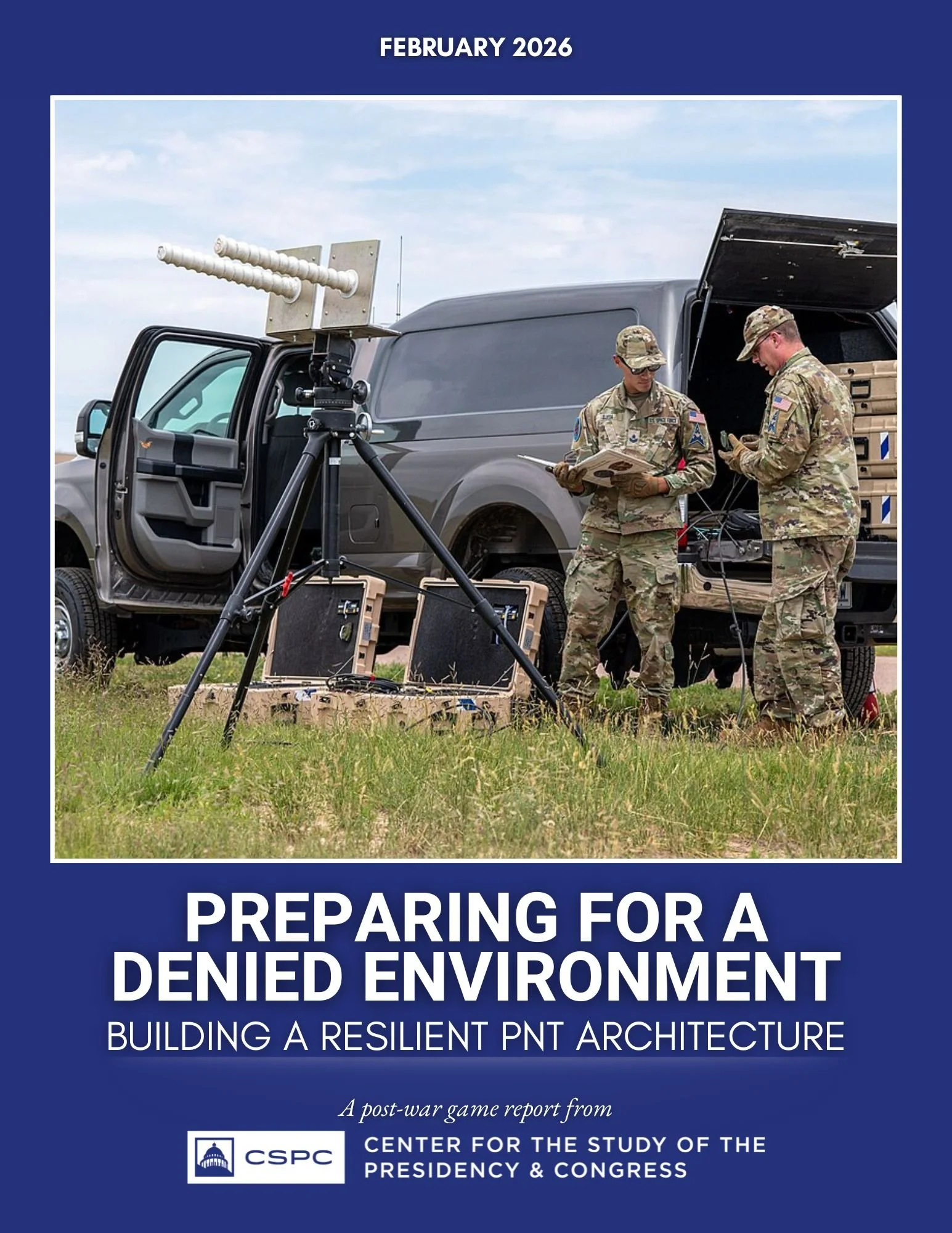
Preparing for a Denied Environment: Building a Resilient PNT Architecture
The Center for the Study of the Presidency and Congress (CSPC) today released its report on the proceedings of a high-level tabletop exercise examining vulnerabilities and strategic responses to a positioning, navigation, and timing (PNT) denial scenario. The exercise, which is part of the Center’s National Security Space Program, convened senior leaders from defense, industry, intelligence, and academic communities to examine the response options to adversary denial of the Global Positioning System.